
Ingeniero Aeronautico Ambrosio L.V. Taravella International Airport, known locally as Pajas Blancas, serves Cordoba, Argentina’s second largest city. Most travellers search for it simply as Cordoba Argentina Airport. It sits on the city’s northern edge, with the Sierras de Cordoba rising to the west. Commonly described as the country’s third busiest airport after the two Buenos Aires fields, it handles roughly three million passengers a year and acts as a hub for domestic flights.
Cordoba Argentina Airport at a Glance
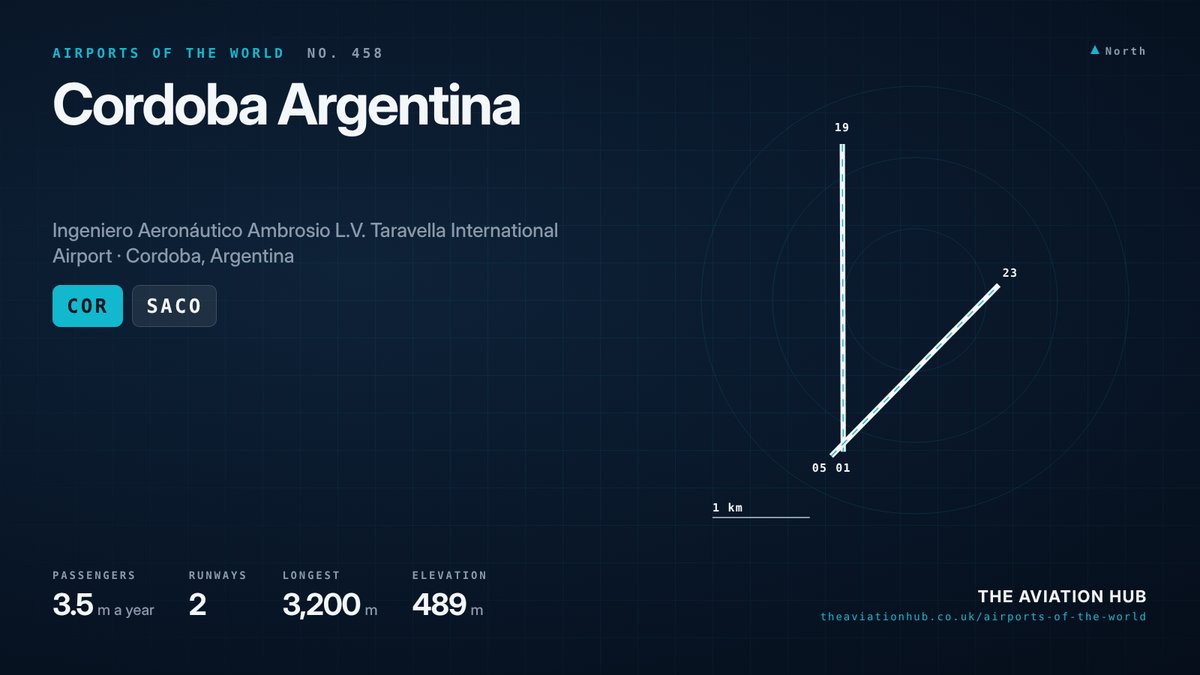
The IATA code is COR and the ICAO code is SACO. The airport lies about 5.6 miles (9 km) north north west of central Cordoba, at an elevation of 1,604 feet (489 m), on a site of 1,020 hectares. It has two runways and one passenger terminal. Recent traffic at Cordoba Argentina Airport has run at around three million passengers a year or more.
The operator is Aeropuertos Argentina 2000, the private company that runs most of the country’s major airports. Aerolineas Argentinas uses the field as a domestic hub, and low cost carriers have a growing presence. Flight information is on the airport’s official website.
How Cordoba’s Airport Came to Be
Cordoba has deep aviation roots. The Fabrica Militar de Aviones, Argentina’s state aircraft factory, opened in the city in 1927, and the air force’s military aviation school is based there too. Commercial flying grew alongside that industry, and Pajas Blancas, named after the area north of the city, became Cordoba’s civil airport and an early jetport.
The official name honours Ambrosio L.V. Taravella, whose title in the name marks him as an aeronautical engineer. The terminal began life as a single storey building. Between 2000 and 2002 a second and third floor were added to designs by the architect Mario Roberto Alvarez, giving the airport its present shape.
In 2002 Aerolineas Argentinas made Cordoba Argentina Airport a hub for domestic flights. International links have come and gone. Iberia flew to Madrid from October 2010 to January 2012, Air Europa began Madrid flights via Asuncion in December 2016, and American Airlines launched Miami service in June 2019, which ended the following year.
Runways at Cordoba Argentina Airport
The main runway, 01/19, is concrete and measures 3,200 metres (10,499 feet) long and 45 metres wide. It handles almost all airline traffic and can take long haul wide bodies. A secondary runway, 05/23, is asphalt and measures 2,200 metres (7,218 feet) long and 45 metres wide, serving as a crosswind option.
The airport has full night lighting. The surrounding countryside attracts birds, and pilots, especially in light aircraft, are warned to watch for them. Summer thunderstorms rolling off the sierras bring the main weather challenge, while winter can bring early morning fog and frost.
Terminals and Airlines
A single terminal at Cordoba Argentina Airport handles domestic and international flights, with the departure areas on the upper floors added in the early 2000s. Aeropuertos Argentina 2000 has invested in internal improvements to attract more airlines. Facilities include shops, cafes and car hire desks, and the building is straightforward to navigate.
Aerolineas Argentinas is the dominant carrier, linking Cordoba with Buenos Aires Aeroparque and with provincial cities across the country, many without a change in the capital. Low cost airlines Flybondi and JetSMART add domestic competition. International services have included Copa Airlines to Panama City and flights to Brazil and Chile, alongside seasonal holiday routes.
Routes and Destinations
Buenos Aires is the dominant market, with frequent flights to Aeroparque throughout the day. Beyond the capital, the network fans out to Mendoza, Salta, Bariloche, Iguazu, Ushuaia and other regional cities. That federal pattern, connecting the provinces without routing through Buenos Aires, is what makes Cordoba Argentina Airport a hub rather than a spoke.
Internationally, Panama City provides connections to North America and the Caribbean, while Brazilian and Chilean routes serve business travel and beach holidays. Madrid has been served at times, making it the longest route when flown. Summer holidays in January and February and the July winter break bring peaks. Cargo is modest and mostly carried in passenger holds.
Getting to and from Cordoba Argentina Airport
There is no rail link. Taxis and remises, the pre booked cars common in Argentina, reach central Cordoba in around 20 to 30 minutes, depending on traffic. Ride hailing apps also operate. A city bus line and private shuttles link the airport with the centre and the main bus terminal, and they are the cheapest sensible option.
The airport is reached by road from the north of the city, and car hire is popular with visitors heading for the Sierras de Cordoba, Villa Carlos Paz and the Jesuit estancias of the region. Villa Carlos Paz, the main resort town in the hills, is about 25 miles (40 km) away, or roughly 45 minutes by car. Parking is available in front of the terminal. Allow extra time in the evening rush hour.
Spotting and Photography
The open land around Cordoba Argentina Airport gives clear views of the main runway from surrounding roads, with the sierras on the western horizon. Aerolineas Argentinas Boeing 737s and Embraer E190s dominate, joined by Flybondi 737s, JetSMART A320 family aircraft and occasional wide bodies. Light is best in the dry winter months from May to September, when clear skies are common and the hills stand out sharply.
The city’s aviation heritage adds interest, and military aircraft linked to Cordoba’s air force school and aircraft factory sometimes appear in the area. Stay on public land, keep away from fences and carry identification. Airport security and police may ask questions, so explain calmly and follow instructions.
What Comes Next
Argentina’s moves to deregulate aviation since 2024 have opened the door to new airlines and routes, and Cordoba stands to benefit from its central location. More international links, particularly to Brazil, Chile and the United States, are the main ambition. The two runway layout and spacious site leave room for growth. Low cost airlines have been present since 2018, and further competition could push traffic well beyond current levels.
The verdict: Cordoba Argentina Airport is set to strengthen its role as a key provincial hub, provided the economy cooperates. Compare it with other South American airports on the Airports of the World map.
Continue to follow The Aviation Hub for more analysis and insight.
Advertise with us Your brand, in front of an aviation audience Home page and in-article placements, sold directly, one advertiser per slot. From £250 a year. See the rates

