
Corfu Airport Guide: Lagoon Landings and Island Routes
Corfu Airport is famous for low landings over a lagoon beside Mouse Island. Read about its history, runway, airlines, busiest markets and how to get there.
 By The Aviation Hub
5 min read
Updated October 20, 2026
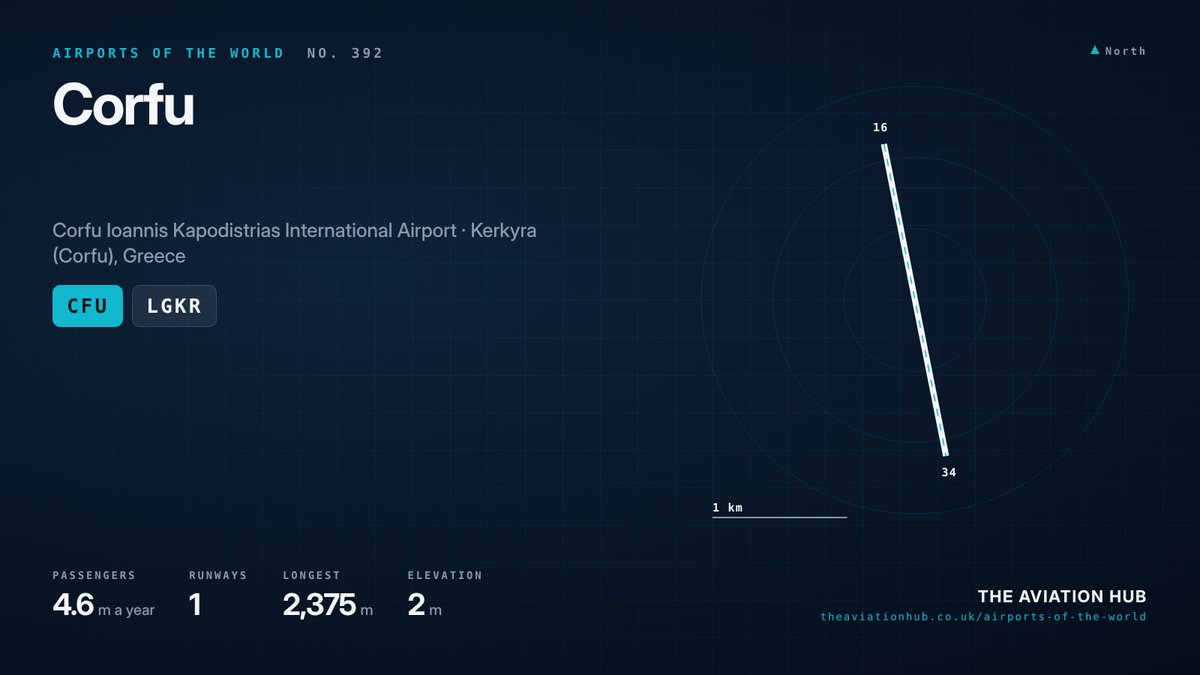
Few holiday airports are as photogenic as this one. Corfu Airport sits on the edge of a shallow lagoon just south of Corfu Town, on the green Ionian island that lies off the coasts of Albania and northwest Greece. Each summer it fills with charter and low cost flights from across Europe, carrying around 4.6 million passengers in 2025. Aircraft landing from the south pass low over the famous Vlacherna monastery and Mouse Island, a sight that draws enthusiasts from all over the world.
Corfu Airport at a Glance
The IATA code is CFU and the ICAO code is LGKR. The airport lies about 1.7 miles (2.7 km) south of Corfu Town, at an elevation of just 2 m (6 ft). It has one runway and one passenger terminal. Corfu Airport handled 4,343,748 passengers and 31,474 aircraft movements in 2024, and it passed 4.59 million by the end of November 2025. Aegean Airlines and Ryanair treat it as a focus city. The airport is state owned and has been run by Fraport Greece under a 40 year concession since April 2017. Timetables and parking details are on the airport’s official website.
A Short History of Corfu Aviation
The airfield was founded in 1937. During the Second World War, German and Italian forces used it as a base for transport and fighter aircraft. Its runway then measured only around 600 m, and it was lengthened in stages to its present size by 1959.
The first commercial flight took off on 19 April 1949, a service from Athens by TAE Greek National Airlines. A small terminal followed in 1962, and that building now houses the Corfu Aeroclub. The field became an international airport in April 1965, when Olympic Airlines flew the first overseas service.
Mass tourism transformed the island from the late 1960s. The current passenger terminal was built between 1968 and 1972 and has been remodelled since. The airport carries the name of Ioannis Kapodistrias, the Corfiot diplomat who became the first governor of independent Greece. Privatisation came in 2017, when Fraport took over Corfu Airport along with 13 other Greek regional airports.
Runways at Corfu Airport
A single asphalt runway, 16/34, handles all traffic. It measures 2,375 m (7,792 ft) long and 45 m wide. That length suits the Airbus A320 family and Boeing 737s that make up most movements, but it limits the payload of larger jets on longer routes.
The setting is what makes the runway famous. Its southern end reaches into the Chalikiopoulos lagoon, so aircraft landing on Runway 34 cross open water just above the surface. Arrivals on Runway 16 come in from the north over the bay beside Corfu Town. The mountains of mainland Greece and Albania rise a short distance to the east, which shapes the approach procedures. Strong winds and summer thunderstorms can make landings demanding, and pilots treat the approach with respect.
Terminals and Airlines
All flights use the main terminal, which Fraport has reorganised to cope with summer peaks. The master plan presented in 2017 aimed to expand check in from 22 to 28 desks, increase departure gates to 12, add in line baggage screening and rearrange the security lanes.
Ryanair runs the largest seasonal network at Corfu Airport, with dozens of routes across Europe. Aegean Airlines connects the island with Athens year round and Heraklion in season. British carriers are a major presence, with Jet2, easyJet, TUI and British Airways all flying in summer. Airlines such as Wizz Air, Eurowings, Volotea and ITA Airways add links to Central Europe, Germany, France and Italy. Winter schedules shrink to a handful of domestic flights.
Routes and Destinations
The United Kingdom is the biggest market by far, with about 1.31 million passengers in 2023. Germany followed with around 715,000, then Greece at 372,000, Italy at 320,000 and Poland at 276,000. Routes from London and Manchester carry heavy volumes, alongside the domestic link to Athens.
Seasonality dominates everything. Traffic peaks between April and October, with July and August the busiest months, while winter traffic is a small fraction of the summer total. The pandemic showed how exposed the island is, with passenger numbers collapsing to about 961,000 in 2020. Recovery has been rapid, and Corfu Airport has since set new traffic records. Poland’s rise as a source market reflects the spread of low cost flying across Central Europe.
Getting to and from Corfu Airport
Corfu Airport is very close to the town centre. A taxi to Corfu Town or the ferry port takes about ten minutes from the rank outside arrivals. There is no rail on the island.
The cheapest option is the blue city bus, which links the airport with San Rocco Square and the town centre in around 15 minutes. Green long distance buses to the resorts leave from the town’s main bus station, so most holidaymakers either take a transfer or hire a car. Resorts such as Kassiopi, Sidari and Paleokastritsa lie 40 minutes to an hour away by road. Car hire desks sit in arrivals, and parking is available directly opposite the terminal.
Spotting and Photography
Corfu is one of Europe’s classic spotting locations. The Kanoni peninsula overlooks the lagoon and the southern end of the runway, and cafés on the hillside offer views of aircraft passing Vlacherna monastery and Mouse Island. A footbridge across the lagoon puts enthusiasts almost directly under the approach to Runway 34, a famous shot of Corfu Airport.
Morning light favours the Kanoni side for arrivals. Summer weekends bring the heaviest charter traffic, with a constant flow of A321s, 737s and the occasional wide body. Keep off the runway safety areas, do not climb walls or fences, and follow any instruction from the police or airport staff.
What Comes Next
Fraport’s investment has modernised the terminal, but the physical site is tight. The lagoon, the town and the sea leave little room to extend the runway, and summer peaks continue to test capacity. Further gains will come from better use of existing space rather than major new construction. Spreading demand into the shoulder months of spring and autumn is the most realistic way to grow.
Demand from the UK, Germany, Italy and Poland shows no sign of slowing. Corfu Airport will remain a seasonal airport with a spectacular approach and a loyal following among holidaymakers and enthusiasts alike. Find more airports on the Airports of the World map.
Continue to follow The Aviation Hub for more analysis and insight.
Advertise with us Your brand, in front of an aviation audience Home page and in-article placements, sold directly, one advertiser per slot. From £250 a year. See the rates

