
Cork Airport Guide: Fog, Runways and Ireland’s Second City
Cork Airport handled almost 3.5 million passengers in 2025 and has a new expansion plan. See its runways, airlines, busiest routes and bus links.
 By The Aviation Hub
5 min read
Updated October 20, 2026
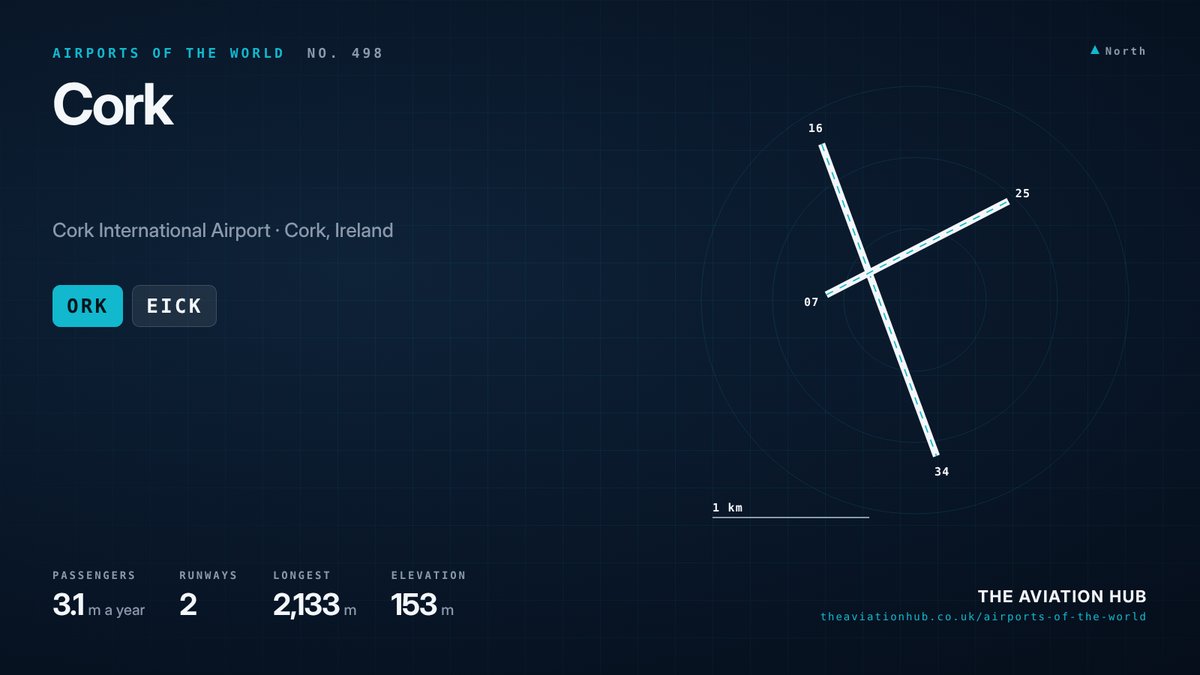
Ireland’s second city is served by a hilltop airfield just south of the centre that has had a strong run since the pandemic. Cork Airport handled almost 3.5 million passengers in 2025, up around 13 per cent, and is the second busiest airport in the Republic after Dublin. Ryanair and Aer Lingus dominate, with heavy traffic to London, Spain and Portugal. A €200 million plan now aims to lift capacity to five million passengers a year.
Cork Airport at a Glance
The codes are ORK and EICK. The airport lies about 4 miles (6.5 km) south of Cork city centre, near Ballygarvan, at an elevation of 502 ft (153 m). It has two runways and a single terminal opened in 2006.
Traffic reached around 3.46 million passengers in 2025, with almost 21,000 aircraft movements. Ryanair has a base at Cork Airport, and Aer Lingus treats it as a focus city. The airport is owned by the Irish state and operated by DAA, which also runs Dublin. ACI Europe named it the best airport in Europe in the under five million passenger category in 2017, 2019 and 2025. Flight information is on the airport’s official website.
How Cork Got Its Airport
The Irish government agreed in 1957 to build an airport for Cork. After weighing many options, it chose a site at Ballygarvan on high ground south of the city. Aer Lingus and Cambrian Airways made proving flights in October 1961, and Cork Airport opened on 16 October 1961. It handled 10,172 passengers in its first year.
The first jet, a BOAC de Havilland Comet, is reported to have landed in 1964. Traffic grew steadily through the following decades, as Aer Lingus built links to London and Europe and charter flights served the sun market.
Ryanair opened its second Irish base at Cork in 2005. The current terminal, designed by HOK and Jacobs Engineering, opened on 15 August 2006 as the first new terminal built in Ireland in the 21st century. The pandemic hit hard, with traffic falling to around 255,000 in 2021, but the recovery since has been rapid.
Runways at Cork Airport
Runway 16/34 is the main runway at 2,133 m (6,998 ft). Runway 07/25 measures 1,310 m (4,298 ft) and serves as a crosswind option for smaller aircraft. Both are 45 m (148 ft) wide, and the main runway is asphalt.
The main runway suits the Boeing 737 and Airbus A320 family, but its length prevents fully laden wide bodies from operating regularly. Charter wide bodies visit occasionally, for example to carry Munster Rugby supporters. A 305 m (1,001 ft) extension and a Category II instrument landing system have greatly cut the number of weather diversions.
Fog is the airport’s old enemy. At 153 m above sea level on exposed high ground, the field is prone to fog and low cloud. Severe weather can still send flights to Shannon, Dublin or Kerry. In February 2011 a Manx2 Fairchild Metro from Belfast City crashed on its third attempt to land in fog, killing six people, including both pilots.
Terminals and Airlines
The 2006 terminal has eight departure gates, two of them with air bridges. Passengers at the other gates walk to the aircraft. The building is compact and quick to use, which helps explain its awards.
Ryanair runs the largest network from Cork Airport, flying Boeing 737-800 and 737 MAX 8200 jets to London Stansted, Spain, Portugal, the Canary Islands, France and Italy. Aer Lingus links Heathrow, Prague and leisure points with Airbus A320 family jets and provides its own ground handling.
Air France and KLM connect their hubs at Paris and Amsterdam. Lufthansa flies a seasonal Frankfurt service, Edelweiss links Zurich and SunExpress serves Turkey. TUI is adding a Palma route from May 2027.
Routes and Destinations
London Heathrow is the busiest route, with almost 420,000 passengers in 2025, followed by London Stansted at around 327,000. Malaga, Manchester and Faro each carried more than 200,000. Amsterdam, Lanzarote, Edinburgh, London Gatwick and Palma complete the top ten.
The mix reflects two markets. Business travellers use Heathrow and Amsterdam for onward connections, while families and golfers head for the Algarve, the Costa del Sol and the Canaries. Summer adds a long list of seasonal sun routes.
There are no transatlantic flights. Norwegian flew to Providence in Rhode Island between 2017 and 2019, but the service ended, and the runway limits long haul flying. Cargo is minimal.
Getting to and from Cork Airport
There is no rail link. Bus Eireann services connect the terminal with Kent Station, the city’s main railway station, and route 226 continues south to Kinsale. Route 225 serves Haulbowline in Cork Harbour. The bus is the cheapest sensible option, taking around 20 to 30 minutes to the centre.
Irish Citylink coaches run to Limerick and Galway. Taxis wait at a rank outside arrivals, and the trip to the city centre takes around 15 minutes outside peak hours. The N27 links the airport to the South Ring Road and the national motorway network.
DAA runs more than 4,600 car parking spaces, from short stay to long term. Rental car desks sit in arrivals, which suits visitors heading for West Cork, Kerry or the Wild Atlantic Way.
Spotting and Photography
Cork Airport is a friendly spotting venue. Ryanair and Aer Lingus jets dominate, but KLM, Air France, Lufthansa and Edelweiss add variety, and charter wide bodies appear on sports weekends. Occasional weather diversions from other airports can bring unusual visitors.
Public roads around the airport give views of approaches to runway 16 and runway 34, with the rolling County Cork countryside as a backdrop. Bright mornings are best on the eastern side of the field. Fog can roll in quickly, so check the forecast.
Stay on public land, keep clear of the perimeter fence and do not block farm gates or narrow lanes. Gardai patrol the area and take security seriously.
What Comes Next
In 2025 the airport announced a €200 million investment plan. It includes a new pier and gates, a solar farm, an extended car park and new security screening. The work requires demolishing the old terminal and control tower, and it would allow up to five million passengers a year.
Cork Airport is heading for steady growth, with Ryanair and Aer Lingus adding capacity and the new pier giving room to expand. The verdict is a confident regional airport with a clear plan. See Ireland’s airports on the Airports of the World map.
Continue to follow The Aviation Hub for more analysis and insight.
Advertise with us Your brand, in front of an aviation audience Home page and in-article placements, sold directly, one advertiser per slot. From £250 a year. See the rates

