
Cusco Airport Guide: Flying Into the Heart of the Andes
Cusco Airport sits at 3,310 m in a narrow Andean valley, with one way runway use and a replacement on the way. See how it works and how to reach Machu Picchu.
 By The Aviation Hub
6 min read
Updated October 20, 2026
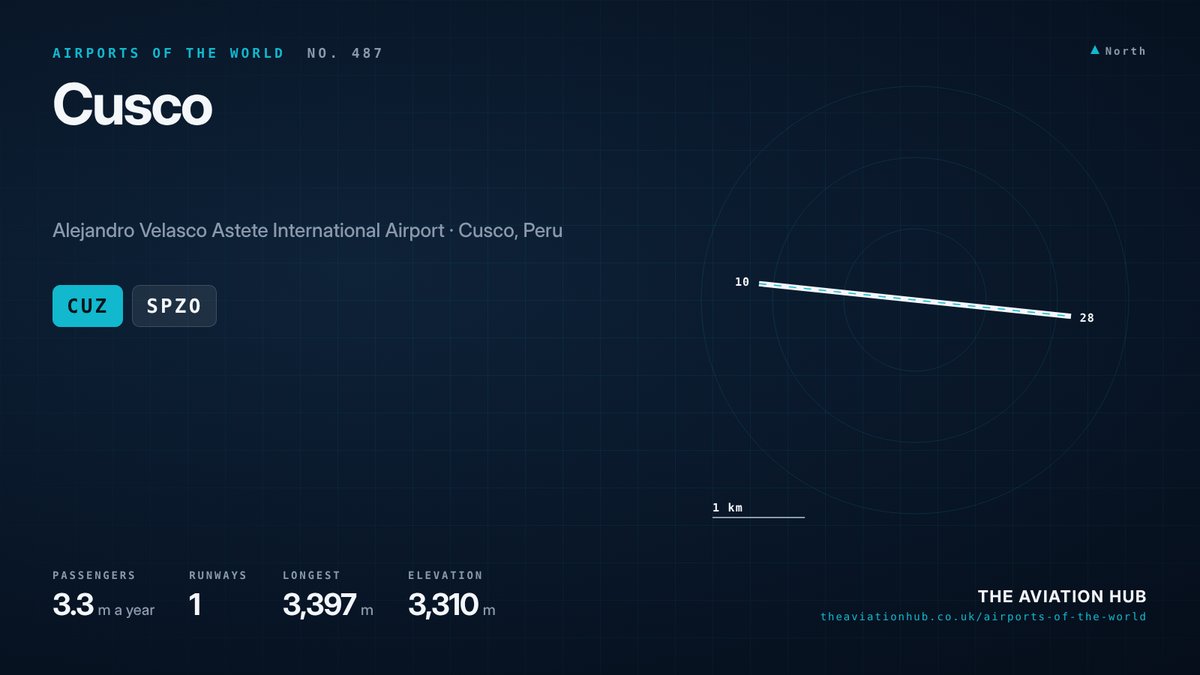
For most visitors to Machu Picchu, the adventure starts with a landing in a high Andean valley ringed by mountains. Cusco Airport, officially Alejandro Velasco Astete International, sits on the edge of the old Inca capital at 3,310 m (10,860 ft). It handles more than three million passengers a year, making it the second most important air terminal in Peru after Lima. Thin air and steep terrain make it one of the more demanding airline fields in South America.
Cusco Airport at a Glance
The codes are CUZ and SPZO. The airport lies in the Wanchaq district, only about 2 miles (3.7 km) south east of the historic centre and the Plaza de Armas. It has one runway and one passenger terminal. Traffic reached just over 3 million passengers in 2023, with around 23,000 aircraft movements, and has kept growing since.
LATAM Airlines Peru treats Cusco as a focus city, and Sky Airline Peru and JetSmart compete hard on the domestic routes. The state company CORPAC operates Cusco Airport. Flight information and passenger guidance are on the airport’s official website, and altitude advice is worth reading before travel.
How Cusco’s Airport Came to Be
The airport opened for commercial service in December 1964. It brought regular airline links to the region at a time when tourism to Machu Picchu was starting to grow.
The name honours Alejandro Velasco Astete, a Peruvian aviator who made the first flight from Lima to Cusco across the Andes in 1925. Less than a month later, in September 1925, he died in a crash at Puno while trying to avoid spectators at an air show.
Tragedy marked the early years. In August 1970, LANSA Flight 502, a Lockheed L-188 Electra, crashed just after take off and killed 99 of the 100 people on board. Among the dead were 49 exchange students from Buffalo, New York. In May 2000, Cusco Airport became the first airport in Peru to use jet bridges.
Runways at Cusco Airport
Runway 10/28 is 3,397 m (11,146 ft) long and 45 m (148 ft) wide, with an asphalt surface. That length is generous on paper, but at 3,310 m above sea level the air is thin. Engines produce less thrust, wings generate less lift, and aircraft need longer runs to take off and land.
High terrain on three sides turns Cusco Airport into a one way operation. Landings use runway 28 only, with aircraft approaching from the south east along the valley. Take offs use runway 10 only, heading back out the way the arrivals came. Climbs are slower and shallower than at sea level, so departures follow carefully planned routes between the peaks.
Weather and heat add further limits. Afternoon winds and rising temperatures cut performance, which is why many flights are scheduled for the morning. Airlines often restrict payload on departures, and operators use aircraft such as the Airbus A320neo and A319 that cope well with high altitude work.
Terminals and Airlines
A single terminal at Cusco Airport handles domestic and international flights. It is busy and compact, with jet bridges at several gates. Taxi companies, car rental desks and a PeruRail sales office sit in the arrivals area.
LATAM Peru is the largest operator, with frequent Airbus A320 family flights to Lima and links to Arequipa and Puerto Maldonado in the Amazon. Sky Airline Peru and JetSmart fly similar routes with their own A320neo fleets, and price competition on Lima has been fierce.
International carriers are few but growing. Avianca flies to Bogota and La Paz, and Boliviana de Aviacion also serves La Paz. American Airlines tried a New York JFK service via Lima with Boeing 757s in 1998 and 1999, but dropped it.
Routes and Destinations
Lima dominates the departure board at Cusco Airport, with dozens of daily flights on LATAM, Sky and JetSmart. Flying time is around 80 minutes, against a full day by road. Arequipa is the second domestic link, and Puerto Maldonado connects the Andes with the rainforest lodges of Madre de Dios.
International growth is the story of the moment. LATAM serves Santiago de Chile, and in late 2025 it won Argentine permits for possible routes to cities such as Mendoza, Cordoba, Salta and Puerto Iguazu, with no start dates set. Sao Paulo Guarulhos is due from March 2027, and Sky is adding Santiago from January 2027.
Demand peaks in the dry season from May to September, when trekking and Machu Picchu visits are at their height. Cargo is limited and mostly carried in passenger aircraft holds.
Getting to and from Cusco Airport
The airport is close enough to the centre for a short taxi ride. A trip to the Plaza de Armas takes around 15 to 20 minutes, depending on traffic. Official taxi companies have counters in arrivals, and several shuttle firms offer door to door transfers to hotels.
There is no rail link from the terminal. Travellers heading to Machu Picchu must take a taxi to the train stations at Poroy, Wanchaq or San Pedro, or drive to Ollantaytambo in the Sacred Valley, around 90 minutes away. Many visitors go straight to the Sacred Valley on arrival, since it is lower and easier on the body.
Local buses pass the airport on the main avenue and are the cheapest option, though they are crowded and impractical with luggage. Car hire is available from Sixt, Hertz, Thrifty and Dollar opposite the entrance.
Spotting and Photography
Cusco Airport sits inside the city, so housing and roads hem in the runway. Arrivals and departures pass close to the surrounding neighbourhoods, and the mountains make a spectacular backdrop. The one way runway pattern means aircraft approach and leave over the south eastern part of the valley, which helps planning.
Light is strongest in the morning, which is also when most flights operate. Clouds often build in the afternoon, especially in the wet season from November to March. The terminal windows give limited but useful apron views.
Respect the altitude. Walk slowly, drink water and do not exert yourself on the first day. Stay clear of the perimeter fence and follow instructions from police and airport staff.
What Comes Next
A new airport is under construction at Chinchero, about 30 minutes north west of the city on the plateau above the Sacred Valley. First proposed in 1978, the project restarted in 2017 and broke ground in November 2021, with capacity for up to 6 million passengers. When it opens, currently planned for around 2028, it should allow larger aircraft and longer international routes, and the current Cusco Airport is expected to close.
Chinchero has drawn criticism, including concern from UNESCO about the impact on Machu Picchu and the Sacred Valley. The verdict is that the old field will keep stretching until its successor is ready. See the wider region on the Airports of the World map.
Continue to follow The Aviation Hub for more analysis and insight.
Advertise with us Your brand, in front of an aviation audience Home page and in-article placements, sold directly, one advertiser per slot. From £250 a year. See the rates

