
Daegu Airport Guide: Low Cost Flights From a Fighter Base
Daegu Airport shares its runways with F-15K fighters. Read about its history, terminals, budget airline routes, subway access and relocation plans.
 By The Aviation Hub
5 min read
Updated October 20, 2026
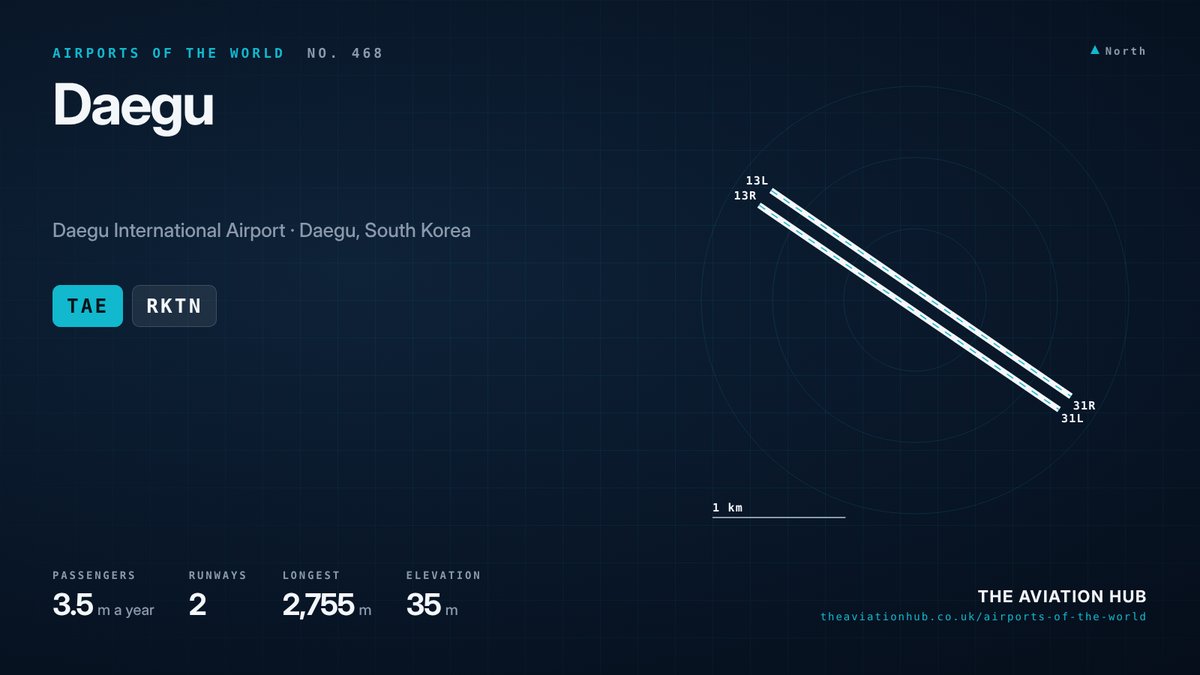
Daegu Airport is the main air gateway to Daegu, a city of around 2.4 million people, and the surrounding Gyeongbuk region. It sits inside the urban area, sharing two parallel runways with a frontline air force fighter wing. Traffic reached about 3.3 million passengers in 2023, rebuilding towards a peak of 4.7 million before the pandemic. Low cost airlines drive most of that demand, flying Daegu residents to Jeju, Japan, China and South East Asia.
Daegu Airport at a Glance
The codes are TAE for IATA and RKTN for ICAO. The IATA code reflects the city’s older romanised name, Taegu. The airport lies in Dong gu, about 4 miles (6.5 km) north east of the city centre and less than 2 miles (3 km) from Dongdaegu railway station. Elevation is 35 metres (116 feet). There are two runways and two passenger terminals, one domestic and one international.
Daegu Airport handled 3,302,107 passengers in 2023, with about 20,200 aircraft movements and 22,000 tonnes of cargo. T’way Air has the largest presence, alongside Korean Air, Asiana, Jin Air and several foreign low cost carriers. Korea Airports Corporation runs the civil terminals, while the Republic of Korea Air Force controls the airfield. Flight information is on the airport’s official website.
A Short History of Daegu’s Airfield
The airfield opened on 31 January 1937 as Taegu Airfield, during Japanese colonial rule. Its moment of fame came in the Korean War, when the US Air Force designated it K-2. In 1950 the field had a dirt and gravel runway, later covered with perforated steel planking and extended to around 1,700 metres. Work on a 9,000 foot concrete runway began in May 1951.
Civil traffic grew alongside the military role, but competition arrived on the ground. When KTX high speed trains reached Daegu in 2004, traffic fell from about 2.2 million passengers in 2003 to 1.6 million a year later. Flights to Seoul were cut back sharply.
Low cost airlines reversed the decline. From 2014 carriers such as T’way Air built international networks from the city, and traffic soared to a record 4,669,057 passengers in 2019. The pandemic cut that to about 1.75 million in 2020, and the recovery has been steady since.
Runways at Daegu Airport
There are two parallel runways, both 46 metres wide. Runway 13R/31L measures 2,755 metres (9,039 feet), and runway 13L/31R measures 2,743 metres (9,000 feet). Both run north west to south east through the flat ground on the north eastern edge of the city.
The Republic of Korea Air Force 11th Fighter Wing is based here, flying three squadrons of Boeing F-15K Slam Eagles. Military jets take priority, and airliners slot in around training sorties. The parallel layout gives flexibility, but noise from the fighters is a constant issue for nearby neighbourhoods and a major reason for relocation plans.
Daegu Airport has seen drama. On 13 June 1991 Korean Air Flight 376, a Boeing 727 from Jeju, made a belly landing after the crew silenced a gear warning. Nobody was seriously hurt. On 26 May 2023 a passenger opened an emergency exit on an Asiana Airbus A321 shortly before landing from Jeju, and several people were taken to hospital.
Terminals and Airlines
The domestic and international terminals sit side by side, a short walk apart. The international terminal is compact and uses traditional Korean design elements. Both buildings fill quickly at peak times, when several low cost departures leave within the same hour.
T’way Air, which has begun rebranding as Trinity Airways, runs the largest network, with flights to Japan, South East Asia and beyond. Jin Air, Asiana, Jeju Air and Korean Air serve Jeju, and Jeju Air also flies to Cebu. Korean Air resumed a domestic connection to Incheon in April 2023, feeding its long haul network. Foreign carriers include HK Express, VietJet, China Eastern, Qingdao Airlines, Loong Air and China United Airlines.
Routes and Destinations
Jeju is the dominant domestic route, with frequent flights by several airlines throughout the day. The Incheon link serves transfer passengers rather than Seoul travellers, since the KTX reaches the capital in under two hours.
Japan is the leading international market, with T’way flying to Osaka Kansai, Fukuoka and Tokyo Narita. Taipei, Hong Kong and Nha Trang are popular leisure routes, and Guam draws families and honeymooners. Chinese links include Qingdao, Ordos and Zhangjiajie, while Ulaanbaatar adds a seasonal Mongolian option.
Summer and the Lunar New Year and Chuseok holidays bring the main peaks. Cargo at Daegu Airport is modest, at around 22,000 tonnes, carried mostly in passenger aircraft holds.
Getting to and from Daegu Airport
The airport is close to the city, which makes access easy. Ayanggyo Station on Daegu Metro Line 1 is about 0.8 miles (1.3 km) away, a short walk or taxi ride. From there trains run through the city centre. City buses stop outside the terminal, and together with the metro they are the cheapest sensible option.
Taxis reach Dongdaegu Station, the KTX hub, in around 10 minutes, and the city centre in about 20. That makes rail and air connections unusually simple. The car park holds about 1,100 vehicles and uses a fully automated system.
Spotting and Photography
Daegu Airport is a difficult place for photography. Because it is an active air force base, photographing the apron, runways or military facilities is strictly prohibited. That rule extends to the F-15Ks, however tempting they look.
The safest approach is to enjoy the movements without a camera, or to photograph airliners only from public places well away from the perimeter. Expect T’way Boeing 737-800s and 737 MAX 8s, Jin Air 737s, Asiana A321s and HK Express Airbus A320neos. Respect signs, stay off military land and follow any instruction from security staff.
What Comes Next
The future lies elsewhere. Daegu and Gyeongbuk plan a new integrated military and civil airport on a site spanning Gunwi and Uiseong counties north of the city centre. The original target was around 2030, but funding disputes have left the timetable uncertain. When it opens, both the fighter wing and civil flights will move. The current site would then be redeveloped.
The new airport promises a longer runway and long haul potential, though questions over cost and distance from the city remain. Until then Daegu Airport will keep serving the low cost market from its cramped urban site. Compare it with Busan and other Korean airports on our Airports of the World map.
Continue to follow The Aviation Hub for more analysis and insight.
Advertise with us Your brand, in front of an aviation audience Home page and in-article placements, sold directly, one advertiser per slot. From £250 a year. See the rates

