
Dalaman Airport Guide: Gateway to the Turquoise Coast
Dalaman Airport serves Fethiye, Marmaris and Turkey's Turquoise Coast. Read about its runway, two terminals, summer routes, transfers and spotting tips.
 By The Aviation Hub
6 min read
Updated October 20, 2026
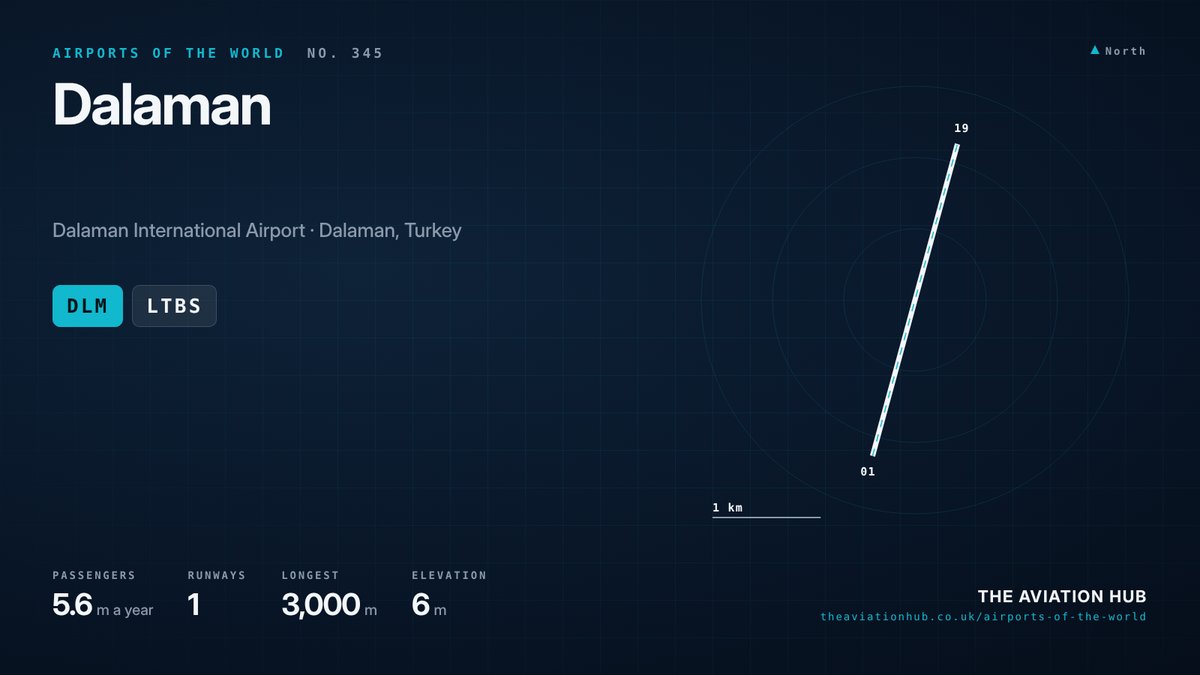
Dalaman Airport is the main gateway to Turkey’s Turquoise Coast, the stretch of pine clad shoreline between Marmaris and Fethiye. It sits on the flat delta of the Dalaman river in Mugla Province, a short drive from the town that gives it its name. Around 5.6 million passengers used it in 2025, and every summer it handles a steady stream of holiday flights from Britain and northern Europe. For travellers bound for Fethiye, Gocek, Dalyan and Oludeniz, Dalaman Airport is their first sight of Turkey.
Dalaman Airport at a Glance
The airport carries the IATA code DLM and the ICAO code LTBS. It stands just 6 m (20 ft) above sea level, a few miles from Dalaman town. Fethiye is roughly 30 miles (50 km) to the east, while Marmaris lies about 60 miles (95 km) to the west by road. One concrete runway handles all commercial traffic, and two terminals split domestic and international flights.
Dalaman Airport handled 5,577,142 passengers in 2025, a fraction below the previous year, and about 3.6 million of them were international. Pegasus Airlines keeps a base here, and Turkish Airlines, AJet, SunExpress, Jet2.com, easyJet and TUI fly most of the schedule. The state airports authority DHMI owns the site, while a company owned 60% by Ferrovial and 40% by YDA Group runs the terminals under a concession that lasts until 2042. Timetables, parking and shuttle details are on the airport’s official website.
How Dalaman’s Airport Came to Be
Construction began in 1976, when the coast west of Antalya had little tourism infrastructure. The field opened as an aerodrome on 7 August 1981 and was raised to full airport status in 1989. It takes its name from Dalaman, the nearest town, rather than from any of the resorts it serves. The site also has a military role and remains a joint public and military airport.
Through the 1990s and 2000s the package holiday boom transformed the region. British tour operators discovered Fethiye, Oludeniz and the gulet harbours of Gocek, and charter flights poured in each summer. The original terminal had been designed for far smaller numbers and became badly crowded on peak weekends.
The answer was a new international terminal designed by the Turkish architect Emre Arolat. It opened in 2006, cost around $150 million and lifted floor space from under 45,000 square metres to about 95,000. Arolat’s practice also designed Terminal 2, which opened in July 2018 and now handles international flights, while the 2006 building serves domestic routes.
Runways at Dalaman Airport
Runway 01/19 is 3,000 m (9,842 ft) long and 45 m wide with a concrete surface. That is ample for the Boeing 737-800s and Airbus A321neos that carry most holiday traffic, and it comfortably takes the occasional wide body charter. Some official listings show a second parallel strip, but scheduled flights use the main runway.
The runway runs north to south across the river delta, with the sea to the south and forested mountains rising to the north and east. That terrain shapes the instrument procedures for both directions. Wind decides which end is in use, and afternoon sea breezes are a regular factor in summer. There are no formal slot limits of the kind seen at London airports, but summer weekend peaks test stand and apron capacity hard.
Terminals and Airlines
Dalaman Airport operates two passenger buildings linked by a covered walkway. Terminal 2, the international building, has 13 boarding gates, 12 of them with covered air bridges, plus remote stands on the enlarged apron. The field now has 57 aircraft parking positions, and the operator puts annual capacity at 17.5 million passengers. Its open departure hall was a big step up from the older buildings.
Terminal 1, the 2006 building, serves flights within Turkey. Turkish Airlines and its low cost arm AJet connect the field with Istanbul and Ankara, while Pegasus flies domestic services from its base here. Internationally, Jet2.com, easyJet and TUI dominate, with SunExpress bringing in German and other European traffic. Alliance groupings matter little at a leisure airport of this kind, where most passengers fly point to point on package or low cost tickets.
Routes and Destinations
Istanbul is the backbone of the domestic network, with flights to both Istanbul Airport and Sabiha Gokcen throughout the year. Ankara is the other main domestic link. The domestic side is the steadier half of the business and carried about 1.9 million passengers in 2025.
International traffic is highly seasonal. The summer timetable runs from roughly April to October and links Dalaman Airport with dozens of destinations across Europe, plus a few in the Middle East. British airports dominate, with Jet2.com, easyJet and TUI flying from London, Manchester, Birmingham, Bristol and a long list of regional bases. Germany, the Netherlands and other northern European markets add further demand. Flights from Manchester take a little over four hours.
In winter the picture changes completely. The international schedule shrinks to a handful of services, and the domestic routes to Istanbul carry most of the load until the season restarts in spring.
Getting to and from Dalaman Airport
There is no rail link. Dalaman Airport sits just off the D400 coastal highway, which links it with Fethiye to the east and with Marmaris and Mugla to the west. The drive to Gocek takes about 20 minutes, Fethiye roughly 45 minutes and Marmaris around an hour and a half, depending on traffic.
Shuttle buses run to Fethiye, Marmaris and Mentese, the central district of Mugla, and they are the cheapest option when the times fit. However, they are timed mainly around domestic arrivals. Most international visitors travel on pre booked transfers included in their package, or take a taxi from the rank outside arrivals. Fares to Fethiye and Marmaris are substantial, so agree the price first or book ahead. Car hire desks sit in the arrivals hall, and the car park holds around 550 vehicles.
Spotting and Photography
Spotting at Dalaman Airport needs a light touch because the field has a military side, and Turkish authorities are sensitive about photography near defence sites. The safest place to watch is the international terminal itself, where the glazed departure area overlooks the apron. Summer Saturdays bring the best variety, with a parade of Jet2 and TUI 737s, easyJet A320s and A321neos and the occasional wide body.
The farmland and roads around the field give glimpses of aircraft on approach, with the mountains behind adding drama to photographs. Early morning and late afternoon offer the best light, since the midday summer sun is high and harsh and heat haze softens distant shots. Avoid long lenses near the perimeter, never photograph military installations, and move on immediately if security staff ask.
What Comes Next
With stated capacity of 17.5 million passengers and traffic of about 5.6 million, Dalaman Airport has room to grow without new buildings. The 2018 terminal and apron work removed the worst bottlenecks. The task now is filling the shoulder months rather than pouring more concrete. Longer seasons from British and European airlines would raise utilisation and smooth the sharp summer peak.
The main risks are external. Lira volatility, regional politics and competition from Antalya and Bodrum all influence how many seats airlines commit. The YDA concession also has a finite term, after which DHMI will choose the next operator. Expect steady growth rather than a step change, because the Turquoise Coast remains a reliable summer favourite. Compare it with other Mediterranean holiday fields on our Airports of the World map.
Continue to follow The Aviation Hub for more analysis and insight.
Advertise with us Your brand, in front of an aviation audience Home page and in-article placements, sold directly, one advertiser per slot. From £250 a year. See the rates

