
Dallas Love Field Airport Guide: Southwest’s Home Base
Dallas Love Field Airport is Southwest Airlines' home base and a 20 gate city field shaped by the Wright Amendment. Routes, DART access and spotting.
 By The Aviation Hub
7 min read
Updated October 20, 2026
Dallas Love Field Airport lies about 6 miles (10 km) north west of downtown Dallas, close enough that passengers can see the skyline from the gates. It was the city’s main airport until Dallas Fort Worth International opened in 1974, and it survived four decades of federal restrictions to become one of the most single airline dominated airports in the United States. Southwest Airlines began flying from here in 1971, keeps its headquarters on the airfield and carries around 97 per cent of the 16.6 million passengers who use the terminal each year.
Dallas Love Field Airport at a Glance
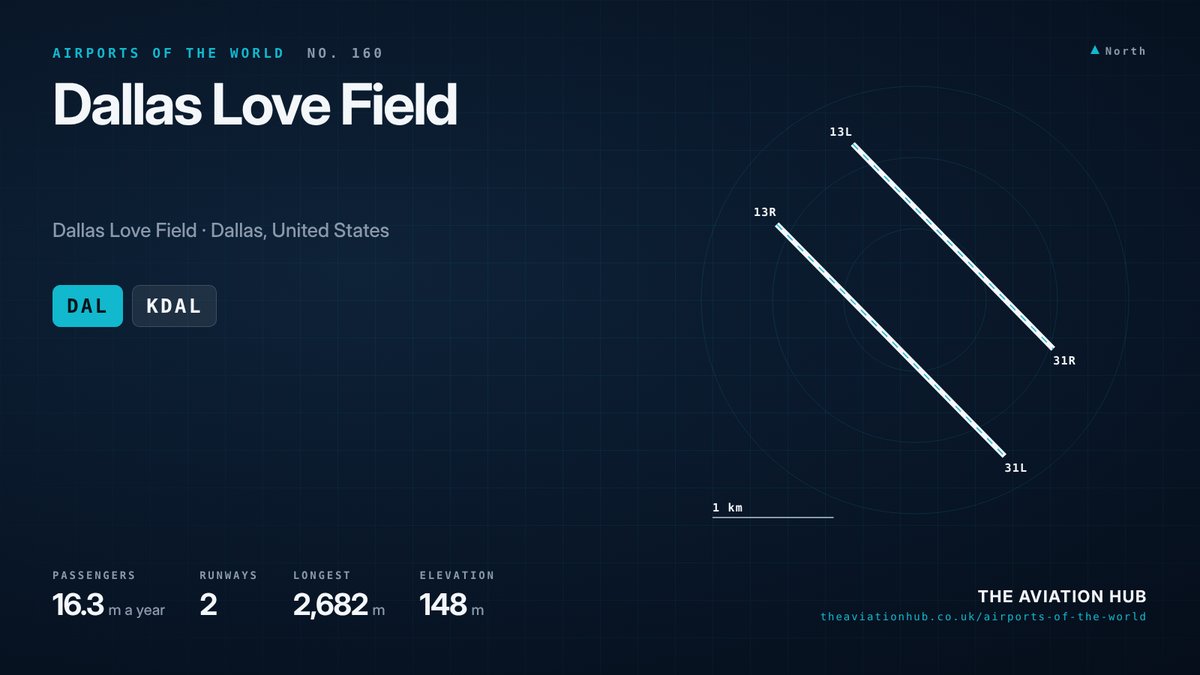
The IATA code is DAL and the ICAO code is KDAL. The field sits in the Love Field neighbourhood of north west Dallas, roughly 6 miles (10 km) from the downtown business district, at an elevation of 148 m (487 ft) on the blackland prairie. There are two parallel runways and a single terminal with 20 gates, a number fixed by federal law. JSX, the semi private jet operator, flies from its own facility on the airfield.
Dallas Love Field Airport handled around 16.6 million passengers in 2025, with some counts putting the total slightly higher. Southwest uses 19 of the 20 gates and Delta the other. The City of Dallas owns and operates the airport through its Department of Aviation, which makes it one of the larger municipally run fields in the country. Flight and parking details are on the airport’s official website.
How Love Field Came to Be
Love Field opened on 19 October 1917 as an Army Air Service training base after the United States entered the First World War, with the 136th Aero Squadron as its first unit. It took the name of Moss L. Love, an Army aviator killed in a 1913 crash near San Diego while practising for his military aviator test. The city bought the field in 1928 and it grew into the commercial airport for Dallas, with American Airlines and Braniff building large operations.
History arrived on 22 November 1963, when President John F. Kennedy stepped off Air Force One here before his motorcade into Dallas. Hours later Lyndon B. Johnson was sworn in as president aboard the same aircraft on the Love Field ramp before it departed for Washington. The deadliest accident at the field remains American Airlines Flight 157 in November 1949, which killed 28.
When DFW opened in 1974, the airlines moved out except Southwest, which had begun intrastate flying in 1971 and won a court fight to stay. Congress passed the Wright Amendment in 1979 to protect DFW, limiting flights on larger aircraft to Texas and four neighbouring states. The 1997 Shelby Amendment loosened it, and a 2006 compromise signed by President George W. Bush repealed the restrictions from 13 October 2014 in exchange for a permanent cap of 20 gates and a ban on international flights.
Runways at Dallas Love Field Airport
Dallas Love Field Airport has two parallel concrete runways. Runway 13R/31L is the longer at 2,682 m (8,800 ft) and 13L/31R measures 2,363 m (7,752 ft), both 46 m wide. The lengths suit the Boeing 737-700, 737-800 and 737 MAX 8 fleet that makes up almost every movement, and Delta’s Atlanta flights and the JSX Embraer regional jets need far less. A third runway, 18/36, was converted to a taxiway in 2017 because it was little used and ran close to housing.
The 13R/31L runway was rebuilt in a $141 million project completed on 28 June 2022, during which the airport ran on a single runway. Southerly winds, the norm in north Texas, put the 13 runways in use with arrivals over the northern suburbs of Bachman Lake and departures climbing out towards downtown. Northerly fronts in winter switch operations to 31, with approaches directly over the city centre. Thunderstorms rather than fog are the operational hazard, and spring storms regularly halt flying for an hour at a time.
Terminals and Airlines
The terminal was rebuilt under the Love Field Modernization Program, which replaced the old terminal and its piers with a new 20 gate concourse completed in 2013 and 2014 in time for the repeal of the Wright Amendment. The single curved concourse has a central food court and shopping area, with the gates arranged along its length. The Frontiers of Flight Museum sits on the south eastern edge of the field.
Southwest is Dallas Love Field Airport. It holds 18 gates of its own and, after Alaska Airlines withdrew in May 2025, uses a former Alaska gate under a licensing arrangement that runs to October 2028. Delta flies from the one remaining gate, operating only to Atlanta after years of litigation over gate access. JSX operates 30 seat Embraer ERJ-145s from its own lounge style terminal with no security queue. No alliance has a presence beyond Delta’s SkyTeam membership. There are no premium lounges in the main terminal.
Routes and Destinations
Houston Hobby is the busiest route, carrying around 400,000 passengers in the year to May 2026 on the original Southwest Texas triangle, followed by Las Vegas, Denver, Phoenix and Orlando, each at more than 350,000. Atlanta, shared by Delta and Southwest, San Antonio, Nashville, Chicago Midway and New Orleans complete the top ten. Since the Wright Amendment ended, Southwest has added both coasts, with Los Angeles, New York LaGuardia and Washington National now on the map.
International airline service is banned by the 2006 law, though JSX flies to Cabo San Lucas from its private terminal. Seattle is the longest route at around 1,670 miles (2,690 km), with Portland and Boston close behind. The schedule is remarkably even through the year, with spring break and the Christmas period as the peaks and summer thunderstorms the biggest cause of disruption. Southwest has announced Cleveland and Detroit flights from March 2027. Cargo is negligible, as the airline carries only belly freight.
Getting to and from Dallas Love Field Airport
DART, the regional transit agency, serves Dallas Love Field Airport through its Love Link shuttle, bus route 5, which runs frequently between the terminal and Inwood/Love Field station on the Green and Orange light rail lines. The shuttle is free from the terminal, and the train into downtown takes about 15 minutes for a DART fare of around $3 (£2.30), which makes it the cheapest sensible option. The Orange line continues to DFW Airport for those connecting between the two.
Taxis and ride hailing services pick up from the lower level, with the trip to downtown costing roughly $20 to $30 and taking 15 to 20 minutes. Drivers arrive from Mockingbird Lane, Lemmon Avenue or Northwest Highway, with Interstate 35E and the Dallas North Tollway a short distance away. A parking garage sits directly opposite the terminal, with cheaper economy lots served by shuttles. The main car hire companies all serve the airport.
Spotting and Photography
The Frontiers of Flight Museum on Lemmon Avenue sits beside the runway 31 thresholds and its grounds give views of arrivals, with a Southwest 737-300 and a Boeing 737 cockpit among the exhibits. Bachman Lake Park to the north lies under the approach to the 13 runways, where aircraft cross the water on short final and the jogging trail offers a clean view. The parking garage’s top level overlooks the ramp and the Southwest headquarters.
Morning light favours the Bachman Lake side for 13 arrivals and the afternoon suits the museum end. The civil variety is almost entirely Southwest 737s in their heart liveries and special schemes, but the busy business aviation ramps produce Gulfstreams, Bombardier Globals and the occasional Boeing Business Jet. Stay in the public parks and museum grounds, keep away from the general aviation fences and respect the signs around the Southwest campus.
What Comes Next
The gate cap is the whole story. Twenty gates, no international airline flights and the 2006 law that enforces both mean that Dallas Love Field Airport can grow only by filling bigger aircraft more often, which is exactly what Southwest’s shift to the 737 MAX 8 does. The city is reinvesting in the terminal, the roads and a new consolidated car hire facility rather than planning runways. Noise agreements with the surrounding neighbourhoods are the other binding constraint, and a voluntary curfew keeps night flying light.
Dallas Love Field Airport is heading for continued intensive use of a fixed footprint, a Southwest fortress inside a growing city. Compare it with DFW and the other Texas gateways on our Airports of the World map.
Continue to follow The Aviation Hub for more analysis and insight.
Advertise with us Your brand, in front of an aviation audience Home page and in-article placements, sold directly, one advertiser per slot. From £250 a year. See the rates

