
Dammam Airport Guide: The Giant of Saudi Arabia’s East
Dammam Airport, King Fahd International, is the biggest airport on earth by land area and the gateway to Saudi Arabia's oil coast. Runways, routes and access.
 By The Aviation Hub
6 min read
Updated October 20, 2026
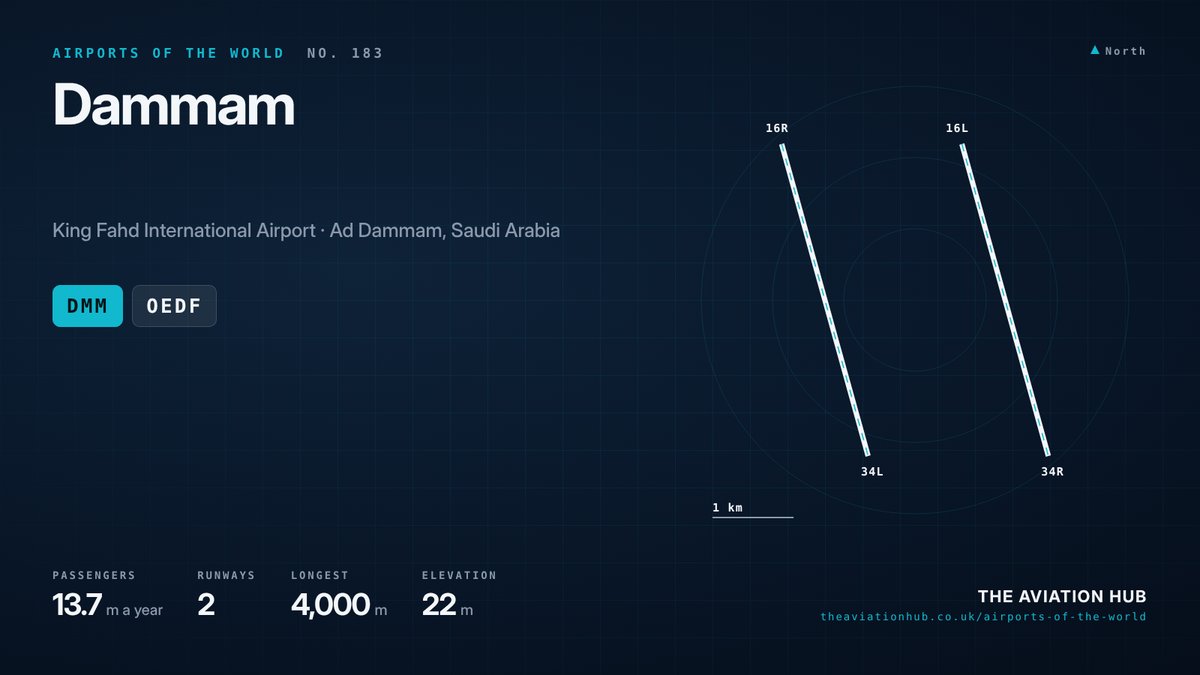
Dammam Airport, formally King Fahd International Airport, serves the Eastern Province of Saudi Arabia and the cities of Dammam, Khobar and Dhahran. It is the third busiest airport in the kingdom and the gateway to the oil industry that built the region. Two parallel 4,000 metre runways, a vast terminal and a land holding of 780 square kilometres make it one of the most physically imposing airports anywhere. Guinness World Records lists it as the largest airport in the world by area. Most of that land is open desert, but the scale sets the tone.
Dammam Airport at a Glance
The IATA code is DMM and the ICAO code is OEDF. The terminal lies about 19 miles (31 km) northwest of central Dammam and roughly 28 miles (45 km) from Khobar, out in the desert beyond the built up coast. Elevation is 22 metres (72 feet). There are two runways and three terminals: the main Passenger Terminal, the Aramco Terminal used only by Saudi Aramco employees, and the Royal Terminal reserved for the royal family.
Passenger numbers were around 10.9 million in 2023 and have climbed since, with recent figures put at roughly 13 to 14 million. Flynas and flyadeal both treat Dammam Airport as a hub, and Saudia operates a large schedule. Saudi Aramco Aviation runs its own employee shuttle network to company sites such as Tanajib, Shaybah and Yanbu. The operator since 2017 has been the Dammam Airports Company, created under Saudi Vision 2030. Timetables and services are listed on the airport’s official website.
A Short History of King Fahd International
Planning started in 1976 under the government’s Airports Development Programme. The old airport at Dhahran, shared with the air base, was hemmed in and could not grow. Construction of the new field began in 1983, and the basic infrastructure, including both runways, was complete by the end of 1990.
Then came the Gulf War. The unfinished airport was handed to the coalition, and 144 Fairchild A-10 Thunderbolt II attack aircraft were based there along with Apache and Chinook helicopters of the US 101st Airborne Division. Operations later moved forward to Kuwait. Commercial opening did not come until 28 November 1999, when airlines moved across from Dhahran and the old airport reverted to the military.
The airport is named after King Fahd, who reigned from 1982 to 2005 and under whom it was built and opened. Growth was slow for a decade, with the sprawling terminal far larger than traffic justified. The rise of flynas and later flyadeal, plus the commercial reforms of Vision 2030, changed that picture through the 2010s and 2020s.
Runways at Dammam Airport
Dammam Airport has two parallel asphalt runways, 16L/34R and 16R/34L. Each is 4,000 metres (13,124 feet) long and 60 metres wide. They are spaced far enough apart for fully independent parallel operations, so arrivals can use one runway while departures roll on the other without conflict. The spacing was built in from the start, which is why the site is so large.
The runways run roughly north to south, aligned with the prevailing shamal wind that blows down the Gulf coast. Summer temperatures above 45 degrees Celsius thin the air, and the 4,000 metre length allows heavy wide body freighters and long haul jets to depart at full weight. Low visibility from dust storms is the main operational hazard, and both runways carry instrument landing systems.
Movements are modest for a field of this size, so delays are rare. The Aramco fleet of Boeing 737s and Bombardier Dash 8s mixes with the airline traffic, and a steady flow of corporate jets uses the Royal and private aviation facilities.
Terminals and Airlines
The Passenger Terminal is a huge six storey structure with a mosque on the roof of the car park and a central hall under a vaulted ceiling. Gates spread along two piers on either side of the building. Domestic and international flights share the complex, with separate processing zones. The scale means long walks, but it also means the terminal has never felt crowded even as traffic has doubled.
Flynas and flyadeal are the biggest operators, running dense domestic schedules to Riyadh, Jeddah, Medina and the regional cities. Saudia links Dammam with Riyadh and Jeddah and flies as far as Beijing. Gulf Air, Emirates, flydubai, Air Arabia, Qatar Airways, SalamAir, Jazeera Airways and Etihad cover the neighbouring states. From further afield come Pegasus, EgyptAir, Royal Jordanian, Ethiopian, Lufthansa, Air India Express, IndiGo and Pakistan’s Airblue and Fly Jinnah. The Aramco Terminal handles only employee flights and the Royal Terminal is closed to the public.
Routes and Destinations
Dubai is the busiest international route from Dammam Airport, with roughly 70 flights a week across several carriers. Cairo, Abu Dhabi, Bahrain, Delhi, Sharjah, Muscat, Mumbai and Istanbul follow. Domestically, Riyadh and Jeddah dominate, often with hourly departures in the morning peak. The network reflects the Eastern Province’s workforce: large expatriate communities from Egypt, India, Pakistan, the Philippines and Bangladesh drive year round demand.
The Bahrain flight is a curiosity. The two airports are only about 54 miles (87 km) apart, and the sector is among the shortest international services in the world. The longest routes stretch to Manila, Beijing Daxing and Frankfurt. Traffic peaks around Ramadan and the Hajj season, when pilgrim flights to Jeddah and Medina multiply. Cargo is significant, driven by oil industry equipment and the petrochemical complex at Jubail.
Getting to and from Dammam Airport
There is no rail link. Access is entirely by road via Route 605, the expressway linking Khobar, Dammam and Qatif, and Route 6466, a spur off Highway 40 to Riyadh. The drive to central Dammam takes 30 to 40 minutes and to Khobar about 45 minutes. Signage is good and the roads are fast and straight.
SAPTCO buses run from Dammam and Khobar, which is the cheapest option but slow. Fixed price taxis wait outside arrivals with set fares to each city. Ride hailing through Careem and Uber is widely used and generally cheaper than a taxi. Car hire desks line the arrivals hall and the airport has enormous surface car parks, so driving is painless. Most visitors use a taxi or an app.
Spotting and Photography
Dammam Airport is not a classic spotting venue. The runways are far from any public road and the surrounding land is fenced desert. The terminal windows on the departures level give good views of the stands and the taxiways, and the glass is clean enough for photographs of the flynas Airbus A320neo fleet and the Saudia wide bodies.
Outside the terminal, the approach roads near the airport entrance offer a chance to catch aircraft on final to runway 34L or 34R in the morning, when the sun is behind you. The shamal usually favours northerly operations. Photography of airports in Saudi Arabia is sensitive, and the military presence at nearby King Abdulaziz Air Base makes it more so. Stay inside the terminal or in your car, do not point cameras at security staff or fences, and comply with any request to stop.
What Comes Next
The Dammam Airports Company is working through a programme of terminal refurbishment, new lounges and a growing roster of international routes. Recent additions include flynas flights to Damascus, Lucknow and the Red Sea resorts. The company’s long term aim is to turn the Eastern Province into a logistics and business hub, with cargo and e commerce facilities on the spare land.
Capacity is not the constraint at Dammam Airport. The terminal was built for far more than today’s traffic and the runway system has decades of headroom. The question is whether the Eastern Province can generate the demand. With Vision 2030 projects spreading along the coast and the Gulf carriers expanding, the trajectory is upward. Place it alongside Riyadh and Jeddah on the Airports of the World map.
Continue to follow The Aviation Hub for more analysis and insight.
Advertise with us Your brand, in front of an aviation audience Home page and in-article placements, sold directly, one advertiser per slot. From £250 a year. See the rates

