
Davao Airport Guide: Mindanao’s Main Air Gateway
Davao Airport explained: its 1940s origins, the 3,000 metre runway, the 2003 terminal, Cebu Pacific and PAL, routes to Doha and Singapore, and upgrades.
 By The Aviation Hub
5 min read
Updated October 20, 2026
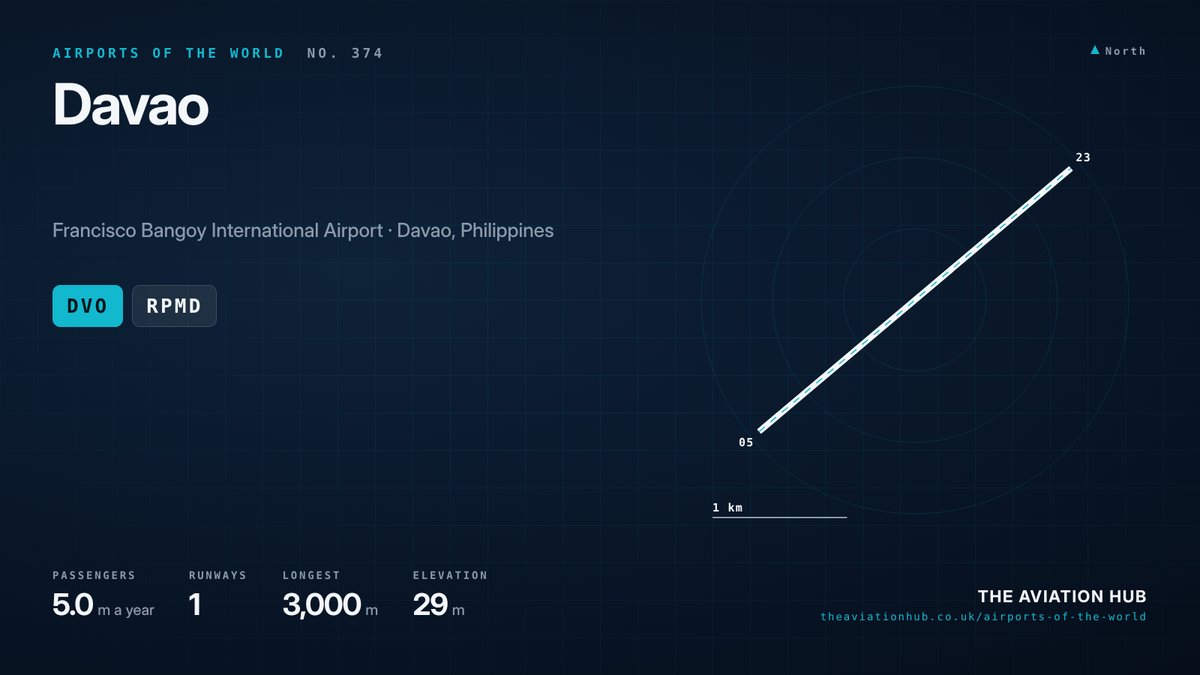
Davao Airport, officially Francisco Bangoy International, is the busiest gateway on Mindanao, the southern island group of the Philippines. It sits on the coast of Davao Gulf a short drive from the city centre. In 2025 it handled about 4.4 million passengers, most of them on domestic flights to Manila and Cebu. A terminal expansion and a long term private partnership are set to reshape it.
Davao Airport at a Glance
The airport carries the IATA code DVO and the ICAO code RPMD. It lies roughly 5 miles (8 km) northeast of Davao’s city centre, at an elevation of 96 feet (29 m). There is one runway and one passenger terminal with four jet bridges. The Davao International Airport Authority runs the site under a 2019 charter, working alongside the Civil Aviation Authority of the Philippines.
Traffic reached about 4.39 million passengers in 2025, up just over 1% on 2024. Cebu Pacific has an operating base at Davao Airport, while PAL Express uses it as a hub. International links include Doha, Singapore and seasonal charters. Flight and service updates are on the airport’s official website.
How Davao’s Airport Came to Be
The site began in the 1940s as Sasa Landing Field, on land donated by the family of Don Francisco Bangoy, a prominent local landowner. His son Paciano later gave more land for access roads and terminals. The airport opened for civil aviation on 25 August 1958 with a new concrete runway, and the original grass strip became a taxiway for light aircraft.
A 1960 law renamed the field Francisco Bangoy Airport in his honour. Wide body service arrived in 1989, when Philippine Airlines began flying Airbus A300s, the city’s first wide body service.
The current terminal opened on 2 December 2003, replacing a building that had served since 1980. Cebu Pacific named Davao Airport its third hub in 2007, driving strong growth in domestic flying. The old terminal has been earmarked for conversion into a trade and cultural museum.
Runways at Davao Airport
The single asphalt runway, 05/23, is 3,000 metres (9,842 feet) long and 45 metres wide. It has instrument landing systems at both ends, meeting ICAO Category I standards. The runway handles wide body jets, and the Antonov An-124 is the largest aircraft to have landed there.
Approaches cross either the city or the waters of Davao Gulf, depending on the wind. Heavy tropical rain is a recurring operational hazard. On 2 June 2013 a Cebu Pacific Airbus A320 overshot the runway in a downpour, and the aircraft was heavily damaged though nobody died.
Davao Airport has also seen tragedy. Air Philippines Flight 541 crashed on approach on 19 April 2000, killing 131 people on Samal Island. On 25 August 2008 a Philippine Air Force Lockheed L-100 Hercules crashed into Davao Gulf shortly after takeoff, killing 11.
Terminals and Airlines
All flights use the 2003 terminal, which has 14 domestic and 14 international check in counters. It is busy at peak times, with about 1,500 seats in the departure areas. A major expansion is under way to ease crowding, adding space for check in, security and waiting passengers.
Cebu Pacific and its regional arm Cebgo are the largest operators, flying Airbus A320 family jets and ATR 72 turboprops across the archipelago. Philippine Airlines and PAL Express serve Manila and other cities. AirAsia Philippines has also flown from Davao.
International carriers are few. Qatar Airways links the city with Doha, Scoot connects with Singapore, and VietJet Air runs seasonal charters to Da Nang.
Routes and Destinations
Manila is the dominant route, with many daily flights from several airlines. Cebu is the second key domestic link, and other routes include Clark, Iloilo, Bacolod and Caticlan, the gateway to Boracay. These routes carry a mix of business travellers, overseas workers and holidaymakers.
Doha is the longest route from Davao Airport, at around 5,000 miles (8,070 km), giving Mindanao a one stop link to the Middle East and Europe. Singapore offers connections across Asia. Cebu Pacific restarts Hong Kong flights from 25 October 2026, and Bangkok Don Mueang is due to follow in December 2026.
Traffic peaks around Christmas, Holy Week and the Kadayawan festival each August. Cargo includes fresh produce such as bananas and durian, reflecting Mindanao’s farming economy.
Getting to and from Davao Airport
There is no rail link, so road transport covers every journey. The Carlos P. Garcia National Highway connects the terminal with the city. The La Verna to Mamay bypass road, opened in 2017, helps travellers avoid congestion.
Metered taxis wait outside arrivals and reach the city centre in around 20 to 30 minutes, depending on traffic. Davao’s taxis are generally regarded as reliable, and fares are modest. For most visitors a taxi is the cheapest sensible option with luggage. Allow extra time in the morning and evening rush, when traffic on the highway into the city slows sharply.
Jeepneys and local buses run along the main roads near the airport, suiting travellers with light bags. A planned Davao City Expressway, with an interchange serving the airport, should cut journey times further. Ferries to Samal Island leave from the waterfront nearby.
Spotting and Photography
Davao Airport offers modest but pleasant spotting. Cebu Pacific A320s and ATRs dominate, with Philippine Airlines jets and the weekly Qatar Airways Boeing 787 adding interest. Occasional military aircraft appear too.
Roads near the runway ends and the coastal areas along Davao Gulf give views of arrivals and departures. Morning light is usually best, before tropical clouds build in the afternoon. On clear days the gulf and the green hills of Samal Island make an attractive backdrop for arriving aircraft. The departure lounges offer views of the apron.
Security around Philippine airports is tight, reflecting the 2003 bombing that killed 21 people outside the old terminal. Stay outside the fences, avoid drones and follow police instructions at all times.
What Comes Next
A terminal expansion worth about ₱650 million (around £9 million) is due for completion in December 2026. It increases floor area from 17,500 to about 25,910 square metres and seating from 1,500 to about 2,200.
A 30 year public private partnership is in progress as part of a ₱16.05 billion bundle covering three airports. A consortium won original proponent status in June 2026, with a competitive challenge stage still pending. Planned phases run to 2041 and 2056, covering terminals, cargo, aprons and roads. Davao Airport is set for steady, long term investment. Compare it with other Philippine gateways on the Airports of the World map. The verdict: a solid regional hub on the edge of significant change.
Continue to follow The Aviation Hub for more analysis and insight.
Advertise with us Your brand, in front of an aviation audience Home page and in-article placements, sold directly, one advertiser per slot. From £250 a year. See the rates

