
Indira Gandhi International lies in the southwest of India’s capital, around 10 miles (16 km) from Connaught Place, on the site of a wartime RAF station at Palam. Delhi Airport is the busiest in India, the primary hub of Air India, and a major base for IndiGo, Air India Express and SpiceJet. It handled a record 79.2 million passengers in the financial year to March 2025 and a touch under that in the year that followed. As India’s aviation market grows faster than any other large economy, this is the field under the most pressure.
Delhi Airport at a Glance
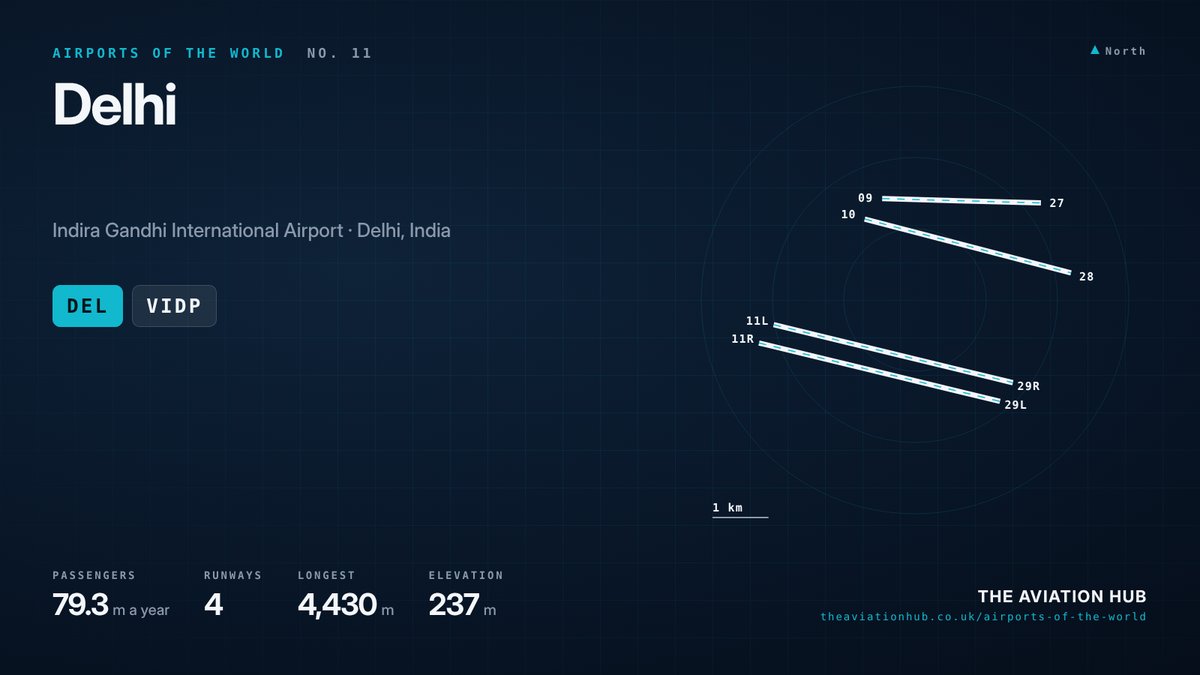
The IATA code is DEL and the ICAO code is VIDP, the P still recalling Palam. The terminals sit roughly 10 miles (16 km) southwest of the city centre, close to the satellite city of Gurugram. Elevation is 777 feet (237 m) on the dusty plain of the Yamuna basin, where winter fog cuts visibility to a few dozen metres for days at a time.
Four runways serve three terminals, numbered 1, 2 and 3. Annual traffic is around 79 million passengers, more than at any other Indian airport. Air India, Air India Express, IndiGo, SpiceJet and Alliance Air all base aircraft here, and FedEx and Quikjet run cargo operations. The operator is Delhi International Airport Limited, in which the GMR Group holds 74 per cent and the Airports Authority of India 26 per cent. Terminal allocations change often, so check the airport’s official website before travelling.
How Delhi’s Airport Came to Be
RAF Palam was established in 1943 as a staging post for Allied operations in Burma and beyond. After independence it became an Indian Air Force station, and commercial flights moved across from the smaller Safdarjung aerodrome in 1962 once the airliners of the day outgrew that site. The original British runway, today’s 09/27, is still in use.
A dedicated international terminal opened in 1986, when the airport was renamed after the assassinated prime minister Indira Gandhi. The decisive change came in May 2006, when control passed to the GMR led private consortium. Terminal 3, a 34 million passenger integrated building, opened in July 2010 ahead of the Commonwealth Games and transformed the passenger experience.
The record includes tragedy. Japan Air Lines Flight 471 crashed on approach in 1972 and the Charkhi Dadri collision of 1996, which killed 349 people, involved a Saudia 747 that had just departed Palam. In June 2024 part of the Terminal 1 forecourt canopy collapsed in heavy rain, killing one person. The rebuilt Terminal 1 opened fully in 2025, and the airport became the first in India to run entirely on hydro and solar power in 2022.
Runways at Delhi Airport
Delhi Airport has four asphalt runways. Runway 11R/29L is the longest at 4,430 metres (14,534 feet) and 60 metres wide, and it carries most of the heavy long haul departures. Its parallel 11L/29R, inaugurated in July 2023 as the fourth runway, is 4,400 metres (14,436 feet) long. Runway 10/28 measures 3,813 metres (12,510 feet) and lies to the north of the terminal area, while the original 09/27 is 2,816 metres (9,239 feet) and handles lighter traffic.
The three long runways are all roughly parallel, which allows simultaneous operations and relieved a severe capacity squeeze. One quirk is famous among pilots: the threshold of runway 29L is displaced by about 1,460 metres, one of the longest displacements in the world, because of a tall statue of Shiva near the approach path. Winter fog from December to February remains the main operational constraint, and the airport has invested heavily in CAT IIIB landing systems to keep flights moving.
Terminals and Airlines
Terminal 3 at Delhi Airport is the main building for both international and full service domestic flights. Air India, Air India Express, Vistara’s former operation now merged into Air India, and almost every foreign carrier use it, from British Airways and Lufthansa to Emirates, Qatar Airways, Singapore Airlines and United. The terminal has a distinctive sculpture of giant hands in mudra gestures above the immigration hall.
Terminal 1, rebuilt and reopened in 2025 with a long pier shaped like a guitar neck, serves low cost domestic flights, chiefly IndiGo and SpiceJet. Terminal 2, renovated and reopened in October 2025, handles a smaller share of IndiGo domestic flights and overflow. Terminals 2 and 3 sit side by side, but Terminal 1 is several miles away on the far side of the runways, with a shuttle bus taking 20 minutes or more. A 7.7 km automated people mover is planned to close that gap.
Routes and Destinations
Domestic traffic provides the bulk of the numbers. Delhi to Mumbai is among the busiest air routes in the world, with IndiGo, Air India and Akasa Air offering departures every few minutes at peak times. Bengaluru, Hyderabad, Kolkata, Chennai and Pune follow, and Delhi Airport is the main gateway to the Himalayan destinations of Leh, Srinagar and Dehradun.
International flying centres on the Gulf, with Dubai, Doha, Abu Dhabi and Sharjah carrying heavy migrant and transit traffic, and on London, where Air India, British Airways and Virgin Atlantic compete. Air India’s Boeing 777 and 787 fleets reach New York, Newark, Chicago, San Francisco, Toronto and Vancouver, with the San Francisco flight stretching to almost 7,700 miles (12,400 km). Traffic peaks in winter and around Diwali. Cargo exceeds a million tonnes a year, led by pharmaceuticals and textiles.
Getting to and from Delhi Airport
The Airport Express metro line is the cheapest sensible option. Trains run from the IGI Airport station under Terminal 3 to New Delhi railway station in about 20 minutes for around 60 rupees (under £1), continuing to Dwarka in the other direction. The Magenta Line has its own station at Terminal 1, and Delhi Aerocity station serves the hotel district beside the airport.
By road, the Delhi to Gurugram Expressway, the Dwarka Expressway and the new Urban Extension Road provide access, though traffic is unpredictable. Prepaid taxis and app based cabs cost 500 to 800 rupees (£5 to £8) to central Delhi and take 40 to 70 minutes. Low floor DTC buses run to the city and to the Inter State Bus Terminal. Multi level car parks face Terminal 3, and the Aerocity hotels are a short cab ride from any terminal.
Spotting and Photography
India is one of the harder countries for aviation photography, and Delhi Airport has no official viewing area. The most practical option is the upper floors of the Aerocity hotels, which sit immediately southeast of the airport and look out towards the airfield. Arrivals on the 28 and 29 runways approach from the east, over the Aerocity side.
The reward is the full Air India fleet, including the Airbus A350-900 and refurbished 777s, alongside the Boeing 787s of Air India and Vistara heritage, dozens of IndiGo A321neos and a strong international mix of wide bodies from the Gulf, Europe and North America. Photographing from roads near the perimeter or from the Air Force side of the field is a bad idea; security forces take it seriously. Keep to the hotels and the terminal, and put the camera away if challenged.
What Comes Next
The fourth phase of the master plan lifted capacity to around 100 million passengers with the new Terminal 1 and the fourth runway, and later phases pencil in Terminals 4, 5 and 6. The people mover between Terminal 1 and Terminal 3 is the next big project, funded by DIAL at an estimated 3,000 to 4,000 crore rupees and roughly 30 months in the building.
The wider picture includes Noida International at Jewar, a separate greenfield airport to the southeast that will share the capital’s traffic once it reaches scale. For the rest of this decade, though, Delhi Airport will stay the heart of Indian aviation. See the wider network on our Airports of the World map.
Continue to follow The Aviation Hub for more analysis and insight.
Advertise with us Your brand, in front of an aviation audience Home page and in-article placements, sold directly, one advertiser per slot. From £250 a year. See the rates

