
Denver Airport Guide: The Mile High Megahub on the Plains
Denver Airport covers more land than any other in North America and is United's largest hub. Six runways, the Great Hall, the A Line and where to spot.
 By The Aviation Hub
6 min read
Updated October 20, 2026
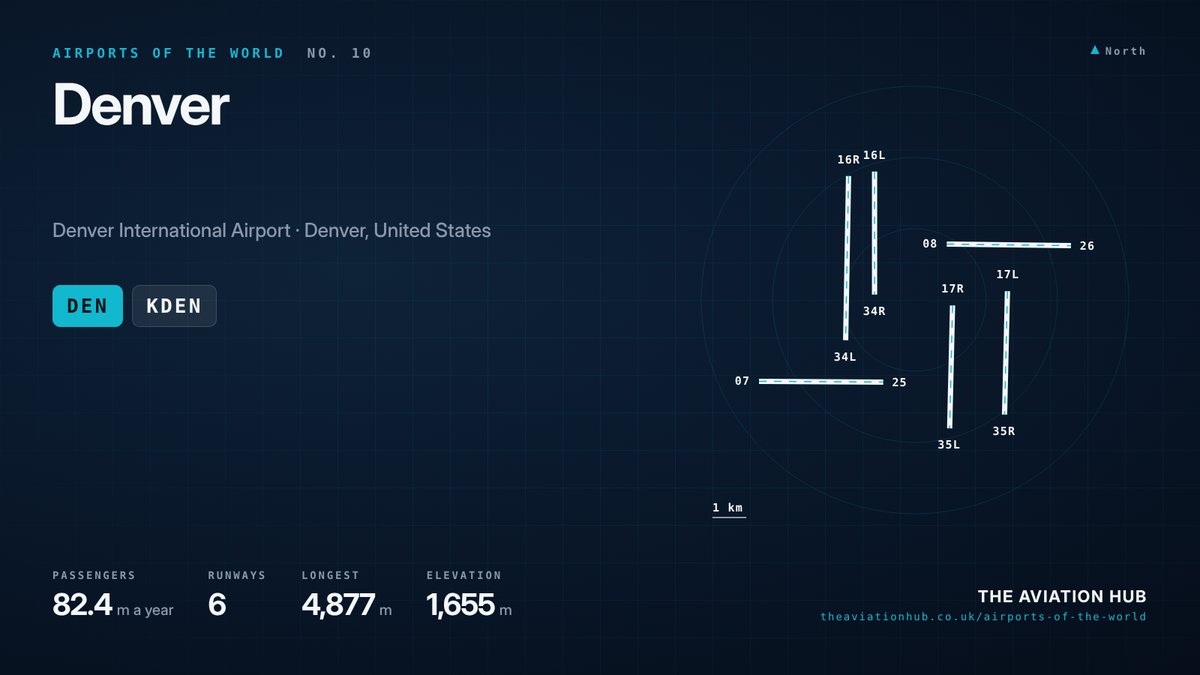
Denver International stretches across 52 square miles (136 sq km) of high prairie about 25 miles (40 km) northeast of downtown, with the Rocky Mountains filling the western horizon. Denver Airport is the largest hub in the United Airlines network, the biggest base for both Southwest and Frontier, and the second largest airport in the world by land area. It handled a record 82.4 million passengers in 2025. The white tented roof of its terminal, echoing the snow covered peaks, is one of the most recognisable airport buildings anywhere.
Denver Airport at a Glance
The IATA code is DEN and the ICAO code is KDEN. The Jeppesen Terminal, named after the aviation chart pioneer Elrey Jeppesen, lies around 25 miles (40 km) from the city centre at the end of Pena Boulevard. Elevation is 5,431 feet (1,655 m), which is why the runways are so long: thin air robs engines and wings of performance on hot summer days.
Six runways serve one terminal and three midfield concourses, A, B and C, with 179 gates between them following the expansions of recent years. Traffic in 2025 was about 82.4 million passengers across 26 airlines and roughly 230 nonstop destinations. United, Southwest and Frontier all treat it as their largest operation. The City and County of Denver owns and runs the airport through its Department of Aviation. Parking and security wait times are published on the airport’s official website.
How Denver’s Airport Came to Be
Stapleton International, opened in 1929 just east of the city, had served Denver for 65 years but was choked by noise complaints, crossing runways and a lack of room to expand. In 1989 voters approved a new airport on annexed land far out on the plains. Construction ran 16 months late and nearly two billion dollars over budget, much of it blamed on an automated baggage system that mangled luggage in testing and was eventually abandoned in 2005.
The new airport opened on 28 February 1995 at a final cost of around 4.8 billion dollars. Stapleton closed the same night and has since been redeveloped as housing. The sixth runway, the 16,000 foot 16R/34L, opened in 2003 to give fully loaded wide bodies a safe margin at altitude.
Blizzards in 2003 and 2006 shut the field for days and stranded thousands, prompting a huge investment in snow clearing. The airport has also acquired an unusual folklore. The Blue Mustang statue on Pena Boulevard, nicknamed Blucifer, killed its sculptor when a section fell on him in 2006, and persistent conspiracy theories about tunnels and secret societies are now embraced by the airport’s own marketing, complete with a talking gargoyle.
Runways at Denver Airport
Denver Airport has six concrete runways arranged in a pinwheel so that parallel pairs point in two directions. Runway 16R/34L is the monster, at 4,877 metres (16,000 feet) long and 61 metres wide, the longest public use runway in North America and the fifth longest in the world. It was built to let a fully fuelled Boeing 747 or 777 depart for Asia in the heat of summer at altitude.
The other five are each 3,658 metres (12,000 feet) long and 46 metres wide. Runways 16L/34R, 17L/35R and 17R/35L run north south alongside the long one, and 07/25 and 08/26 run east west on either side of the terminal area. The layout allows up to four simultaneous arrival streams in good weather and gives controllers a crosswind option whenever the wind swings. Strong westerly winds off the mountains bring the east west pair into regular use. Space exists for six further runways in the master plan.
Terminals and Airlines
Everything starts in the Jeppesen Terminal, whose 34 fabric peaks cover the check in halls, baggage claim and, since the Great Hall project, the two main security checkpoints on Level 6. From there an underground train runs to the three concourses in sequence. Concourse A, reached also by a pedestrian bridge over a taxiway, hosts Delta, Alaska, JetBlue, Frontier, some United flights and every international carrier, since it contains the customs hall.
Concourse B at Denver Airport belongs entirely to United and its United Express partners, with 72 gates stretched along the longest pier. Concourse C is the Southwest building, shared with American and most of the remaining regional operators. All three concourses gained new gate extensions between 2018 and 2020, adding 39 gates in total. Walking from the train to the far end of B takes a good ten minutes.
Routes and Destinations
Denver Airport sits almost exactly in the middle of the continental United States, which makes it a natural connecting point. Phoenix, Las Vegas, Los Angeles, Chicago O’Hare and Seattle were the busiest domestic routes in the year to May 2026, with United, Southwest and Frontier competing head to head on most of them. Ski season from December to March brings a surge of traffic from the east coast and Texas, and mountain resort flights to Aspen and Vail run on regional jets.
International service has grown fast. Cancun, Vancouver, London Heathrow, Munich and Frankfurt lead the list, and Lufthansa began daily Airbus A380 flights to Munich in 2025, the type’s first scheduled visit to the airport. United flies to Tokyo, and British Airways and Air Canada are long established. Cargo is modest for an airport of this size, though the altitude and open land have attracted a growing e commerce presence.
Getting to and from Denver Airport
The RTD A Line commuter rail opened in 2016 and runs from a station beneath the Westin hotel at the terminal to Union Station downtown in about 37 minutes, roughly every 15 minutes. At around 10 dollars (£8) it is the cheapest sensible option and far more reliable than the roads in winter. RTD skyRide buses serve Boulder and the suburbs from the same transit centre.
By car, Pena Boulevard runs 12 miles from the terminal to Interstate 70, and the E-470 toll road crosses it southwest of the airport. A taxi or rideshare to downtown costs 60 to 80 dollars (£48 to £64) and takes 35 to 50 minutes. Parking ranges from the expensive garages beside the terminal to the Pikes Peak and Mount Elbert shuttle lots far out on the airport road. Shuttle vans run to the mountain resorts in winter, often with a four hour journey to Vail or Aspen.
Spotting and Photography
The open landscape around Denver Airport is both a blessing and a curse. Views are unobstructed for miles, but the runways are far from any public road and heat haze shimmers over the prairie by late morning. The Westin hotel at the terminal and the outdoor decks on all three concourses, open airside from 6am to 10pm, are the easiest options, while the Final Approach cell phone lot off Pena Boulevard works landside. Northerly flow on the 34s and 35s is common, with arrivals coming in from the south.
Early morning gives the best light and the clearest air, often with the mountains sharp behind departing aircraft. Expect United 787s and 777s, a river of Southwest and Frontier 737 and A320neo family jets, and Lufthansa’s seasonal A380. Airport police patrol the perimeter roads and the land is airport property, so stay on public roads, do not stop on Pena Boulevard itself, and never approach the fences.
What Comes Next
The Great Hall renovation is due to finish in 2027, with the West Security checkpoint opening in 2024 and East Security in 2025, moving screening up to Level 6 and freeing the old floor for shops and seating. Beyond that lies the Operation 2045 master plan, which sketches four additional concourses and around 100 more gates, plus pedestrian tunnels costing anywhere from 300 to 700 million dollars as a backup to the underground train.
No other large American airport has this much land or this much room to grow. With United still growing here, Denver Airport looks likely to break 100 million passengers within the next decade. Place it in context on our Airports of the World map.
Continue to follow The Aviation Hub for more analysis and insight.
Advertise with us Your brand, in front of an aviation audience Home page and in-article placements, sold directly, one advertiser per slot. From £250 a year. See the rates

