
Detroit Airport Guide: Six Runways and a Mile Long Concourse
Detroit Airport is Delta's second largest hub, with six runways and a concourse a mile long. Read how the Motor City's gateway works and where to watch it.
 By The Aviation Hub
7 min read
Updated October 20, 2026
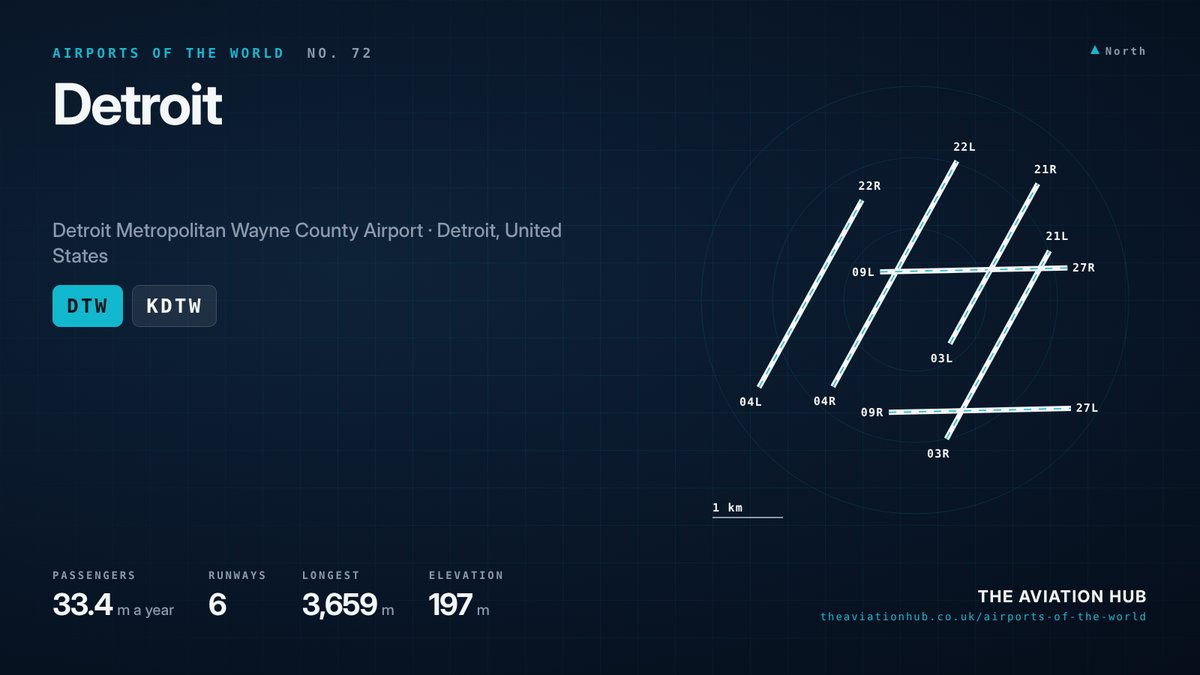
Detroit Metropolitan Wayne County Airport lies in Romulus, Michigan, about 18 miles (29 km) southwest of downtown Detroit and roughly midway between the city and Ann Arbor. It is the second largest hub of Delta Air Lines after Atlanta and the main gateway between the American Midwest and Asia, a legacy of its Northwest Airlines years. Six runways, two terminals and a concourse almost a mile long make Detroit Airport far bigger than its city’s reputation suggests. Around 33 million passengers used it in 2025.
Detroit Airport at a Glance
The codes are DTW and KDTW. The field sits at 645 ft (197 m) above sea level on flat farmland in Wayne County, bounded by Interstate 94 to the north and Interstate 275 to the west. It has six runways in three alignments and two terminals, McNamara and Evans. The Wayne County Airport Authority owns and operates it along with the smaller Willow Run airport nearby.
Detroit Airport handled roughly 33.4 million passengers in 2025, up a little over one per cent. Delta and its regional partners carry more than half of them, and Spirit Airlines built a large base and a maintenance hangar here before it ceased operations in May 2026. More than 140 destinations are served, around 30 of them international. Parking rates, terminal maps and flight status are on the airport’s official website.
How Detroit’s Airport Came to Be
Wayne County began planning an airport in the late 1920s on a square mile of farmland near Romulus. The first aircraft landed on 22 February 1930 and the field was dedicated as Wayne County Airport that September. Thompson Aeronautical Corporation, a forerunner of American Airlines, started service the same year, but Detroit City Airport closer to town kept most of the traffic for two decades.
The military called it Romulus Field during the Second World War, when it served as a ferrying base for aircraft built at the Willow Run bomber plant. It became Detroit Wayne Major Airport in 1947 and took its current name in 1958, by which time the airlines were moving out from the cramped city airport. American, Northwest and others settled in through the 1960s.
Northwest made it a hub after deregulation and its merger with Republic Airlines in 1986. The McNamara Terminal opened in 2002 as Northwest’s showpiece, and the North Terminal, renamed Evans in 2022, followed in 2008. Delta inherited the hub when it absorbed Northwest in 2008 and has kept it as a core connecting point.
Runways at Detroit Airport
Detroit Airport has six runways. Four run roughly northeast to southwest in two parallel pairs. The longest, 04R/22L, is concrete, 3,659 m (12,003 ft) long and 61 m wide, and handles the heavy departures to Asia. Its partner 04L/22R is concrete and 3,048 m (10,000 ft). The second pair, 03R/21L at 3,048 m (10,001 ft) and 03L/21R at 2,591 m (8,501 ft), lies on the eastern side of the field.
Two crosswind runways complete the set. Runway 09L/27R is 2,654 m (8,708 ft) long, while 09R/27L is 2,591 m (8,500 ft). The four parallel runways allow simultaneous arrivals on more than one of them in good weather, and the airport rarely runs out of runway capacity. Westerly and southwesterly winds dominate, so the 21 and 22 runways are the most used.
The field has a sombre history. Northwest Flight 255, a McDonnell Douglas MD-82, crashed on departure in August 1987 after the crew failed to set the flaps, killing 154 on board and two on the ground, with a four year old girl the sole survivor. In December 1990 two Northwest aircraft collided in fog on the runway, killing eight.
Terminals and Airlines
The McNamara Terminal is one of the largest airline terminals in the United States, with 122 gates on Concourses A, B and C. Concourse A runs for about a mile and is served by an overhead tram, and the Light Tunnel between A and the B and C concourses stages a colour changing light show. Delta and Delta Connection fill almost the whole building, with Air France, Aeromexico and WestJet sharing it as partners. The Japanese signage reflects the long standing traffic to Japan from Michigan’s car industry.
The Evans Terminal has 29 gates and houses every other carrier. American, United, Southwest, Frontier, JetBlue, Alaska, Air Canada Express, Lufthansa, Turkish Airlines and Royal Jordanian all use it. Lufthansa runs a lounge there. The two terminals are not connected airside, and the free shuttle between them takes about ten minutes.
Routes and Destinations
Atlanta is the busiest route from Detroit Airport with around 797,000 passengers in 2025, followed by Orlando at 665,000 and Dallas Fort Worth at 508,000. New York LaGuardia, Las Vegas, Denver, Fort Lauderdale, Los Angeles, Chicago O’Hare and Phoenix complete a top ten with plenty of sunshine destinations for the Michigan winter. Delta’s Boeing 737-900ERs and Airbus A321s do most of the work.
Amsterdam is the leading international route at about 394,000 passengers, with Paris Charles de Gaulle at 311,000 and Cancun at 275,000. Delta’s Asian network is the hub’s distinguishing feature, with Tokyo Haneda, Seoul Incheon and Shanghai served by Airbus A350-900s. Shanghai is the longest route at roughly 7,100 miles (11,450 km). Lufthansa flies Frankfurt, Turkish Airlines Istanbul, Air France Paris and Royal Jordanian Amman. Toronto and Montreal are short hops.
Cargo is significant for the automotive supply chain, with FedEx, UPS, Kalitta Air and Asian freighters using the airport’s cargo area. Winter traffic peaks are driven by snowbirds heading for Florida.
Getting to and from Detroit Airport
Detroit is a car city and the airport reflects it. Interstate 94 serves the Evans Terminal via Merriman Road, and Interstate 275 reaches the McNamara Terminal via Eureka Road, with John D. Dingell Drive linking the two. A taxi or ride hailing car to downtown takes 25 to 40 minutes and costs around $50 to 60. Parking is extensive, with garages beside both terminals, including the Big Blue Deck at Evans, and cheaper Green lots served by shuttle.
There is no rail service. The Detroit Air Xpress coach runs to downtown Detroit in about 40 minutes, and the SMART FAST Michigan bus covers the same corridor at a standard local fare, which makes it the cheapest sensible option. Michigan Flyer coaches serve Ann Arbor and East Lansing, and Robert Q Airbus runs across the border to Windsor, London and other Ontario cities.
Spotting and Photography
There is no official observation area at Detroit Airport, but the flat terrain helps. The roads south of the field around the 03 and 04 thresholds near Eureka Road give views of arrivals on the parallel runways in northerly operations, and Middlebelt Road along the eastern side overlooks the approaches to the 21 and 22 runways. The McNamara Terminal’s long glass walls look out on the Delta operation and the A350s at the far end of Concourse A.
Light is best from the east side in the morning and from the west side in the afternoon. Highlights include the Delta Airbus A350-900s and A330-900s bound for Asia, the Kalitta Air Boeing 747-400Fs and 777Fs, Lufthansa’s A340-300s or A350s on the Frankfurt run and the Turkish Airlines 787-9.
Airport police patrol the perimeter roads and will ask what you are doing. Stay off private property, do not stop on the interstate shoulders and keep cameras away from the fence.
What Comes Next
The Wayne County Airport Authority is renovating the McNamara Terminal in phases, refreshing the gates and concessions and upgrading the baggage system. Delta continues to add Asian and European frequencies as the automotive and tech sectors in Michigan trade with Japan, Korea and Germany. JetBlue resumed its Fort Lauderdale flights from the Evans Terminal in July 2026, two months after Spirit’s collapse.
There is no need for new runways at a field that already has six, so growth will come through better terminals and a bigger Delta network. Detroit Airport will remain a quietly powerful hub that most travellers see only as a connection. Compare it with the other American hubs on the Airports of the World map.
Continue to follow The Aviation Hub for more analysis and insight.
Advertise with us Your brand, in front of an aviation audience Home page and in-article placements, sold directly, one advertiser per slot. From £250 a year. See the rates

