
Dhaka Airport Guide: Bangladesh’s Crowded Front Door
Dhaka Airport, officially Hazrat Shahjalal International, handles most of Bangladesh's air traffic. Runway, terminals, Biman, Terminal 3 and access.
 By The Aviation Hub
6 min read
Updated October 20, 2026
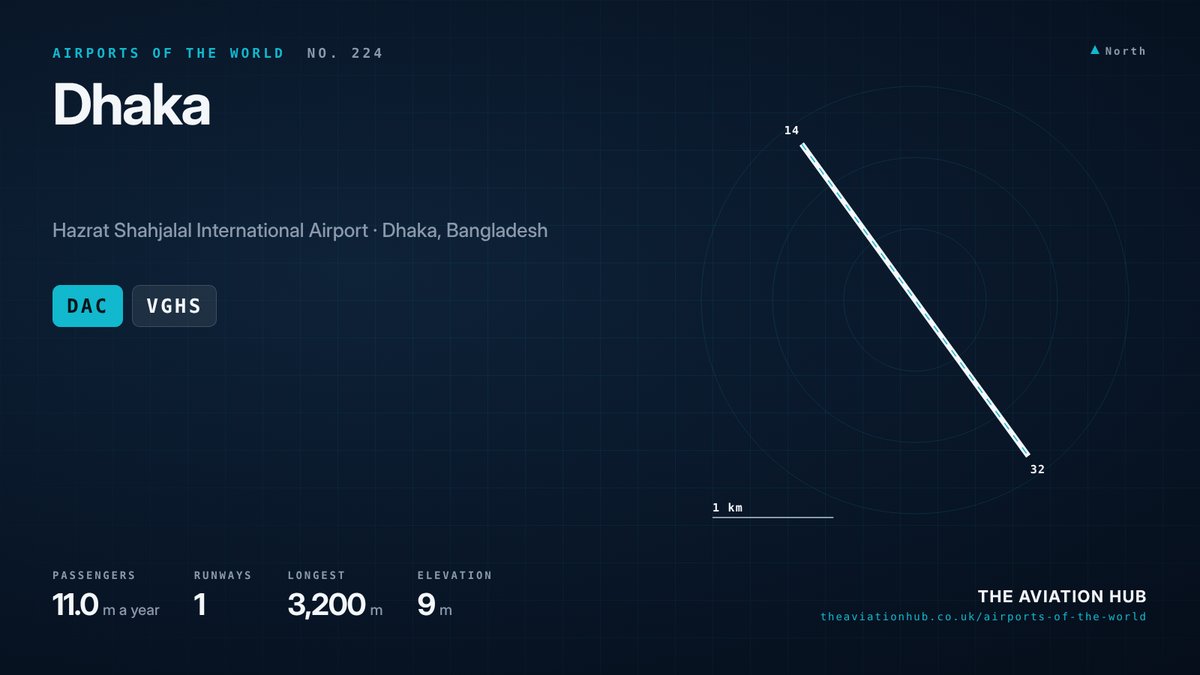
Hazrat Shahjalal International Airport sits in Kurmitola, in the north of Dhaka, about 11 miles (17 km) from the historic centre of the Bangladeshi capital. It is the home of Biman Bangladesh Airlines and the base for every private carrier in the country. Dhaka Airport handles well over 11 million passengers a year on a single runway and through a terminal built for a fraction of that number. A long delayed third terminal promises relief, while a serious cargo fire in October 2025 showed how fragile the operation can be.
Dhaka Airport at a Glance
The IATA code is DAC, a relic of the old spelling Dacca, and the ICAO code is VGHS. The field lies at 30 feet (9 m) above sea level on the flat floodplain north of the city. There is one runway and, for now, two international terminals in one building plus a separate domestic terminal. In 2025 the airport handled around 12.7 million passengers and more than 500,000 tonnes of cargo, by far the largest volumes in Bangladesh.
Biman Bangladesh Airlines, US Bangla Airlines, Novoair, Air Astra, Fly Dhaka and the cargo operator Easy Fly Express are all based here. The Civil Aviation Authority of Bangladesh owns and operates the airport on behalf of the government. Basic flight information and the latest Terminal 3 updates are posted on the airport’s official website.
How Dhaka’s Airport Came to Be
The British built a wartime strip at Kurmitola in 1941 as a spare landing ground for Tejgaon, then the main airfield for Dacca. The strip saw fatal crashes in the 1940s and was bombed by Indian aircraft in 1965, who mistook the abandoned site for Tejgaon. Pakistan began constructing a new airport on the site in 1966, and the work was finished after Bangladesh won independence in 1971.
The airport opened in 1980 as Dacca International Airport, taking over from Tejgaon as the country’s main gateway. It was renamed Zia International Airport in 1983 after the assassinated president Ziaur Rahman. In 2010 the government changed the name again to honour Shah Jalal, the fourteenth century Sufi saint associated with the spread of Islam in Bengal.
The terminal building has been patched and extended many times but never replaced. By the 2010s it was handling more than its design capacity. Terminal 3, financed by the Japan International Cooperation Agency and built by a Japanese and Korean consortium, began construction in December 2019 and was partly inaugurated in October 2023. Its full opening has slipped repeatedly.
Runways at Dhaka Airport
The single runway is 14/32, an asphalt strip of 3,200 metres (10,499 feet) and 45 metres wide. It handles everything from ATR 72 turboprops to the Boeing 777-300ER and 787-9 of Biman, as well as Emirates and Qatar Airways wide bodies and regular freighters. Approaches on runway 14 cross the northern suburbs of Uttara, while runway 32 brings arrivals in over the dense city districts to the south east.
One runway for 12 million passengers and heavy cargo traffic makes Dhaka Airport a bottleneck. Movements bunch into the early morning and late evening when Gulf and Asian connections arrive, and a single incident can shut the airport. A second runway, dependent on the first and close to it, has been proposed for years but has not progressed past planning. Monsoon rain and poor visibility in the winter fog season add further disruption.
Terminals and Airlines
Terminals 1 and 2 at Dhaka Airport share one building. In practice Terminal 1 means international arrivals on the ground floor and Terminal 2 means international departures on the floor above. The building is cramped and queues at immigration can be long. A single storey domestic terminal sits alongside and handles the frequent flights to Chittagong, Sylhet, Cox’s Bazar, Jessore, Rajshahi and Saidpur.
Biman is the largest operator, with a fleet of Boeing 777-300ER, 787-8 and 787-9 jets plus 737-800s and Dash 8 turboprops. US Bangla flies Boeing 737-800s and ATR 72s across the region and to Asian cities. Novoair and Air Astra operate ATR 72 fleets on domestic routes. Foreign carriers include Emirates, Qatar Airways, Saudia, Turkish Airlines, Singapore Airlines, Malaysia Airlines, Cathay Pacific, Thai Airways, China Southern, IndiGo and Air India.
No alliance dominates. Biman is unaligned, so connections rely on individual airline agreements rather than alliance networks.
Routes and Destinations
The Gulf dominates the Dhaka Airport timetable. Millions of Bangladeshi workers live in Saudi Arabia, the United Arab Emirates, Qatar, Kuwait and Oman, and flights to Dubai, Doha, Riyadh, Jeddah, Dammam, Abu Dhabi, Kuwait and Muscat run many times a day. Kuala Lumpur and Singapore serve the same labour flows to south east Asia. Kolkata, Delhi and Chennai are the main Indian routes, with Chennai driven by medical travel.
Biman flies long haul to London Heathrow, Manchester and Toronto, which are the longest routes from the airport. It also serves Rome, while Turkish Airlines links Dhaka with Istanbul. Bangkok is a leading leisure destination. Chittagong is the busiest domestic route, with Cox’s Bazar growing fast as a resort.
Cargo is critical to the economy. Ready made garments bound for Europe and North America fill freighters and belly holds, which explains the half million tonnes handled in 2025 and the scale of the October fire’s impact.
Getting to and from Dhaka Airport
Airport Railway Station sits directly outside the terminal on the Dhaka to Chittagong main line. Trains run to Kamalapur station in central Dhaka and to Chittagong, Sylhet and the north, which makes the airport a useful rail interchange. It is the cheapest way into the city, though the trains are crowded and not built for luggage.
Most passengers use the eight lane Airport Road, which runs south into the city. A journey to Gulshan or Banani takes 20 to 40 minutes, but reaching the old city can take two hours in Dhaka’s notorious traffic. Ride hailing apps including Uber, Pathao and Obhai work well, and a prepaid taxi kiosk near international arrivals offers fixed fares. Hotels in Gulshan run shuttle buses.
Parking exists but is chaotic, and most locals are collected by family. Leave far more time than the distance suggests.
Spotting and Photography
Dhaka Airport is a difficult place for enthusiasts. Security is tight, and photography around the perimeter and inside the terminal attracts attention from police and army personnel. The practical option is to shoot from the departure gate windows, which look onto the apron, or from the roof terraces of hotels in Uttara, which lies under the approach to runway 14.
Runway 14 brings arrivals low over the northern suburbs. Morning light works best for aircraft on short final to 14 as they pass over Uttara. The attraction is Biman’s 787s and 777s in a bright livery, plus the Gulf wide bodies and a steady stream of freighters.
Ask permission before photographing from private buildings, keep away from fences and never photograph military aircraft or installations, which share the field. The consequences of a misunderstanding can be severe.
What Comes Next
Terminal 3 is the whole story for Dhaka Airport. The new building adds 26 boarding bridges, 37 aircraft stands and a modern baggage system, roughly tripling capacity. It was partly inaugurated in October 2023, and in April 2026 officials said it would likely open fully by 16 December 2026 or early 2027. A Japanese consortium is expected to operate it under a concession.
Beyond that, plans include a second runway, a new radar system and a larger cargo village to replace the facilities damaged in the 2025 fire. Dhaka Airport is heading from a cramped relic to a modern hub, provided the terminal opens and the runway question is finally answered. See how it compares with South Asia’s other gateways on the Airports of the World map.
Continue to follow The Aviation Hub for more analysis and insight.
Advertise with us Your brand, in front of an aviation audience Home page and in-article placements, sold directly, one advertiser per slot. From £250 a year. See the rates

