
Doha Hamad Airport Guide: Inside Qatar Airways’ Home Hub
Doha Hamad Airport explained: two very long runways, the Orchard garden terminal, Qatar Airways' hub, metro access and capacity past 70 million.
 By The Aviation Hub
7 min read
Updated October 20, 2026
Doha Hamad Airport is the home of Qatar Airways and one of the great transfer hubs of the Middle East. It rose from reclaimed land on the Gulf shore east of the Qatari capital and opened in 2014, replacing the old Doha International next door. Around 54 million passengers used it in 2025, the vast majority changing planes between Europe, Asia, Africa and Australia. Two of the longest runways in the world, a terminal with an indoor forest and a giant bronze teddy bear make it unlike anywhere else.
Doha Hamad Airport at a Glance
The IATA code is DOH and the ICAO code is OTHH. The field lies a few miles east of central Doha, partly on land reclaimed from the Gulf, at an elevation of 4 m (13 ft). The state owned Qatar Civil Aviation Authority holds ultimate responsibility and the airport company MATAR, part of the Qatar Airways Group, operates it day to day.
One huge terminal with five concourses and two parallel runways serve the traffic. Qatar Airways, Qatar Airways Cargo and the business jet arm Qatar Executive are all based at Doha Hamad Airport, and the flag carrier accounts for the overwhelming share of movements. Skytrax named it the world’s best airport in 2024. Flight status, lounge access and transport details are available on the airport’s official website.
How Doha’s New Airport Came to Be
The old Doha International Airport, a single runway field squeezed between the city and the sea, could not keep pace with Qatar Airways after the airline relaunched in 1997 and set out to become a global carrier. Planning for a replacement began in 2003 and construction started in 2005 on a site reclaimed from the Gulf beside the old airport. The project was first called New Doha International Airport and was meant to open in 2008.
Delays piled up. A soft launch planned for April 2013 was cancelled hours before it was due over safety concerns, and Qatar Airways threatened a $600 million lawsuit against the contractor fitting out its lounges. Human Rights Watch and the International Trade Union Confederation concluded that forced labour was significantly used in the construction. The airport finally opened to passengers on 30 April 2014 and Qatar Airways moved across on 27 May 2014.
The name honours Hamad bin Khalifa Al Thani, the former Emir who ruled from 1995 to 2013 and drove Qatar’s transformation. The Phase A expansion with the Orchard garden opened in November 2023, and Phase B completed Concourses D and E in March 2025.
Runways at Doha Hamad Airport
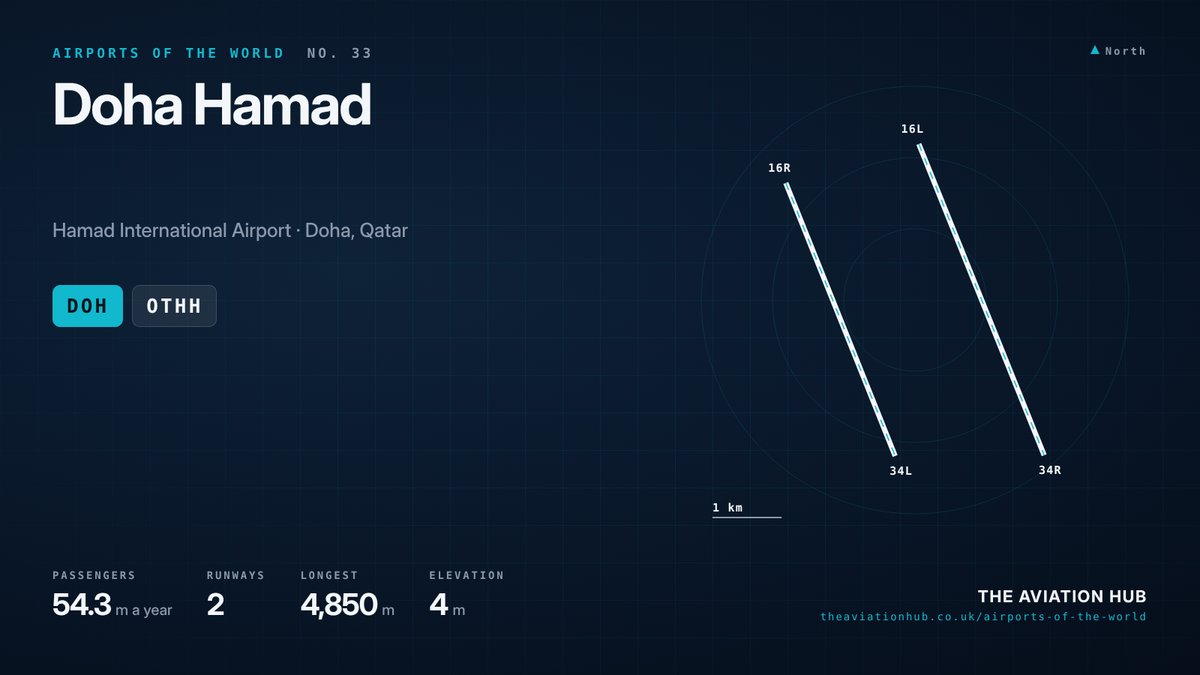
Doha Hamad Airport has two parallel asphalt runways, both aligned roughly north to south along the coast. Runway 16L/34R is 4,850 m (15,912 ft) long and 60 m wide, the longest runway in Western Asia. Runway 16R/34L is 4,250 m (13,944 ft). The two are separated by about 2 km, which allows fully independent simultaneous arrivals and departures.
The lengths are deliberate. Summer temperatures pass 45 degrees Celsius with high humidity, and a Boeing 777-300ER or Airbus A350-1000 bound for Auckland or Los Angeles needs a very long run to lift its full fuel load. Qatar Airways has operated some of the longest routes in the world from here.
Operations typically land on one runway and depart from the other, switching ends with the wind. The prevailing shamal wind from the northwest favours the 34s. The field runs in two enormous waves each day, with hundreds of arrivals and departures bunched around the early morning and late evening connecting banks, and relative quiet in between.
Terminals and Airlines
The terminal at Doha Hamad Airport is one continuous building designed by HOK, with an undulating roof meant to suggest waves and sand dunes. Concourses A and B each have ten contact gates, two of them built for the Airbus A380. Concourse C has 24 contact gates plus 44 remote stands served by buses. Concourses D and E were extended into a single 1.3 km concourse in March 2025, and the central concourse opened in 2023 holds the Orchard, a 10,000 square metre indoor garden with a 268 m water feature beneath a glass roof.
Qatar Airways uses the whole building and its Al Mourjan business lounges and the Al Safwa first lounge sit above the retail hall. Other carriers include British Airways, Iberia, Turkish Airlines, Air India, IndiGo, Japan Airlines, Malaysia Airlines and a growing list of Chinese and Central Asian airlines. The Lamp Bear sculpture by Urs Fischer stands in the main hall and a KAWS figure called Small Lie also stands in the terminal. A mosque with a mushroom shaped dome serves the terminal.
Routes and Destinations
Qatar Airways serves around 170 destinations, and nearly all of them connect through here. London Heathrow is one of the heaviest routes, with multiple daily A380 and Boeing 777 flights, and Manchester, Edinburgh, Birmingham and Gatwick give the UK unusual depth. Paris, Frankfurt, Milan, Madrid, Istanbul and the Scandinavian capitals anchor the European bank. Across Asia, Delhi, Mumbai, Bangkok, Kuala Lumpur, Singapore, Hong Kong and Tokyo carry the bulk of the transfer traffic.
The long haul extremes are striking. Auckland, Sydney, Melbourne, Los Angeles, Dallas Fort Worth and Sao Paulo all appear on the boards, several of them among the longest flights operated anywhere. Regional traffic to Dubai, Abu Dhabi, Muscat, Kuwait and the Saudi cities runs almost like a shuttle. Cargo is a major business, with Qatar Airways Cargo’s Boeing 777F fleet moving around 2.6 million tonnes through the field in 2025.
Getting to and from Doha Hamad Airport
The Doha Metro Red Line has a station at the terminal, opened in December 2019, and runs to Msheireb in the city centre in about 20 minutes and on to Lusail. A standard fare is 2 riyals (around 40p) or 10 riyals for the Gold Club carriage, which makes the metro the cheapest and often the fastest option. Qatar Airways passengers can also book the Al Maha meet and assist service.
Taxis from the official Karwa rank charge roughly 50 to 70 riyals (about £11 to £15) to West Bay and take 20 to 30 minutes. Ride hailing apps work well. Four regional bus routes serve the terminal and route 757 runs to downtown Doha. The airport sits beside the Ras Abu Aboud Expressway, with multi storey short and long term car parks in front of the terminal. The old Doha International is a short drive away to the west.
Spotting and Photography
Doha Hamad Airport is a tough place to spot from outside the fence. There is no public viewing area, and the perimeter is patrolled closely. The best views are from inside, where the floor to ceiling glass in Concourses A, B and C and the upper levels of the Orchard look out over the aprons and the eastern runway. The Oryx Airport Hotel inside the terminal has rooms facing the apron.
Outside, the coastal road towards Al Wakrah gives distant views of the 34 approaches from the south, and the Ras Abu Aboud area to the north sees arrivals on the 16s. Light is strong and harsh, so early morning is best, with haze and dust building through the day. Do not photograph near the perimeter fence, the military areas or the Emiri terminal, and keep cameras away from security staff, who take a strict line.
What Comes Next
Phase B lifted capacity at Doha Hamad Airport to more than 70 million passengers a year, and the operator is now working on how to fill it. A possible Concourse F has not been finalised. Qatar Airways has large orders for the Boeing 777-9 and 787 and is expanding into Africa and secondary Asian cities, which will drive the next wave of transfer growth.
The 2022 World Cup proved the airport could handle extreme peaks, and the metro and road links built for the tournament remain. Dubai and Riyadh are both planning far larger airports, so Doha’s answer is quality rather than scale. Doha Hamad Airport is heading towards 70 million passengers as a premium transfer hub built around one airline. Compare it with its Gulf rivals on the Airports of the World map.
Continue to follow The Aviation Hub for more analysis and insight.
Advertise with us Your brand, in front of an aviation audience Home page and in-article placements, sold directly, one advertiser per slot. From £250 a year. See the rates

