
Dubai Airport Guide: Inside the Emirates Megahub
Dubai Airport handles more international passengers than any other airport on earth. Here is how DXB works, from runways to metro links.
 By The Aviation Hub
7 min read
Updated October 20, 2026
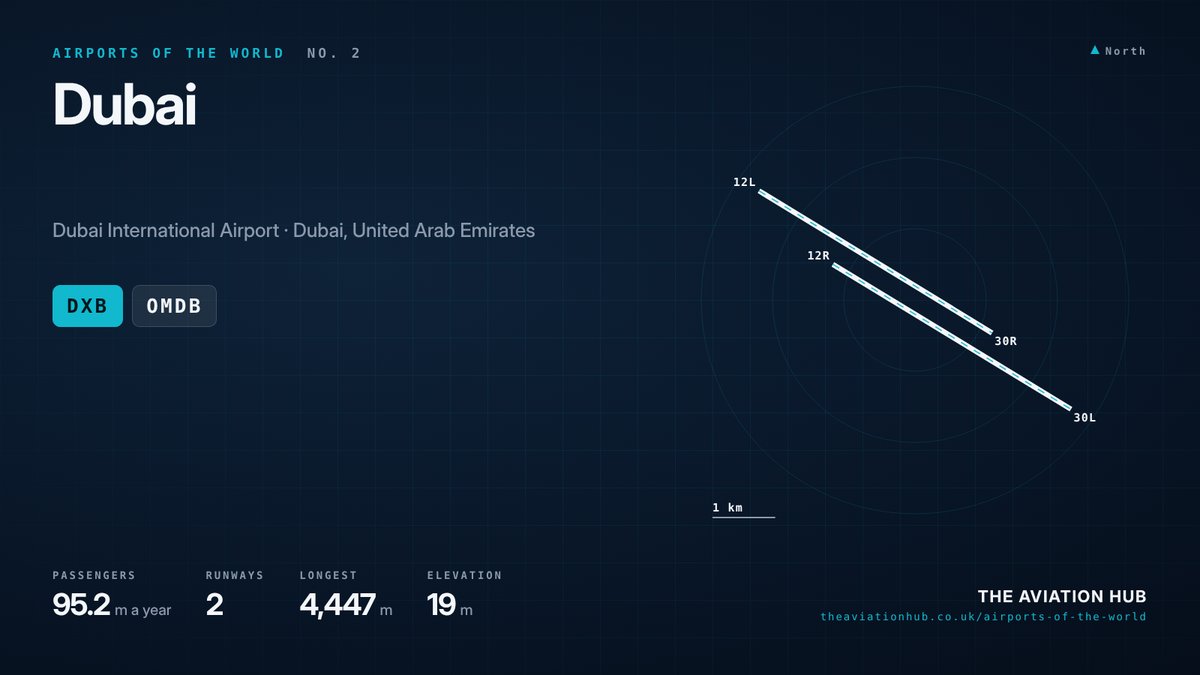
Dubai International sits in the Al Garhoud district, close to the creek that gave the city its start as a trading port. It is the busiest airport in the world for international passengers, and it passed 95 million travellers in 2025. Dubai Airport is the Emirates hub, the base of flydubai, and the point where Europe, Africa, South Asia and Australasia are stitched together in one overnight bank of flights.
Dubai Airport at a Glance
The IATA code is DXB and the ICAO code is OMDB. The airport lies roughly 2.9 miles (4.7 km) east of the city centre and about six miles (10 km) from Downtown Dubai and the Burj Khalifa. Elevation is just 62 feet (19 m), and the site is hemmed in on all sides by housing, highways and the Dubai Creek.
There are two parallel runways and three terminals, with Terminal 3 alone split into Concourses A, B and C. Passenger traffic in 2025 reached around 95.2 million, with cargo at roughly 2.2 million tonnes. Emirates carries about half of all passengers, flydubai a further 13 per cent or so. The operator is Dubai Airports, a government owned company that also runs Al Maktoum International. Current operational notices and terminal maps are published on the airport’s official website.
How Dubai’s Airport Came to Be
Commercial aviation reached Dubai in 1937, when Imperial Airways flying boats began calling at the creek on the route to India. Sheikh Rashid bin Saeed Al Maktoum ordered a proper airport in 1959, and it opened on 30 September 1960 with a compacted sand runway suitable for aircraft the size of a Douglas DC-3. An asphalt runway followed within a few years as oil money started to flow.
A new terminal building opened in 1971, the year the United Arab Emirates was formed. Emirates launched in October 1985 with two leased aircraft from Pakistan International Airlines and grew with a speed that reshaped the airport around it. Terminal 2 opened in 1998 to absorb regional and charter traffic, and Terminal 3 opened in 2008 as a dedicated Emirates facility. Concourse A, built for the Airbus A380, followed in 2013.
Record rainfall in April 2024 flooded aprons and access roads and caused days of disruption. In early 2026 the airport was hit during the conflict with Iran and was still running at reduced capacity at the end of March.
Runways at Dubai Airport
Dubai Airport has two parallel asphalt runways, both aligned roughly northwest to southeast. Runway 12R/30L is the longer at 4,447 metres (14,590 feet), while 12L/30R measures 4,351 metres (14,275 feet). Both are 60 metres wide and long enough for an A380 or a fully laden Boeing 777-300ER bound for Los Angeles or Auckland, although the second runway dates from 1984, long before either type flew. The pair sits close together, so the airport generally runs one runway for arrivals and the other for departures.
The prevailing wind favours operations on the 30s, with aircraft arriving from the southeast over Mirdif and departing northwest over Deira towards the Gulf. A road tunnel under the airfield opened in 2003 and links the terminal side with the Airport Free Zone. Resurfacing closures, such as the 45 day shutdown of the southern runway in 2019, force Emirates to cut its schedule sharply because there is no spare capacity on the site.
Terminals and Airlines
Terminal 3 is where most visitors will land. It belongs to Emirates in all but name, and the carrier uses Concourse A for its A380 fleet, Concourse B for the bulk of its 777 flying, and Concourse C for further wide body departures. United Airlines also operates from Terminal 3 under its partnership with Emirates. The building was once ranked the largest in the world by floor area.
Terminal 1 handles most other international airlines through Concourse D, which opened in 2016. British Airways, Lufthansa, Air France, Turkish Airlines and the big Chinese carriers all work from here. A common airside transit area joins it to Terminal 3.
Terminal 2 sits on the opposite side of the airfield beside the Free Zone. It is home to flydubai and a cluster of regional and low cost carriers serving India, Pakistan, Iran, Afghanistan and Saudi Arabia. Transfers between Terminal 2 and the rest of Dubai Airport mean a bus ride around the perimeter, so leave at least two hours.
Routes and Destinations
India is the largest single market, with several million passengers a year spread across Mumbai, Delhi, Kochi, Hyderabad and a dozen smaller cities. London Heathrow has long been the busiest individual route, served by Emirates A380s alongside British Airways and Virgin Atlantic, and Dubai to Heathrow regularly tops global rankings for seat capacity on a single city pair. Doha, Riyadh, Jeddah and Karachi fill out the regional top ten.
Ultra long haul is where Emirates stands apart. Dubai to Auckland runs close to 8,800 miles (14,200 km) and ranks among the longest scheduled flights anywhere, operated by the Airbus A380. Sao Paulo, Los Angeles, Houston and Sydney all sit well beyond the 14 hour mark. Traffic peaks during the Gulf summer holidays and again around Christmas, when the overnight wave of departures to Europe is at its densest.
Cargo matters too. FedEx runs its Middle East hub from the airport, and Emirates SkyCargo flies 777 freighters alongside the belly capacity of the passenger fleet. Around 2.2 million tonnes moved through the field in 2025.
Getting to and from Dubai Airport
The Dubai Metro Red Line has stations at Terminal 1 and Terminal 3, with trains to the Burj Khalifa and Dubai Mall in around 20 minutes and on to Dubai Marina in roughly 45. A fare of AED 8 or so (about £1.70) makes it the cheapest sensible option, although luggage is limited to two pieces and the network stops in the early hours. The Green Line serves the Airport Free Zone, with a short bus link to Terminal 2.
Taxis queue at every terminal and are plentiful and metered. Expect to pay AED 50 to 80 (£11 to £17) to Downtown, with a surcharge on pickups from the airport, and 15 to 25 minutes in normal traffic. The E311 gives fast road access to Abu Dhabi and Sharjah, and intercity coaches run to Abu Dhabi, Al Ain and the northern emirates. Multi storey car parks sit beside Terminals 1 and 3.
Spotting and Photography
The classic viewpoint is the Mirdif side of the field, where aircraft on short final to the 30s pass low over the rooftops. The upper floors of hotels along Airport Road and in Al Garhoud give excellent views across the aprons. Early morning light favours the northern side of the airport, while late afternoon works best from the creek.
When the wind swings and the 12s are in use, departures climb out over the same area instead, bringing the heavy A380 and 777 traffic directly overhead. Emirates dominates, so the variety comes from European flag carriers, Air India 777s and the daily flow of Indian and Pakistani narrow bodies.
Photography near airport perimeter fences in the UAE is sensitive, and police do stop people with long lenses. Shoot from hotels, public parks and the metro rather than from the roadside, keep away from any military or government facilities, and move on politely if asked.
What Comes Next
The long term plan is startling in scale. Dubai Airports intends to shift all operations to the expanded Al Maktoum International at Dubai World Central, a project approved in 2024 at a cost of around AED 128 billion (£27 billion) with a stated capacity of 260 million passengers. Once DWC is fully operational, Dubai Airport is planned to close, freeing a huge tract of land in the heart of the city for redevelopment.
That handover is at least a decade away. In the meantime the existing airport is squeezed against its limits, with no room for a third runway. Expect incremental work: gate upgrades for the Airbus A350-900 and Boeing 777X, more automated immigration, and repairs following the floods and the strikes. Dubai Airport will remain the world’s international crossroads for years yet, but its successor is already being built. Explore the rest of the region on our Airports of the World map.
Continue to follow The Aviation Hub for more analysis and insight.
Advertise with us Your brand, in front of an aviation audience Home page and in-article placements, sold directly, one advertiser per slot. From £250 a year. See the rates

