
Dublin Airport sits at Collinstown in north County Dublin, about 6 miles (10 km) north of the city centre and just south of Swords. It is by far the largest airport in Ireland, the home of Aer Lingus and the second biggest Ryanair base in Europe. Transatlantic passengers clear United States immigration before they board, which makes it a popular connecting point between Europe and North America. A record 36.4 million passengers used the airport in 2025, well above a planning cap that the operator is fighting to remove.
Dublin Airport at a Glance
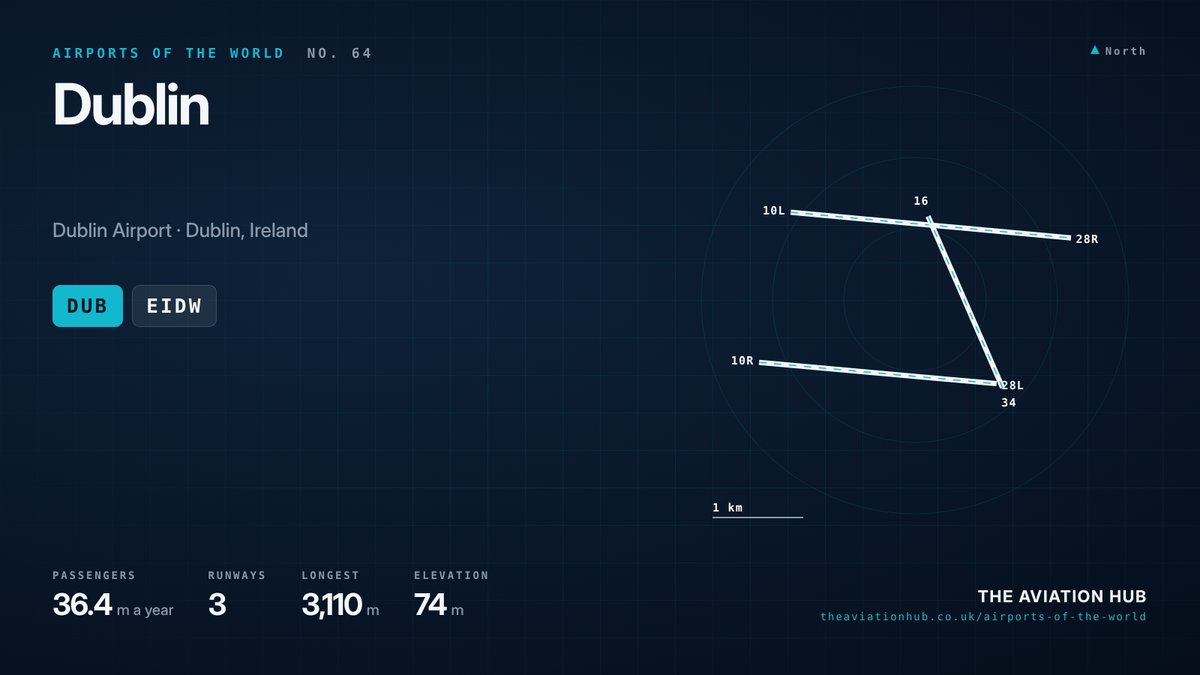
The codes are DUB and EIDW. The field lies at 242 ft (74 m) above sea level on gently rolling farmland between the M1 and M2 motorways. It has three runways, two of them parallel, and two passenger terminals. A new control tower of about 87 m, the tallest inhabited structure in Ireland, opened in 2022.
Dublin Airport handled roughly 36.4 million passengers in 2025, a rise of just over five per cent on the previous year. Aer Lingus, Ryanair and Emerald Airlines, which flies as Aer Lingus Regional, are the based carriers. The state owned DAA owns and operates the airport, and it is also the company that runs Cork and holds management contracts abroad. Live flight information and car park prices are on the airport’s official website.
How Dublin’s Airport Came to Be
The site began as a Royal Flying Corps aerodrome at Collinstown in 1917, during the final years of British rule. The new Irish state later chose it to replace the military field at Baldonnel as the capital’s civil airport. Dublin Airport opened on 19 January 1940 with an Aer Lingus flight to Liverpool, and its curved art deco terminal by Desmond FitzGerald remains a protected building.
Growth was slow until the jet age. Transatlantic services began in 1958, and the first runway long enough for jets followed. Terminal 1 opened in 1972 and Runway 10R/28L in 1989, the latter carrying the airport through the Ryanair boom of the 1990s and 2000s.
Terminal 2 opened in November 2010, just as the Irish economy crashed, and was criticised at the time as too big. It is now full. The North Runway, 10L/28R, opened on 24 August 2022 after decades of planning and legal argument, and it brought with it night flight limits that, alongside the 32 million passenger cap set when Terminal 2 was approved in 2007, dominate the airport’s politics today.
Runways at Dublin Airport
Dublin Airport operates three runways. The North Runway, 10L/28R, is concrete and measures 3,110 m (10,203 ft) by 45 m. The original main runway, 10R/28L, is asphalt and 2,637 m (8,652 ft) long. Both run roughly east to west, and the prevailing southwesterly wind means the 28 pair handles most traffic, with arrivals coming in over Dublin Bay and Portmarnock.
The crosswind runway, 16/34, is asphalt and 2,072 m (6,798 ft) long. It sees occasional use when strong southerly or northerly winds blow and for some departures at quiet times. Approaches to Runway 34 cross the M50 and the suburbs of Santry and Ballymun.
The two parallel runways are 1,690 m apart, far enough for independent operations. Planning conditions attached to the North Runway restrict night movements, while the annual passenger cap comes from the Terminal 2 permission. The DAA has applied to raise the cap to 40 million and a court ruling in 2025 suspended its enforcement while European legal questions are resolved.
Terminals and Airlines
Terminal 1 is the older, larger building. Ryanair dominates it from the pier at its northern end, and most other European carriers use it too, including Lufthansa, KLM, SAS, Air France, Turkish Airlines, Qatar Airways and Etihad. Emerald Airlines flies the Aer Lingus Regional ATR 72 network to Britain and the Irish regions.
Terminal 2 is the Aer Lingus terminal and the transatlantic gateway. It houses the United States preclearance facility, so every American carrier uses it: American, Delta, United and JetBlue. British Airways, Emirates, Iberia Express and Vueling are also in Terminal 2. Aer Lingus runs its long haul fleet of Airbus A330s and A321XLRs from the building, alongside its European Airbus A320 family.
The two terminals at Dublin Airport are a short walk apart and share a single airside zone, so connecting passengers move freely between piers. Lounges include the Aer Lingus lounge in Terminal 2 and the DAA’s own lounges in both buildings.
Routes and Destinations
London Heathrow is the busiest route, with around 1.83 million passengers in 2025 split between Aer Lingus and British Airways. It is one of the densest city pairs in Europe. Amsterdam follows with about 1.33 million and Manchester with 1.15 million. London Gatwick, Stansted, Birmingham, Edinburgh and Glasgow make Britain the dominant market by a wide margin.
Across the Atlantic, Aer Lingus flies to New York JFK, Boston, Chicago, Washington, Los Angeles, San Francisco, Orlando and more, with Toronto also served. The longest route is Los Angeles, around 5,170 miles (8,320 km). Emirates and Etihad cover the Gulf, and a China Eastern service to Shanghai began in July 2026, restoring a direct link to mainland China last offered by Hainan Airlines in 2018 and 2019.
Summer brings a surge of Mediterranean leisure flying by Ryanair, Aer Lingus and TUI. Cargo is modest, but freighters from FedEx, DHL and ASL Airlines use the cargo apron.
Getting to and from Dublin Airport
Dublin Airport has no rail link, which is an embarrassment the city has been trying to fix for 20 years. Dublin Express coaches run through the Port Tunnel to Tara Street and Heuston Station in 25 to 40 minutes. Aircoach serves the city centre, the southern suburbs, Cork and Belfast. Dublin Bus routes 16 and 41 and the Go Ahead Ireland 102 are the cheapest sensible option at a couple of euros, though the 41 to Lower Abbey Street can take an hour.
Taxis queue outside both terminals and cost around €30 to €40 to the city centre, taking 25 to 45 minutes. The M50 and M1 are at the airport’s doorstep, and traffic on the M50 in the evening peak can be heavy. Long stay parking in the Express Red and Holiday Blue car parks is served by shuttle buses, with pre booked rates far cheaper than turning up.
MetroLink, an underground railway from the city centre through Dublin Airport to Swords, won planning permission in 2025. Construction may start in 2027 or 2028 with opening pencilled in for around 2035.
Spotting and Photography
The best known viewing spot is the mound at the end of the old runway near the Toberburr Road, which overlooks the 10R/28L threshold and the taxiways. The Boot Inn and the lanes around St Margaret’s give views of arrivals on 28L and 28R, while the Naul Road passes close to the 10L end. Spotters watching the 28 approaches from the coast at Portmarnock get aircraft over the sea with Howth as a backdrop.
Morning light favours the western ends of the runways and the afternoon suits the eastern approaches. The Radisson Blu and Maldron hotels next to the terminals have some rooms facing the aprons. Traffic is a steady flow of Ryanair Boeing 737-800s and 737 MAX 8-200s, Aer Lingus Airbus A320neos and A330s, and the morning wave of American wide bodies.
Airport police are used to photographers but the roads around the field are narrow and busy. Park properly, stay off the grass verges by the fences and do not use drones anywhere near the airport after the disruption of 2023.
What Comes Next
The DAA has lodged a planning application for a €2 billion infrastructure programme. It includes two new piers, more aprons, an airside tunnel to remote stands, a bigger preclearance hall and a new cargo area, all intended to lift capacity to 40 million passengers. Aer Lingus is growing its A321XLR fleet, which opens thinner North American routes such as Nashville and Indianapolis.
The passenger cap remains the central question. Airlines, the Irish government and the DAA all want it lifted, while local residents and climate campaigners want it enforced. Whatever the outcome, Dublin Airport will stay the hinge between Europe and North America for Irish travel. Place it in context on the Airports of the World map.
Continue to follow The Aviation Hub for more analysis and insight.
Advertise with us Your brand, in front of an aviation audience Home page and in-article placements, sold directly, one advertiser per slot. From £250 a year. See the rates

