
Dubrovnik Airport Guide: Adriatic Summer Surge Explained
Dubrovnik Airport swings from quiet winters to more than 500,000 passengers a month in summer. See its runway, terminals, airlines and transfers.
 By The Aviation Hub
5 min read
Updated October 20, 2026
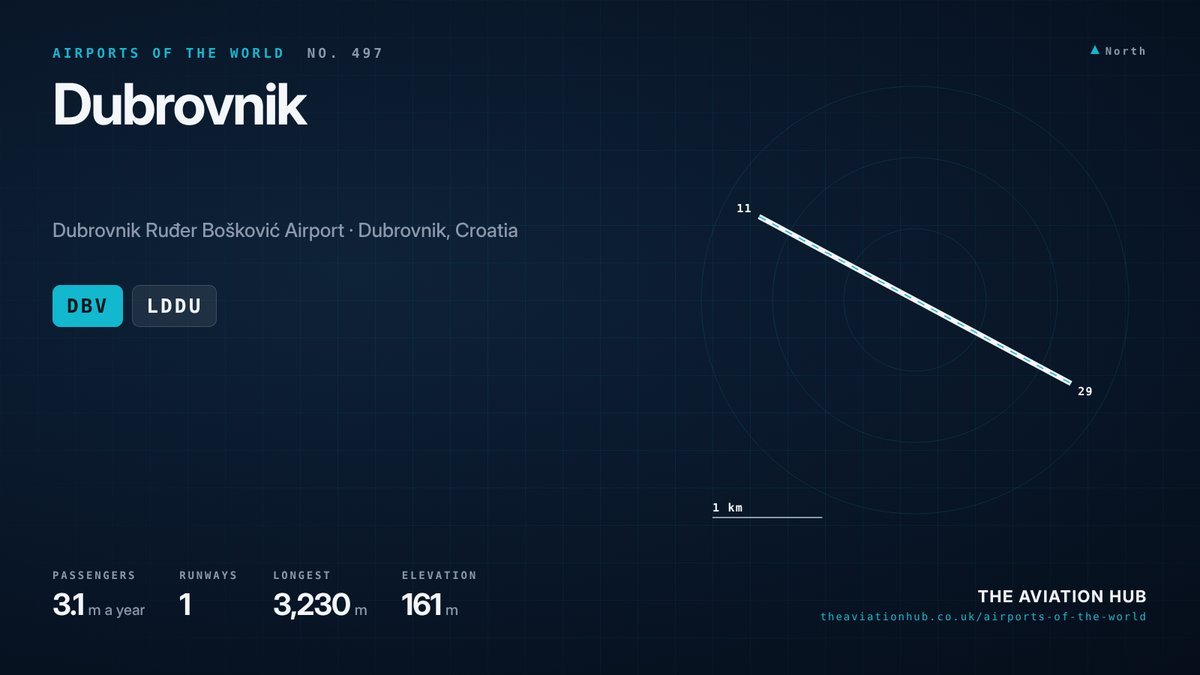
Few European airports feel the seasons as sharply as the one serving Croatia’s walled city on the Adriatic. Dubrovnik Airport, at Cilipi south east of the city, handled around 3.1 million passengers in 2025, but almost all of them came between April and October. In January it sees fewer than 20,000 passengers. By August that figure tops half a million, as British, German and Scandinavian holidaymakers pour in.
Dubrovnik Airport at a Glance
The codes are DBV and LDDU. The airport lies about 10 miles (15.5 km) south east of Dubrovnik’s Old Town, near the village of Cilipi in the Konavle region, at an elevation of 527 ft (161 m). It has one runway and a terminal complex made up of three buildings.
Traffic reached 3,090,245 passengers in 2025, up 4.6 per cent, making it the third busiest airport in Croatia. Croatia Airlines uses Dubrovnik Airport as a hub, and Ryanair has an operating base. Dubrovnik Airport Ltd operates the field, which serves the whole of Dubrovnik Neretva County. Flight information is on the airport’s official website.
How Dubrovnik’s Airport Came to Be
Dubrovnik first took to the air in 1936. The Yugoslav airline Aeroput used a seaplane station in the city for a route to Belgrade via Sarajevo, and land flights began the same year at Gruda, about 5 km south east of today’s site. Gruda operated mainly in summer at first and stayed in use after the Second World War.
The present airport at Cilipi opened in 1962. Traffic peaked in the Yugoslav era in 1987 at almost 1.5 million passengers. The war of 1991 and 1992 then closed the airport as fighting reached the Konavle area during the siege of Dubrovnik, and traffic took years to recover.
Dubrovnik Airport passed one million passengers again in 2005. A new terminal opened in May 2010, part financed by the European Bank for Reconstruction and Development, and Terminal C followed in 2017. In 2023 the airport was renamed after Rudjer Boskovic, the Dubrovnik born astronomer, physicist and polymath of the 18th century.
Runways at Dubrovnik Airport
Runway 11/29 is 3,230 m (10,597 ft) long and 45 m (148 ft) wide, with an asphalt surface. It sits on a plateau above the sea, with the Adriatic to the south and steep limestone mountains to the north.
The length lets Dubrovnik Airport handle heavy wide body aircraft, including transatlantic flights in summer. The terrain demands care. Approaches must avoid high ground, and the bora, a cold, gusty north easterly wind, can make landings rough in winter.
The mountains have a tragic history. In April 1996 a United States Air Force CT-43, a military Boeing 737, crashed into St John’s hill north of the airport during an approach in bad weather. All 35 people on board died, including the United States Commerce Secretary Ron Brown.
Terminals and Airlines
The terminal complex at Dubrovnik Airport has three parts. Terminal A is closed to passengers and now sorts baggage. Terminal B handles arrivals. Terminal C, opened in 2017, is the departure building, with 24,181 sq m of space, eight security lanes and 16 gates, two of them domestic. Total capacity is about 3.5 million passengers a year.
Croatia Airlines links Dubrovnik with Zagreb year round and adds European routes in summer, mostly with Airbus A220 and A320 family jets. Ryanair, easyJet, Jet2 and TUI carry the British and Irish market. Vueling and Wizz Air add low cost capacity from Spain and central Europe.
Network carriers fly in from their hubs. British Airways comes from London, Lufthansa from Germany, KLM from Amsterdam and Austrian from Vienna. Air Serbia now serves Belgrade year round.
Routes and Destinations
The United Kingdom is the biggest single market, with London airports, Manchester, Edinburgh and other regional cities linked through the summer. Germany, Scandinavia, France and Italy are also important markets. Croatia Airlines’ Zagreb route is the main domestic link and the backbone of the winter schedule.
Seasonality is extreme. In 2025, monthly traffic rose from under 20,000 in January to around 540,000 in both July and August, then fell to around 32,000 in December. Cruise ship crews and passengers add to demand in summer.
Transatlantic flying has arrived at Dubrovnik Airport in recent seasons, with United Airlines linking Newark in the summer season. Cargo is minor, at around 300 tonnes in 2025 and far less in most recent years.
Getting to and from Dubrovnik Airport
There is no rail in the region. The Platanus shuttle bus runs from the terminal to the Old Town at Pile Gate and on to the main bus station at Gruz, timed to meet flights. It is the cheapest sensible option, and the journey takes around 30 to 40 minutes.
Taxis wait outside arrivals and charge more for the same trip. The coastal road, the D8, carries all traffic to the city, and it can be slow on summer days. Cavtat, the nearest resort, is only around 10 minutes away.
Rental car desks are in arrivals. A hire car makes sense for trips to Montenegro, whose border is a short drive south, or to the Peljesac peninsula. Parking is available next to the terminal.
Spotting and Photography
Dubrovnik Airport offers a dramatic setting. Aircraft land and take off against a backdrop of mountains and sea, and summer Saturdays bring a parade of airlines from across Europe. Wide bodies on transatlantic flights add interest.
The roads and villages of Konavle around Cilipi give views of the runway from higher ground. Morning light is usually best for the southern side of the field, while late afternoon light flatters aircraft against the mountains.
Stay on public land, respect private farms and vineyards, and keep clear of the fence. Croatian police patrol the perimeter and may ask photographers to move on.
What Comes Next
With terminal capacity of around 3.5 million and traffic above 3 million, Dubrovnik Airport is close to its limits in summer. Traffic in the first seven months of 2026 was up more than 4 per cent. The pressure is to spread demand into spring, autumn and winter.
New year round routes, such as Air Serbia’s Belgrade link, help. Overtourism in the Old Town is also a political issue. The verdict is slower, more balanced growth rather than bigger summer peaks. See the Adriatic on the Airports of the World map.
Continue to follow The Aviation Hub for more analysis and insight.
Advertise with us Your brand, in front of an aviation audience Home page and in-article placements, sold directly, one advertiser per slot. From £250 a year. See the rates

