
Durban Airport Guide: Inside King Shaka International
Durban Airport, officially King Shaka International, opened in 2010 at La Mercy. Explore its long runway, airlines, routes, Dube TradePort and transport.
 By The Aviation Hub
6 min read
Updated October 20, 2026
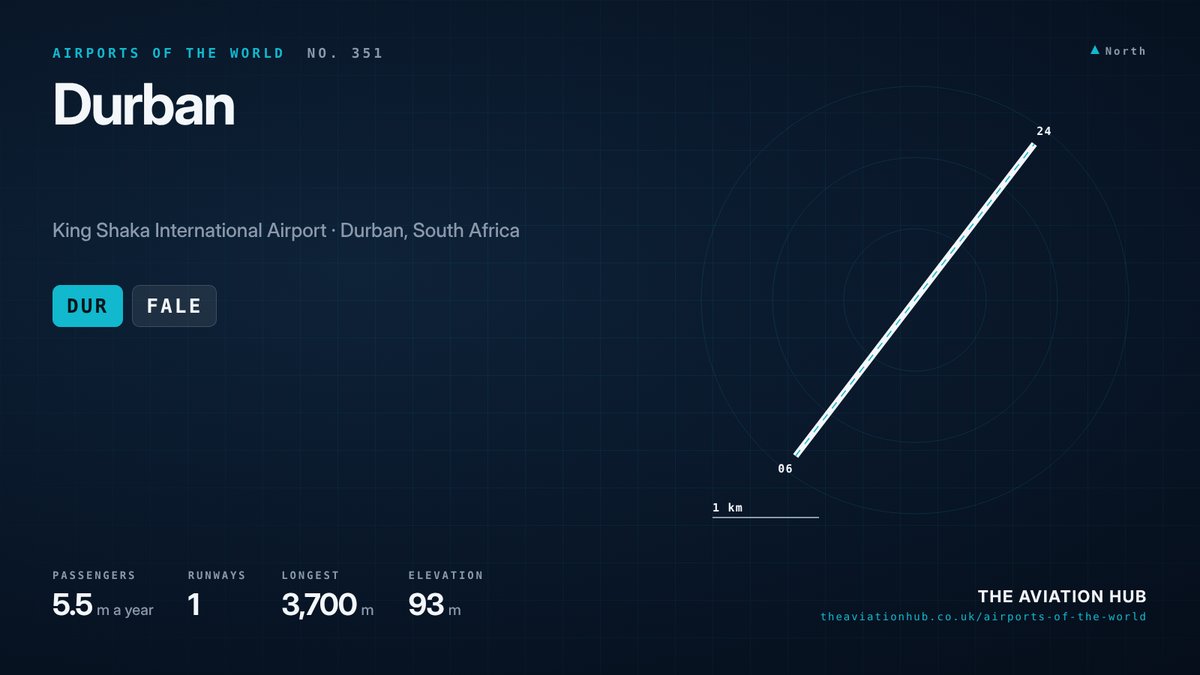
Durban Airport, officially King Shaka International Airport, is the main gateway to KwaZulu Natal and South Africa’s third busiest airport. It opened in 2010 on former sugar cane land at La Mercy, on the coast north of the city, replacing a cramped field in the south. Around 5.6 million passengers passed through in the 2025 to 2026 financial year. Its long runway and modern terminal give the province direct links to the Gulf and Turkey.
Durban Airport at a Glance
The airport uses the IATA code DUR, inherited from its predecessor, and the ICAO code FALE. It lies about 22 miles (35 km) north of Durban city centre at an elevation of 93 m (304 ft). There is one asphalt runway, 06/24, and a single passenger terminal handling both domestic and international flights.
Durban Airport handled 5,616,199 passengers and 45,144 aircraft movements in the 2025 to 2026 financial year. Airlink treats it as a hub and FlySafair as a focus city, with South African Airways, CemAir and LIFT also flying domestic routes. Airports Company South Africa runs the passenger terminal, while the Dube TradePort Corporation is responsible for the cargo terminal. Flight times and parking details are on the airport’s official website.
How Durban’s Airport Came to Be
For decades Durban was served by Durban International Airport on the southern edge of the city. Its runway was too short for large aircraft on intercontinental routes, which left Durban behind Johannesburg and Cape Town in long haul connectivity. A new site at La Mercy had been discussed for years, but disputes and a tender battle held the project back.
Construction finally began on 24 August 2007, after environmental approval. The deadline was fixed by the 2010 FIFA World Cup, and the airport opened to passengers on 1 May 2010, just 41 days before the tournament began. The total cost was about R6.8 billion (roughly US$900 million). The old airport closed and later fell out of use.
The name came out of public hearings that began in November 2009. It honours King Shaka, the founder of the Zulu kingdom, and became official on 2 February 2010.
Runways at Durban Airport
Runway 06/24 is 3,700 m (12,139 ft) long and 60 m wide, with an asphalt surface. That is far longer than the runway at the old airport and allows fully loaded wide bodies to fly nonstop to the Gulf and beyond. The Emirates Boeing 777-300ER is the largest type in regular service, and the field is built to handle the Airbus A380.
The runway is aligned roughly north east to south west, parallel to the coast and the prevailing coastal winds. Its approach paths cross cane fields rather than dense housing. Bird strike risk is a known issue. Millions of barn swallows roost in summer at Mount Moreland, under the Runway 06 approach, and the airport installed a bird detection radar to manage the hazard. The master plan safeguards land for two parallel runways in the distant future.
Terminals and Airlines
Durban Airport has one passenger terminal, with arrivals on the lower floor and departures upstairs. It has 72 check in counters, 16 jet bridges and separate security for domestic and international flights. The international side includes two stands designed for the A380, and annual capacity is about 7.5 million passengers.
Domestic airlines dominate. FlySafair flies Boeing 737s to Johannesburg, Cape Town, Gqeberha and East London, and Airlink flies Embraer jets to several cities and to Harare. South African Airways and LIFT compete on the trunk routes, while CemAir serves smaller markets such as Bloemfontein and George. Emirates, Qatar Airways and Turkish Airlines provide the long haul links, and Eswatini Air connects Manzini. Alliance links are thin: Turkish Airlines and SAA represent Star Alliance, Qatar Airways flies for oneworld, and Emirates sells its own network.
Routes and Destinations
Johannesburg O. R. Tambo is by far the busiest route from Durban Airport, flown many times a day by SAA, FlySafair, Airlink, LIFT and CemAir. FlySafair also serves Johannesburg Lanseria. Cape Town is the second major domestic market, and Gqeberha, East London, George and Bloemfontein are also served.
The international network is small but valuable. Emirates flies daily to Dubai, Qatar Airways links Doha and Turkish Airlines connects Istanbul, giving the province one stop access to Europe, Asia and the Americas. Istanbul, at nearly 5,000 miles (8,000 km), is the longest link on the map. Regional services reach Harare and Manzini. Leisure demand peaks in December and January and around Easter, when inland South Africans head for the coast.
Cargo matters too. The Dube TradePort cargo terminal was designed for 150,000 tonnes a year at first, with long term capacity of about 1 million tonnes.
Getting to and from Durban Airport
There is no rail link. A light rail feasibility study was cancelled in June 2025 after no acceptable tenders were received. Durban Airport is reached by the N2 freeway and the R102, linked by the M65, and some routes pass toll plazas.
The drive to central Durban takes around 30 to 40 minutes outside rush hour. Airport shuttle buses run to the city centre and Umhlanga, and they are the cheapest sensible option for most visitors. Metered taxis and ride hailing apps operate from the forecourt, and fares to Umhlanga are modest because it is only about 15 minutes away. The resort town of Ballito lies a short drive north. There are around 6,500 public parking bays, and car hire is popular for exploring KwaZulu Natal.
Spotting and Photography
Spotting at Durban Airport is harder than it should be. The terminal has no public viewing deck, an omission that drew criticism when the airport opened. Departure lounge windows give views of the apron, but only for ticketed passengers.
Outside, enthusiasts use public roads around the perimeter and the cane fields near the runway ends, depending on which direction is in use. The best catches are the long haul visitors from Emirates, Qatar Airways and Turkish Airlines, so check their arrival times first. Coastal haze can soften long lens shots, so mornings are often clearer. Keep to public roads, do not enter private farmland, and respect security staff, who patrol the boundary.
What Comes Next
Expansion is moving in small steps. Two heavy class remote stands, known as the Foxtrot aprons, were reported under construction in 2018, and Taxiway Bravo is being extended. Longer term, the master plan imagines two parallel runways and terminal capacity of around 45 million passengers a year, though details remain scarce.
The bigger question for Durban Airport is airline appetite. Winning back a nonstop European route, last flown by British Airways to Heathrow until 2020, would transform the airport’s profile, and the province continues to lobby for one. Traffic now sits well within terminal capacity. Expect steady domestic growth and patient work on long haul. Compare it with other African airports on our Airports of the World map.
Continue to follow The Aviation Hub for more analysis and insight.
Advertise with us Your brand, in front of an aviation audience Home page and in-article placements, sold directly, one advertiser per slot. From £250 a year. See the rates

