
Edinburgh Airport Guide: Scotland’s Busiest Gateway
Edinburgh Airport is Scotland's busiest airport, a single runway field at Turnhouse handling 17 million passengers a year. Airlines, access and spotting.
 By The Aviation Hub
7 min read
Updated October 20, 2026
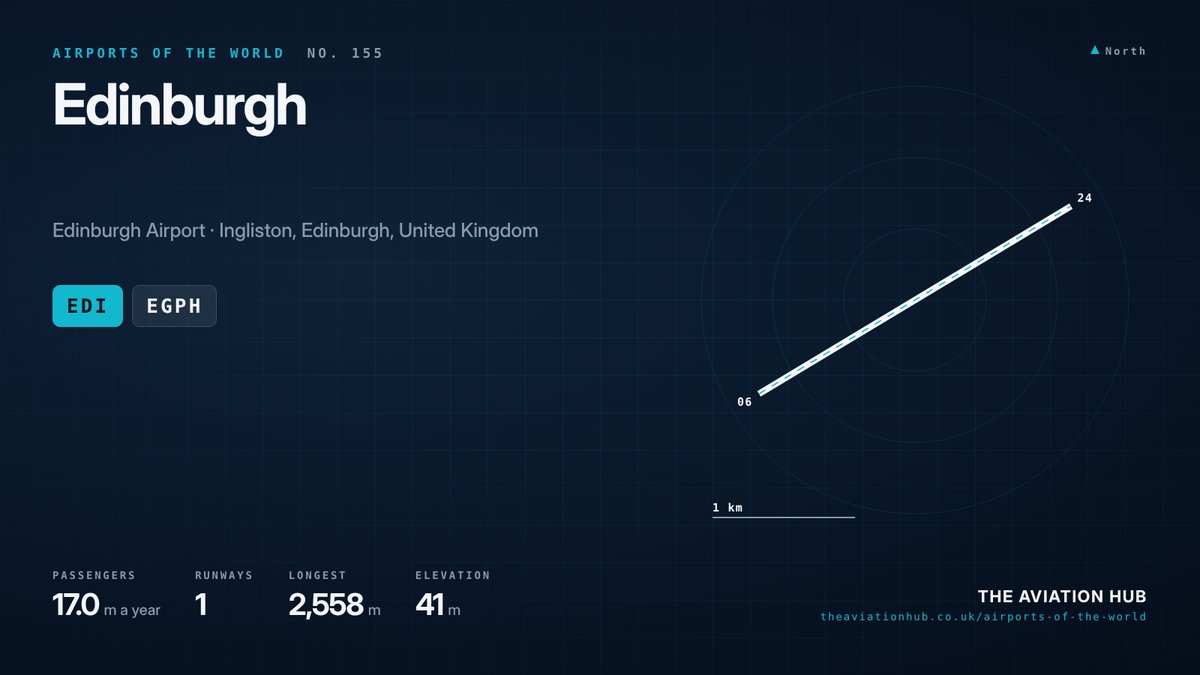
Edinburgh Airport lies at Turnhouse on the western edge of the Scottish capital, about 6 miles (10 km) from Princes Street and a short tram ride from the city centre. It is the busiest airport in Scotland and the sixth busiest in the United Kingdom, with close to 17 million passengers a year using a single runway and a single terminal. The field began as a First World War air defence station, and the RAF stayed until 1997. Today it is owned by the French group Vinci and Global Infrastructure Partners and serves more than 150 destinations.
Edinburgh Airport at a Glance
The IATA code is EDI and the ICAO code is EGPH. The airport sits in the Ingliston area, roughly 6 miles (10 km) west of the city centre beside the A8 and the M8, at an elevation of 41 m (135 ft) on the flat ground south of the Firth of Forth. There is one runway, 06/24, and one terminal building that has been extended in stages, most recently with a new security hall and retail area.
Edinburgh Airport handled a little under 17 million passengers in 2025, up around 7.5 per cent on the year before, with roughly 121,000 aircraft movements. Loganair uses it as a hub, and easyJet, Jet2.com, Ryanair and Ryanair UK all keep bases here. BAA owned the airport from 1971 until 2012, when it sold to Global Infrastructure Partners for £807 million. Vinci bought a controlling 50.01 per cent stake in June 2024 for £1.27 billion. Flight and parking information is on the airport’s official website.
How Turnhouse Became an Airport
Turnhouse Aerodrome opened in 1916 as the most northerly air defence station in Britain, flying patrols against Zeppelin raids. It became RAF Turnhouse in 1918 and played its part in the Second World War, with Spitfires of 603 Squadron flying from here in the early months of the war before the squadron moved south for the Battle of Britain. Commercial flying began on 19 May 1947, when a British European Airways Douglas C-47 with 18 seats called on its way from London Northolt to Shetland.
The British Airports Authority took over in 1971 and built the present terminal, designed by Sir Robert Matthew, which opened in 1977 alongside the new 06/24 runway. Growth was gradual until the 1990s, when the arrival of low cost airlines and the Scottish Parliament’s return to Edinburgh in 1999 turned the airport into a serious rival to Glasgow. It overtook Glasgow in passenger numbers in the mid 2000s and has not looked back.
A planned heavy rail link was cancelled in 2007, which left the long delayed tram as the public transport answer when it finally opened in 2014. The old crosswind runway 12/30 was withdrawn on 29 March 2018 to make way for apron and taxiway expansion. The most serious accident in recent memory was Loganair flight 670A, a Shorts 360 that ditched in the Firth of Forth in February 2001 after slush entered both engines, killing both pilots.
Runways at Edinburgh Airport
Edinburgh Airport has one asphalt runway, 06/24, which is 2,558 m (8,392 ft) long and 45 m wide. The length is ample for the Airbus A320neo, Boeing 737-800 and Embraer E195 aircraft that fill the schedule, and it comfortably handles the Boeing 787-9, Airbus A330-300 and Boeing 767-300ER types used on transatlantic and Middle East routes. Full payload departures by the heaviest wide bodies are rare enough not to be a concern.
Prevailing south westerly winds mean runway 24 is in use most of the time, with aircraft approaching over the Forth and the Cramond shore before crossing the A90. Easterly operations on runway 06 bring arrivals in over Broxburn and Livingston. Since the loss of 12/30 there is no crosswind option, so strong northerlies can cause diversions to Glasgow or Newcastle. The runway has a Category III instrument landing system for the haar that rolls in off the North Sea.
Terminals and Airlines
The single terminal has grown from its 1977 core into a long building with a central check in hall, a 2013 extension reaching the tram stop and a newer security and retail block. The gates are arranged along a pier to the east and a separate domestic and international pier added in 2006. Loganair’s Embraer and ATR fleet uses the remote stands and the smaller gates, while easyJet’s Airbus A320 family and Ryanair’s Boeing 737s fill the main pier.
easyJet is the largest airline at Edinburgh Airport, followed by Ryanair and Jet2.com, which has built a big holiday base here. British Airways runs a heavy Heathrow shuttle, and the oneworld presence continues with Qatar Airways and American Airlines. Star Alliance is represented by Lufthansa, United and Turkish Airlines, and SkyTeam by KLM, Air France and Delta. Aer Lingus, Emirates and Air Canada round out the long haul and feeder picture. The Aspire and Plaza Premium lounges are the main airside options.
Routes and Destinations
London Heathrow was the busiest route in 2025 with around 1.09 million passengers, and London Stansted and Belfast International followed as the next biggest domestic flows at roughly 720,000 and 520,000. Internationally, Dublin led with close to 790,000 passengers, Amsterdam was just behind on around 750,000 and Paris Charles de Gaulle came third at about 500,000. The Dublin and Amsterdam flows reflect the pull of Aer Lingus and KLM connections to North America and Asia.
Long haul has expanded steadily. Qatar Airways flies to Doha, Emirates to Dubai, and United, Delta and American serve Newark, Washington, Chicago, Atlanta, Boston and Philadelphia, mostly in summer. Air Canada operates Toronto and Montreal. The longest route is Delta’s seasonal Atlanta service at around 4,000 miles (6,440 km). Summer brings a wave of Jet2 and easyJet flights to the Mediterranean, while winter adds ski flights and the Edinburgh Christmas market inbound trade. Cargo is light, with no scheduled freighter operation.
Getting to and from Edinburgh Airport
Edinburgh Trams run from a stop beside the terminal to Princes Street in about 35 minutes and on to Leith and Newhaven, with fares of around £7.50 single. The tram also stops at Edinburgh Gateway, a railway station that connects to ScotRail trains towards Fife, Dundee and Aberdeen, and at Edinburgh Park for services west towards Glasgow. There is no railway station at the airport itself after the 2007 cancellation of the rail link.
The Airlink 100 bus from Lothian Buses runs around the clock to Waverley Bridge in about 30 minutes for around £5.50, the cheapest sensible option, and Lothian’s Skylink routes serve the suburbs. Ember’s electric coaches run to Dundee, and Scottish Citylink and Stagecoach cover Glasgow, Fife and Perth. Drivers arrive from the A8, M8, M9 or the M90 via the Queensferry Crossing, and a taxi to the city centre costs roughly £25 to £30. The drop off zone charges a fee, and the long stay car park with a shuttle is the sensible option for a week away.
Spotting and Photography
The best known vantage point at Edinburgh Airport is the public footpath and layby on the Ingliston side, beside the Royal Highland Showground. The old Turnhouse Road on the northern side, past the Royal Air Force gate, gives views of the apron and taxiing aircraft. Cramond foreshore to the north east is ideal for aircraft on final approach to runway 24, descending over the Forth with the Fife hills behind them.
Morning light suits the Cramond side for arrivals and the southern Ingliston positions work best in the afternoon. Runway 06 days send departures out over Cramond, where a long lens from the beach catches climb outs against the Forth bridges. The traffic is largely narrow body, but the Qatar Airways A350, Emirates Boeing 777 and the North American 767s and 787s give daily wide body interest. Stay on public paths, do not block the showground access and respect the Ministry of Defence signs at the old RAF site.
What Comes Next
Vinci’s arrival in 2024 brought a new master plan built around growing the terminal rather than adding a runway. The airport is enlarging its eastern pier and apron, with the old 12/30 land now providing room for stands, and is investing in a bigger security hall. Capacity on the single runway is adequate for well over 20 million passengers a year, so the limits are terminal space, road access and Edinburgh’s tight planning environment. The council and the airport continue to argue over night flights and noise.
Edinburgh Airport is heading for 20 million passengers on one runway, with French ownership and a transatlantic push shaping the next decade. Compare it with Glasgow and the other British gateways on our Airports of the World map.
Continue to follow The Aviation Hub for more analysis and insight.
Advertise with us Your brand, in front of an aviation audience Home page and in-article placements, sold directly, one advertiser per slot. From £250 a year. See the rates

