
Eindhoven Airport sits on the western edge of the Netherlands’ fifth largest city, in the province of North Brabant. It is the country’s second busiest airport by passengers, a long way behind Schiphol but well ahead of Rotterdam. Just under seven million passengers used it in 2025, nearly all of them on Ryanair, Wizz Air and Transavia. It is also a working Royal Netherlands Air Force base, which shapes everything from the runway length to the movement cap that politicians argue over.
Eindhoven Airport at a Glance
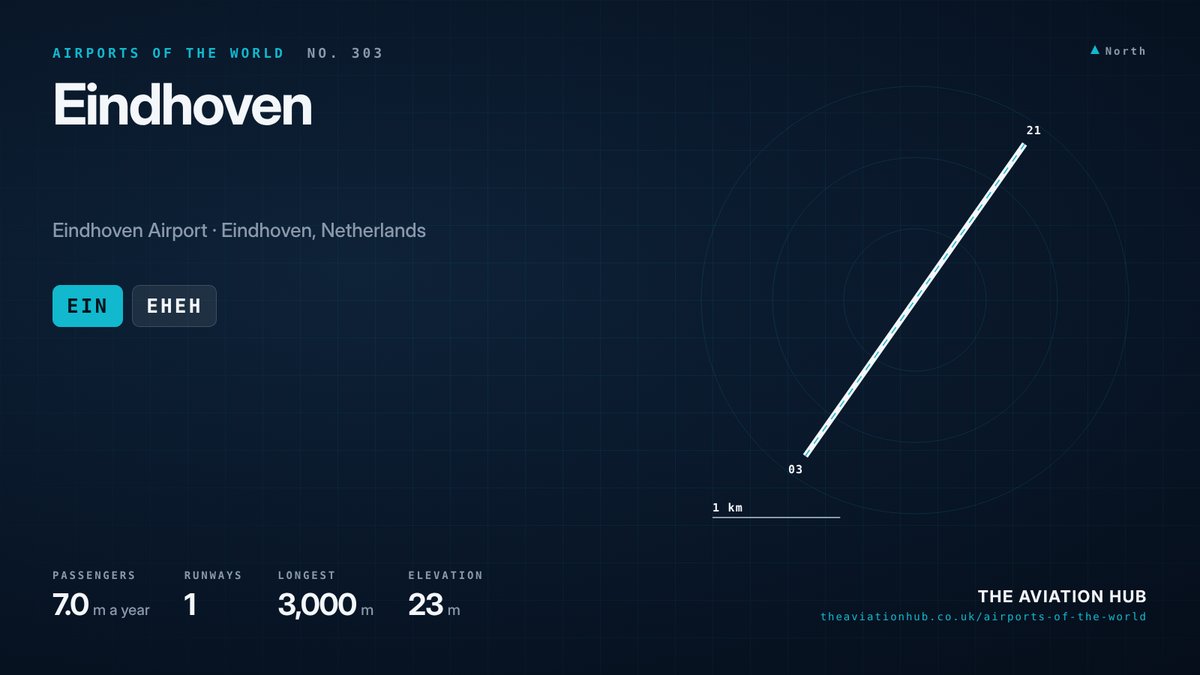
The IATA code is EIN and the ICAO code is EHEH. The terminal lies about 5 miles (8 km) west of Eindhoven city centre, beside the A2 motorway. Elevation is 74 feet (23 m). There is one runway and one passenger terminal, which the operator is extending. The Royal Netherlands Air Force shares the field with its transport and tanker aircraft.
Eindhoven Airport N.V. runs the civil operation. Schiphol Group owns 51 per cent, with the Province of North Brabant and the City of Eindhoven holding 24.5 per cent each. The airport handled about 6.96 million passengers in 2025 and roughly 6.8 million in 2023, with annual civil movements capped at around 41,500. Transavia and TUI fly Netherlands treat it as a focus city, and Wizz Air links it with 16 cities. Flight information and parking bookings are available through the airport’s official website.
A Short History of Welschap
The airfield opened in 1932 as Vliegveld Welschap, a grass strip serving the Philips company town that Eindhoven had become. German forces seized it in 1940 and laid hard runways, which made it a target for Allied bombers and, after liberation, a base for Allied aircraft. The Royal Netherlands Air Force took over in 1952, and for three decades the civil side amounted to little more than a few charter flights.
A civilian terminal arrived in 1984. The real transformation came in the 2000s, when Ryanair discovered that a cheap airport in the south of the country could draw passengers from the whole southern Netherlands and Belgian Limburg. Wizz Air followed with routes to Poland, Romania and Hungary. Passenger numbers passed one million in 2006 and five million by 2017.
An expansion that began in 2012 added a Tulip Inn hotel, and a Holiday Inn opened on site in 2019. The air force meanwhile turned Eindhoven into its main transport hub, home to Lockheed C-130H Hercules, Airbus A330 MRTT tankers and the multinational European Air Transport Command. The one dark day was 15 July 1996, when a Belgian Air Force C-130H crashed on landing and 34 people died.
Runways at Eindhoven Airport
Eindhoven Airport has a single asphalt runway, 03/21, measuring 3,000 m (9,843 ft) and 45 m wide. It was built to military standards and is far longer than the Boeing 737-800s and Airbus A320s that make up most of the civil traffic need. Runway 21 is the preferred direction in the prevailing southwesterly winds, with arrivals from the northeast over Best and the A2.
The runway is shared with the air force, so civil pilots regularly queue behind a C-130 or an Airbus A330 MRTT. The military side also hosts visiting NATO transports and the occasional Boeing C-17 Globemaster III. Civil night flights are heavily restricted and the airport closes to commercial traffic overnight from 23:00 with limited exceptions, which pushes the low cost carriers into tight early morning and late evening waves.
Terminals and Airlines
There is one passenger terminal, a long low building that was already tight at five million passengers and is now being extended from about 27,300 square metres to 35,000. Check in, security and a single central departure lounge sit on one level, with bus gates and a handful of contact stands serving the apron. The 2025 works add gate capacity, a bigger security hall and more baggage space.
Ryanair is the largest carrier at Eindhoven Airport, operating Boeing 737-800s and 737 MAX 8-200s on dozens of routes even after closing its crew base in November 2018. Wizz Air bases Airbus A321neos here for its Central and Eastern European network. Transavia, the KLM group’s low cost arm, flies 737s and A321neos to Mediterranean leisure spots. TUI fly Netherlands runs holiday charters with 737 MAX aircraft, and Pegasus, SunExpress and TUI fly Belgium fill in Turkey and Morocco. Lounge options are limited to a small pay in facility; this is a no frills airport by design.
Routes and Destinations
The busiest route in 2024 was Malaga with about 360,000 passengers, followed closely by London Stansted and Alicante at around 340,000 each. Faro, Budapest and Valencia complete the top six. The pattern is clear: sun destinations in Spain and Portugal for Dutch and Belgian holidaymakers, plus a large flow of labour migration traffic between Brabant and Poland, Romania and Hungary.
Ryanair’s network stretches from Manchester and Vilnius to Marrakesh and Fez, while Wizz Air serves cities such as Cluj, Katowice, Skopje and Tirana. The longest route is the seasonal TUI fly service to Sal in Cape Verde, about 2,860 miles (4,600 km) away, with Egypt and the Canary Islands next. There are no long haul flights and no plans for any, since the movement cap and the night curfew make wide body scheduling impractical.
Seasonality is strong. Summer Saturdays are the peak, with the apron turning over every stand several times a day. Winter sees ski flights to Innsbruck and Salzburg replace some of the beach capacity. Cargo is negligible on the civil side, though the military ramp is permanently busy with freight for Dutch and NATO deployments.
Getting to and from Eindhoven Airport
The bus is the sensible choice. Bravo line 400 runs as a dedicated shuttle between the terminal and Eindhoven Centraal railway station in about 20 minutes, and line 401 does the same journey as a bus rapid transit route through the city centre. A single fare costs a few euros with a contactless card. From Centraal, intercity trains reach Utrecht in 50 minutes and Amsterdam in about 80. Line 20 serves Best, Veldhoven and the High Tech Campus.
Coaches extend the catchment. A KLM branded bus links Eindhoven Airport with Amsterdam Schiphol for connecting passengers, and FlixBus runs to Antwerp, Brussels, Paris and Amsterdam from the forecourt. By road the airport is minutes from the A2 and A58 motorways, and Antwerp is about 60 miles (97 km) away. Parking is spread across P1 next to the terminal and cheaper long stay fields a shuttle ride away. Taxis to the city centre cost roughly €30 to €35.
Spotting and Photography
Eindhoven is one of the easier Dutch airports for enthusiasts, because civil and military aircraft share one runway. The best known spot is the car park on Spottersweg, near the threshold of runway 21, which looks across the whole airport and sits under the arrivals path. Roadside spots on Scherpenering, on the south side, cover the approach to runway 03 for the days when the wind turns easterly.
Light favours the eastern side in the morning and the western side in the afternoon. The civil traffic is repetitive, so the draw is the air force. Airbus A330 MRTTs, C-130s and visiting NATO heavies appear most weekdays, and exercises bring fighters. Military police watch the fences closely. Photograph from the designated areas, do not point lenses at the base’s hangars, and leave if asked. The Dutch are relaxed about spotting, but not about security on an active base.
Expansion Plans
The future of Eindhoven Airport is a political argument about noise. The government froze civil movements at about 41,500 a year, and the airport’s own strategy accepts that growth must come from fuller and quieter aircraft rather than more flights. The current terminal extension is about comfort and resilience, not raw capacity. A new permit framework due later this decade is expected to tie any further growth to measurable noise reductions.
That makes Eindhoven unusual among European low cost airports. It has a long runway, a motorway on its doorstep and airlines queueing for slots, yet it is choosing to stay around seven million passengers. Expect newer A321neos and 737 MAX jets, a nicer terminal and roughly the same number of departures. See how it compares with Rotterdam and Schiphol on our Airports of the World map.
Continue to follow The Aviation Hub for more analysis and insight.
Advertise with us Your brand, in front of an aviation audience Home page and in-article placements, sold directly, one advertiser per slot. From £250 a year. See the rates

