Emirates Does Really Cool Thing for Arsenal With Aircraft Parts
 By The Aviation Hub
4 min read
By The Aviation Hub
4 min read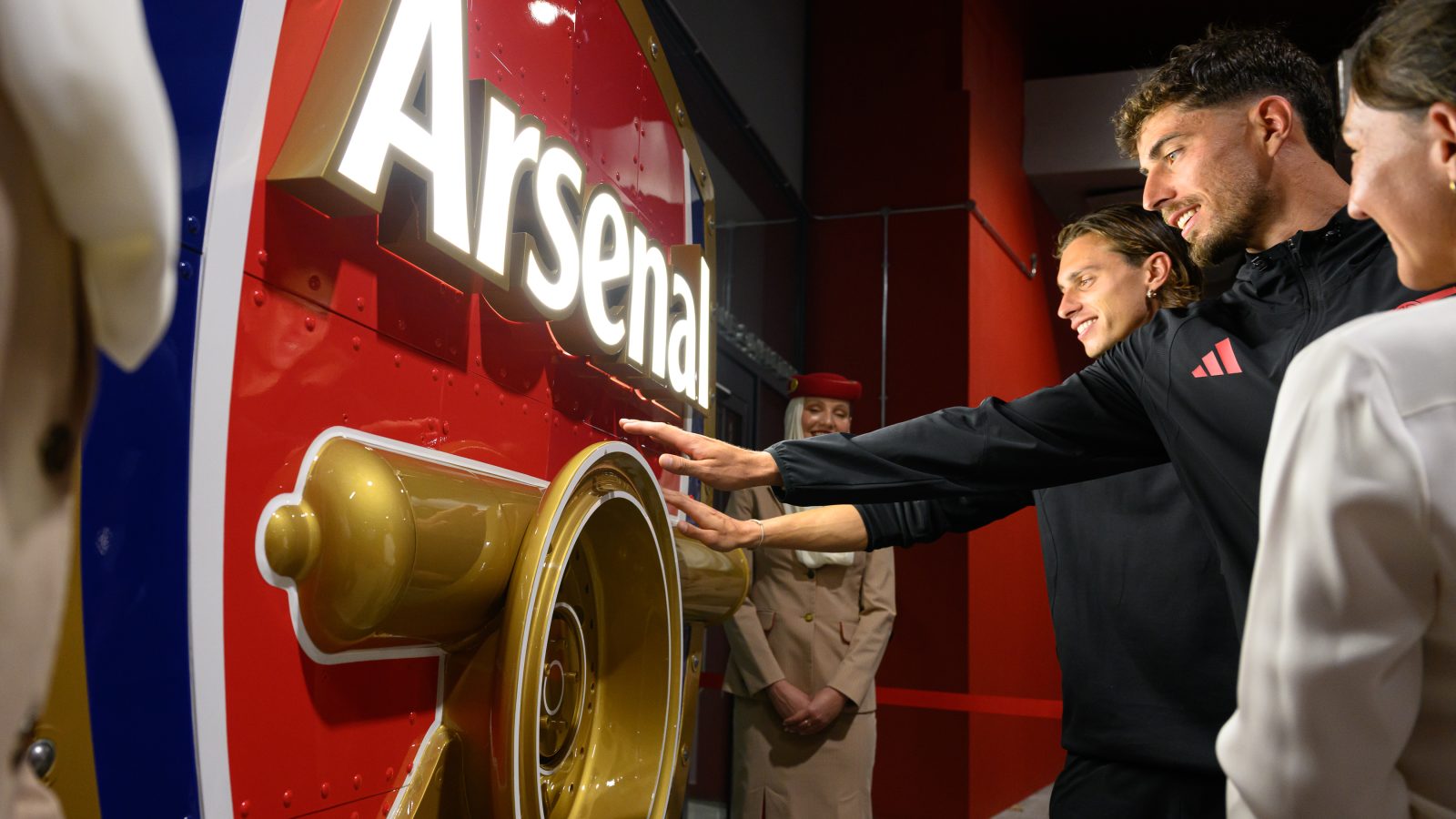
Emirates and Arsenal have unveiled a 2.4 metre illuminated sculpture of the club crest, built almost entirely from components stripped out of the airline’s Airbus A380 and Boeing 777 aircraft.
The installation was revealed at Emirates Stadium on 9 August 2026, ahead of Arsenal’s Emirates Cup fixture against Borussia Dortmund.
Sir Tim Clark, President of Emirates Airline, and Arsenal Chief Executive Richard Garlick carried out the unveiling.
The piece marks 20 years of the partnership between airline and club, and the extension of that agreement through to 2033.
Thirty four days inside Emirates Engineering
The Aircrafted Arsenal Crest was designed and built at Emirates Engineering in Dubai. A team of 15 engineers, designers, mechanics, technicians and painters completed the work in 34 days.
Responsibility sat with the facility’s Aircraft Material Upcycling team.
Components were selected for their strength, shape and potential to be transformed, then cleaned, cut, curved, machined, riveted and assembled.
Emirates says the rivets fastening the panels were installed to the same exacting standards demanded for flight.
The finished crest was painted to Arsenal’s official colour specification, fitted with its lighting system, and flown from Dubai to London aboard an Emirates SkyCargo freighter.
The Arsenal cannon rides on A380 landing gear
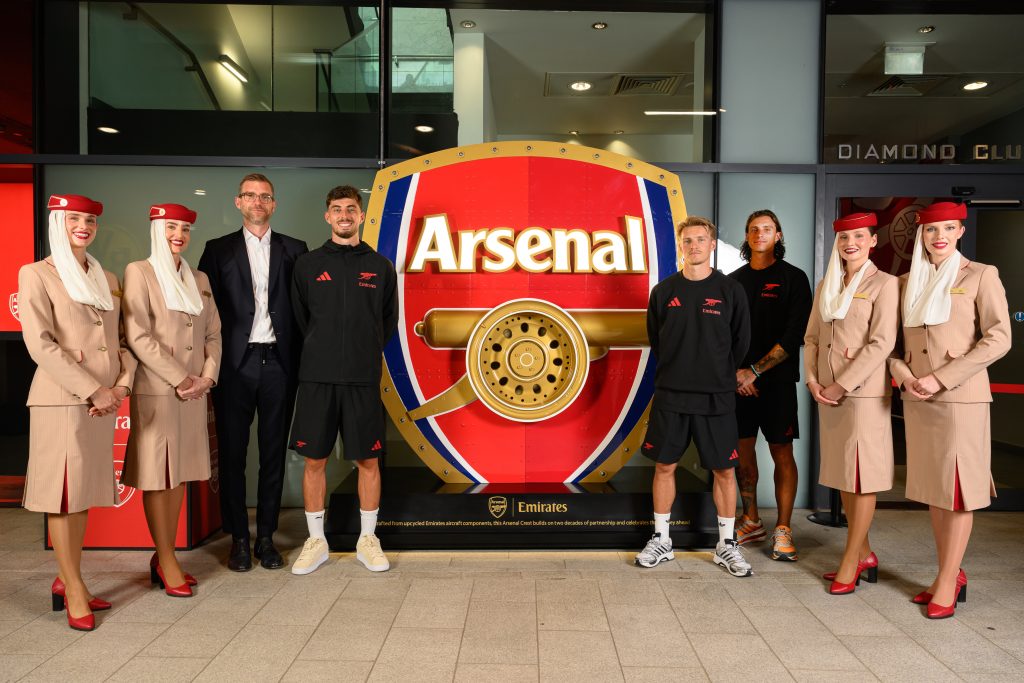
The most technically interesting element sits at the centre of the shield. Arsenal’s cannon has been rebuilt almost entirely from A380 hardware.
Two main landing gear wheel hubs form the cannon wheel.
Both were refurbished after thousands of landings, then joined using a manufactured studded shaft and an original hub bearing.
The barrel began life as a titanium bleed air duct, a component built to withstand the high temperature air drawn from the engines. Engineers cut it, reprofiled it and finished it with a milled cap.
The body and handles were built up from lightweight composite cabin floor panels, the same surfaces passengers walked on at 40,000 feet.
Fuselage skin, cargo tracks and cabin windows
The face of the shield uses sheets of aluminium fuselage skin taken from a Boeing 777.
Cargo tracks from an A380 freight deck were adapted to form the outer edge and the internal frame, which meant taking parts engineered to stay perfectly straight and persuading them into a curve.
Cargo rollers, which once moved thousands of tonnes of freight, now sit as the studs around the perimeter.
The Arsenal lettering was individually shaped from acrylic cabin window panels and backlit in warm white.
Further lighting beneath the plinth washes the sculpture and its specially built black tile base.
Upcycling as an engineering discipline
Emirates has turned retired cabin materials into consumer products before, most visibly through its Aircrafted range of bags and accessories made from A380 interiors.
This project pushes the same idea into structural territory, using landing gear, ducting and fuselage panels rather than leather and fabric.
That distinction matters. Cabin trim is relatively easy to repurpose. Forged wheel hubs and titanium ducting are not.
Reworking them demands machining capability, material knowledge and the process discipline of a maintenance organisation, which is exactly what a facility of Emirates Engineering’s size already holds.
The result is an unusual piece of brand engineering.
It also quietly points to a wider question, as the A380 fleet ages and heavy components begin coming off the line in volume.
Twenty years and an agreement running to 2033 with Arsenal…
Emirates first appeared on Arsenal shirts in 2006, the year the club moved into the stadium carrying the airline’s name.
The relationship now runs to 2033 and covers shirt sponsorship, training kit and stadium naming rights, making it the longest arrangement of its kind in the Premier League.
The timing helps. The unveiling follows Arsenal’s Premier League winning season, and the club enters the new campaign as reigning champions.
“Emirates and Arsenal have shared an extraordinary journey over the past 20 years,” Clark said.
He described the sculpture as both a celebration of what the two organisations have achieved and a statement of shared ambition.
Garlick called the crest a powerful reflection of the relationship, adding that the club enters the next chapter with confidence and ambition.
Arsenal: A symbol with industrial roots
Arsenal’s cannon has featured in every version of the club emblem since 1905 and gave the Gunners their nickname.
Building its wheel around an A380 landing gear hub is a neat piece of symbolism, connecting the club’s industrial origins in Woolwich to the engineering base of its longest standing commercial partner.
Following the unveiling, The Aircrafted Arsenal Crest will remain on permanent display in the Emirates hospitality space at Emirates Stadium.
Continue to follow The Aviation Hub for more analysis and insight!
Advertise with us Your brand, in front of an aviation audience Home page and in-article placements, sold directly, one advertiser per slot. From £250 a year. See the rates