Emirates profit fell sharply in the first half of its financial year as regional conflict cut passenger numbers and jet fuel prices roughly doubled. Yet the airline still made money. Here is what the results show and what comes next.
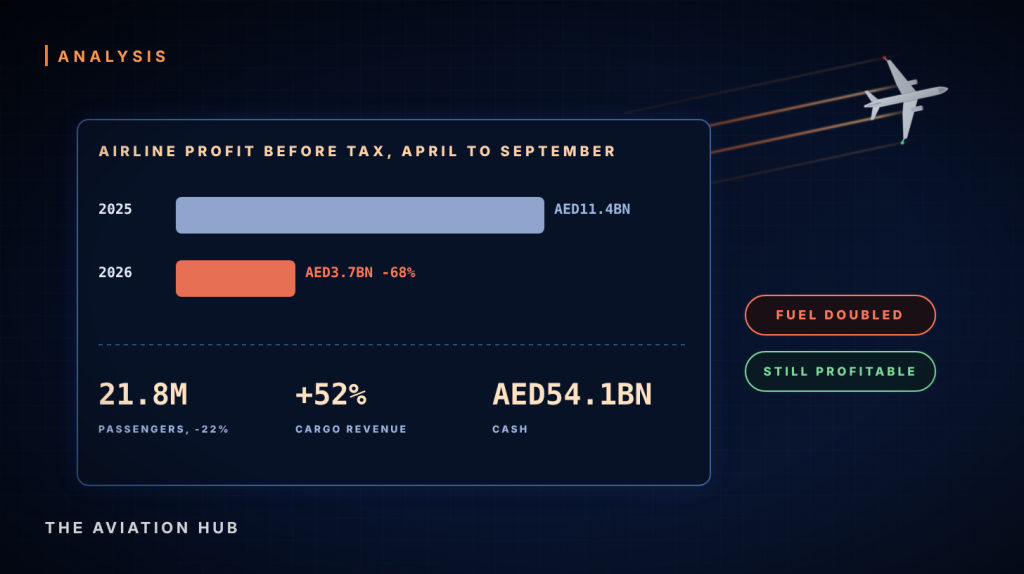
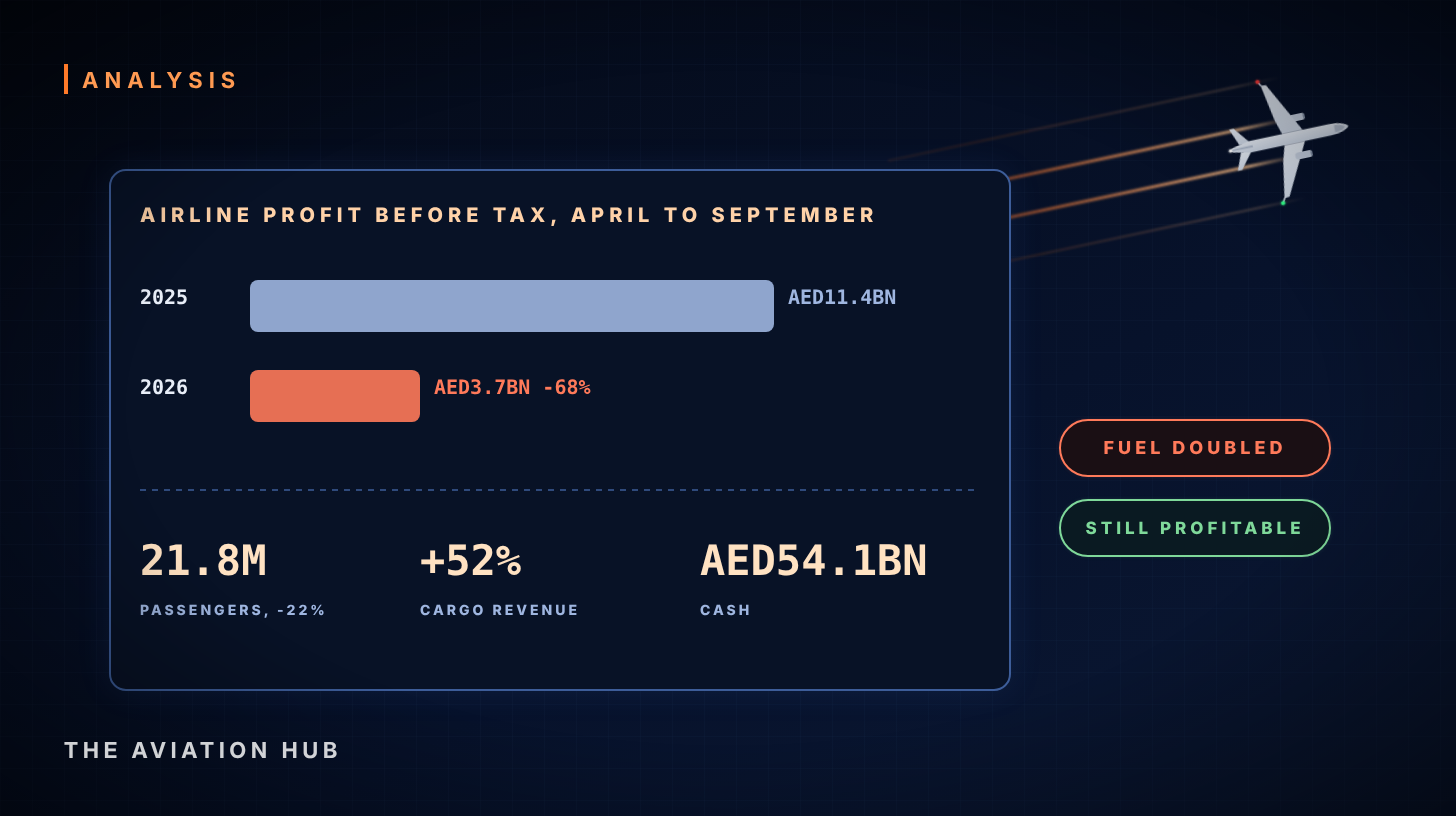
Emirates profit fell 68% in the six months to 30 September, as the airline absorbed the full impact of conflict in the region and soaring fuel costs. The airline made a profit before tax of AED3.7 billion (US$1.0 billion), down from AED11.4 billion a year earlier, the Emirates Group said.
Across the wider group, which includes ground handler dnata, profit before tax fell 66% to AED4.1 billion. Revenue dropped 12% to AED66.2 billion.
Where Emirates Profit Went
Passenger numbers took the biggest hit. Emirates carried 21.8 million passengers, down 22%, and its seat factor slipped to 72.0% from 79.5% a year earlier.
Capacity also shrank. Available seat kilometres fell 17%. Emirates was running 91% of its network from before the disruption, serving 150 airports in 78 countries.
The same trend shows up in UK data. Passenger numbers between UK airports and Dubai fell 22% between July and September, Yahoo News reports. The Civil Aviation Authority linked the drop to the Middle East conflict.
How Fuel Hit Emirates Profit
Fuel was the second blow. Jet fuel prices roughly doubled year on year, the group said, and fuel now accounts for 34% of the airline’s operating costs.
Before hedging, Emirates’ fuel bill rose 60% compared with the previous half year. Hedging gains of AED7.1 billion cut that increase to 13%, which explains much of why Emirates profit held up at all.
Cargo Came to the Rescue
Emirates SkyCargo was the bright spot. Cargo revenue rose 52%, even though tonnage slipped 1% to 1.2 million tonnes.
That shows how much freight rates rose while capacity in the region was squeezed. Chairman and chief executive Sheikh Ahmed bin Saeed Al Maktoum said cargo made a strong contribution. He added that customer demand stayed steady through a demanding period.
A Strong Balance Sheet
The group still holds AED54.1 billion in cash, down from AED59.6 billion at the end of March. That cushion lets Emirates keep investing while profits are under pressure.
Indeed, it took nine new Airbus A350s in the half and refurbished nine A380s and three Boeing 777s. It also fitted Starlink wifi to 36 more aircraft. Its retrofit programme is worth more than US$7 billion.
The Boeing 777X Problem
The next big question is new aircraft. Emirates will only get three to five Boeing 777-9s towards the end of 2027, Paddle Your Own Kanoo reports. It has 270 777X jets on order.
Those delays matter for growth. When demand returns, Emirates will need extra capacity, and its newest widebodies are still years behind schedule.
The Outlook for Emirates Profit
The group said it enters the second half with “measured optimism”. It will keep a close watch on costs and on events in the region.
For passengers, the picture is mixed. Fewer travellers mean more empty seats, but high fuel costs make deep fare cuts unlikely.
The Bottom Line
Emirates profit fell 68% to AED3.7 billion, as the airline carried 22% fewer passengers and paid far more for fuel. Even so, strong cargo revenue, fuel hedging gains and a large cash pile kept it firmly profitable.
The second half will depend on how quickly travel to the Gulf recovers. Emirates has the balance sheet to wait, but its growth plans still hinge on the delayed 777X.
Continue to follow The Aviation Hub for more analysis and insight.
Advertise with us Your brand, in front of an aviation audience Home page and in-article placements, sold directly, one advertiser per slot. From £250 a year. See the rates