
Faro Airport Guide: The Algarve’s Busy Holiday Gateway
Faro Airport is the gateway to the Algarve, with one runway beside the Ria Formosa lagoon. Explore its history, airlines, routes, transport and spotting.
 By The Aviation Hub
6 min read
Updated October 20, 2026
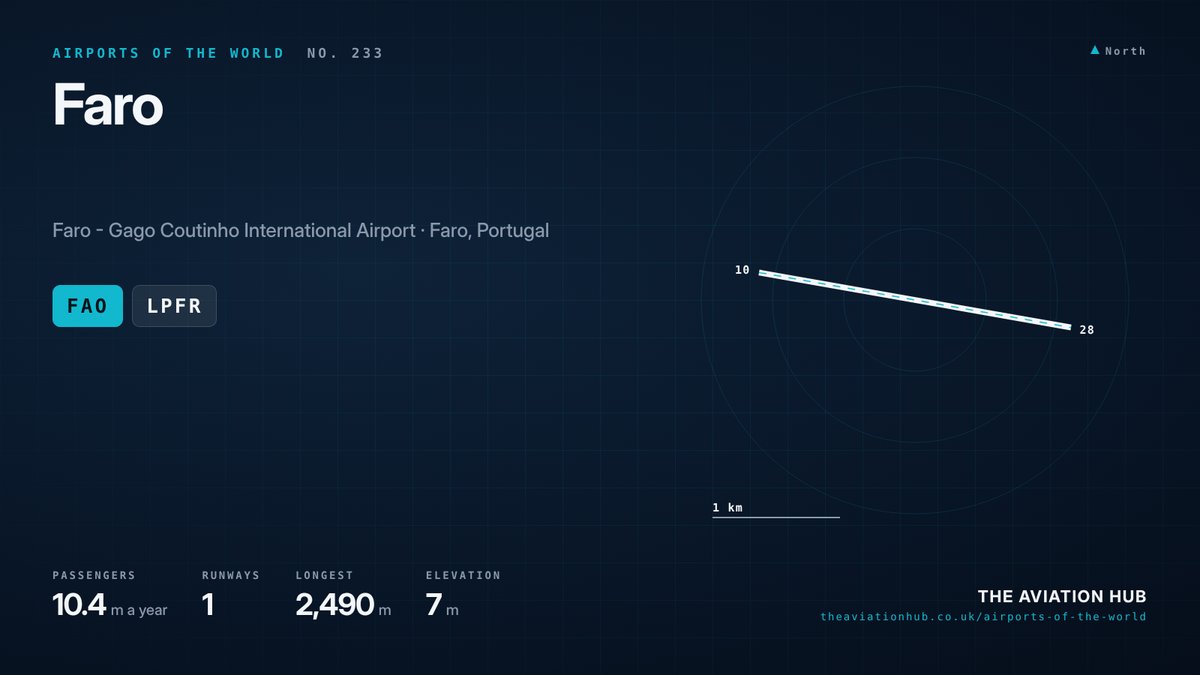
Faro’s airport sits on the edge of the Ria Formosa lagoon, a few miles west of the city centre on Portugal’s southern coast. For millions of British, Irish and northern European holidaymakers it is simply the way into the Algarve. Faro Airport handled about 10.4 million passengers in 2025, more than its terminal was designed for. The traffic is overwhelmingly leisure, and the summer schedule looks more like a roll call of UK regional airports than a Portuguese timetable.
Faro Airport at a Glance
The IATA code is FAO and the ICAO code is LPFR. The field lies about 2.5 miles (4 km) west of central Faro, just 24 feet (7 m) above sea level. It has a single runway and a single passenger terminal with around 60 check in desks and 36 boarding gates. In 2025 it handled roughly 10.4 million passengers, and the first four months of 2026 brought more than 2.3 million.
Ryanair keeps a base at Faro Airport, while easyJet, Jet2, TUI and British Airways fly in heavy volumes from the UK. The Portuguese state owns the airport, and ANA Aeroportos de Portugal, part of Vinci Airports since 2013, operates it under concession. Flight information, parking and bus details are on the airport’s official website.
How Faro’s Airport Came to Be
Before the 1960s the Algarve was a quiet region of fishing towns and almond groves, a long road or rail journey from Lisbon. The government saw tourism as a way to develop the south and built a jet capable airport on flat land beside the lagoon. Faro Airport opened in July 1965, and the package holiday boom that followed transformed the coast from Lagos to Monte Gordo.
Growth brought tragedy as well as prosperity. On 21 December 1992 Martinair Flight 495, a McDonnell Douglas DC-10, crash landed in heavy rain and wind shear. Of the 340 people on board, 56 died.
The modern terminal took shape in two phases. Between 2010 and 2011 the airport added stands, taxiways and a new instrument landing system. A renovation from 2011 to 2013 rebuilt the terminal and lifted capacity from six to eight million passengers a year. In 2022 the airport was renamed Faro Gago Coutinho International Airport, honouring the navigator of Algarve origin who flew across the South Atlantic with Sacadura Cabral a century earlier.
Runways at Faro Airport
There is one runway, 10/28, with an asphalt surface 2,490 metres (8,169 feet) long and 45 metres wide. That length suits the Airbus A320 family and Boeing 737 jets that make up almost all of the traffic. It also handles the occasional wide body, including seasonal charters and transatlantic flights, though heavy aircraft need care on hot summer days.
The prevailing westerly and north westerly winds mean runway 28 is in use most of the time. Arrivals on 28 approach from the east, passing low over the lagoon and the edge of the city. Departures climb out over the beach at Praia de Faro and turn over the Atlantic. With no parallel runway and a single taxiway system, summer Saturdays stretch the airfield close to its limit.
Terminals and Airlines
All passenger flights use the one terminal, which divides into Schengen and non Schengen areas. Since Brexit, UK flights use the non Schengen gates and passport control, which explains the long queues on peak summer days. Flights to Ireland use the same side, because Ireland also sits outside the Schengen area.
Ryanair is the largest airline at Faro Airport and links it with dozens of cities across the UK, Ireland and Europe. easyJet, Jet2 and TUI carry huge numbers of British holidaymakers, while British Airways flies from London. TAP Air Portugal connects Lisbon and Funchal. Transavia, Eurowings, Lufthansa, KLM, Aer Lingus and Edelweiss serve their home markets, and seasonal flights reach Scandinavia and central Europe.
Routes and Destinations
The United Kingdom is the dominant market by a wide margin. London Gatwick, Stansted and Luton, together with Manchester, Bristol, Birmingham and Edinburgh, supply a steady stream of flights. Dublin and the other Irish airports follow, then Germany, the Netherlands and France.
The pattern is strongly seasonal. Summer weekends bring a wall of departures and arrivals, while the winter schedule shrinks but never disappears. Golfers, retirees and long stay winter visitors keep the airport busy outside the peak, and the Algarve’s courses make Faro Airport a major gateway for golf holidays. Seasonal flights to Toronto, serving Canada’s large Portuguese community, stretch the network to roughly 3,700 miles (5,900 km). Cargo is minor.
Getting to and from Faro Airport
There is no rail link. Faro railway station lies about 3.5 miles (5.7 km) away, with trains to Lisbon in around three hours and local services along the Algarve coast. Buses 14 and 16 run daily from the terminal to Faro’s central bus station in about 20 minutes, and they are the cheapest sensible option at a couple of euros.
Most holidaymakers take a pre booked transfer. Albufeira and Vilamoura are typically 30 to 45 minutes away, and Lagos about an hour. Taxis wait outside arrivals, with fares into Faro of around 15 euros. The A22 motorway gives fast access east to Spain and west along the coast, but it uses electronic tolls, so hire car drivers should arrange a transponder. Seville is around two hours by road from Faro Airport.
Spotting and Photography
Spotting at Faro Airport is popular and easy. The road to Praia de Faro passes close to the western end of the runway, so departures from 28 climb out almost overhead. The beach itself gives classic shots of jets over the sand and surf.
Light can be tricky, as the sun sits to the south for most of the day. Spots on the southern side, towards Praia de Faro, keep the sun behind you, while the northern side around Montenegro faces into the light. Summer Saturdays and Sundays bring the heaviest traffic, with Ryanair, easyJet, Jet2 and TUI dominating and occasional wide bodies adding interest.
Behave sensibly. Stay on public land, never climb fences, keep clear of the lagoon’s protected wildlife areas and move on if police or airport staff ask.
What Comes Next
The terminal was rated for about nine million passengers a year in 2019, and traffic has already passed ten million. Further terminal and apron work is therefore the priority, as is easing the border queues for UK passengers. A solar plant of around 3 MWp, announced in 2022, is expected to supply roughly 30 per cent of the airport’s electricity.
The single runway and the protected lagoon limit how far the field can grow. Faro Airport is heading for steady growth driven by British and Irish demand, but it needs a bigger terminal to keep the experience bearable on summer weekends. Compare it with Lisbon, Porto and Seville on the Airports of the World map.
Continue to follow The Aviation Hub for more analysis and insight.
Advertise with us Your brand, in front of an aviation audience Home page and in-article placements, sold directly, one advertiser per slot. From £250 a year. See the rates

