
Tuscany’s capital draws millions of visitors, yet its own airport is famously cramped. Florence Airport, at Peretola on the city’s north western edge, handled around 3.5 million passengers in 2024 on a single runway of just 1,560 m. Mountains to the north east and a motorway alongside shape every movement. Pisa handles more traffic, but Peretola is the convenient choice for Florence itself.
Florence Airport at a Glance
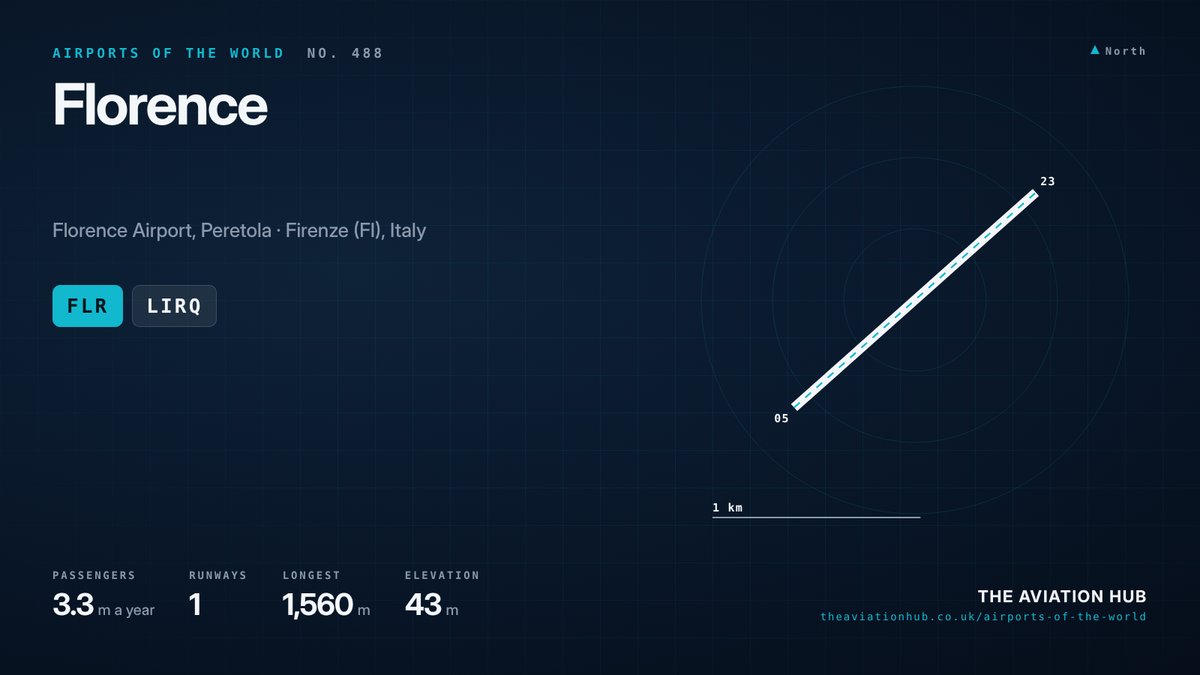
The codes are FLR and LIRQ. The airport lies about 3 miles (5 km) north west of the Duomo, between the city and Sesto Fiorentino, at an elevation of 142 ft (43 m). It has one runway and a passenger terminal made up of two connected buildings.
Traffic reached roughly 3.52 million passengers in 2024, up more than 14 per cent, with around 40,000 aircraft movements. Vueling and Volotea use Florence as a focus city, and the big European network carriers fly in from their hubs. Toscana Aeroporti, which also runs Pisa, operates Florence Airport. The formal name is Amerigo Vespucci Airport. Timetables are on the airport’s official website.
How Florence’s Airport Came to Be
Florence first flew from Campo di Marte, an airfield created in 1910 for early experiments in air navigation. The city needed something bigger, and in 1928 a site was chosen on the plain at Peretola. The new airport opened on 4 June 1931.
For decades Florence Airport stayed small, overshadowed by Pisa. In 1990 it was renamed after Amerigo Vespucci, the Florentine navigator whose name was given to the Americas. A management company, AdF, was formed in 1984 and received a full concession in 1998, which opened the way for investment.
The runway was extended by 250 m in 1996. In 2015 the Florence and Pisa operators merged to form Toscana Aeroporti, after years of rivalry between the two cities.
Runways at Florence Airport
Runway 05/23 is 1,560 m (5,118 ft) long and 45 m (148 ft) wide, with an asphalt surface. That is short by modern standards, and the geography makes it tighter still. Monte Morello rises sharply to the north east, so aircraft normally land on runway 05, approaching over the flat plain from the south west, and take off on runway 23, away from the mountain.
The result is opposite direction operations. Arriving aircraft turn at the end and backtrack to the terminal. Departing aircraft often taxi down the runway before turning to take off. With no full parallel taxiway, every movement occupies the runway for longer than usual, which caps capacity.
Tailwind limits are strict on the short runway. When winds are strong from the wrong direction, aircraft divert to Pisa or Bologna. In July 1997, Air Littoral Flight 701, an ATR 42 from Nice, overran on landing and ended up in a ditch beside the A11 motorway. The captain later died, and 14 people were injured.
Terminals and Airlines
The main building at Florence Airport houses check in, security, duty free, arrivals and gate 1. An older building, linked by a covered bridge, holds gates 2 to 11 and a food court. There are no jet bridges, so passengers board by bus from every gate.
Vueling and Volotea have the largest networks, flying Airbus A320 family jets across Spain, France, Italy and beyond. Network carriers bring their hub feed. Air France and KLM fly from Paris Charles de Gaulle and Amsterdam, British Airways from Heathrow and London City, Swiss from Zurich and Iberia from Madrid. ITA Airways links Rome Fiumicino.
The short runway shapes the fleet. Embraer E190 and E195 jets, the Airbus A319 and A320 and turboprops are typical. Aegean, TAP Air Portugal and Scandinavian Airlines add Athens, Lisbon and Nordic links.
Routes and Destinations
Paris, London, Amsterdam and the other European hubs are the backbone routes, carrying business travellers and long haul visitors connecting from North America and Asia. Rome Fiumicino feeds ITA Airways’ international network. Vienna, Zurich and Lisbon add further connections.
Barcelona, Madrid and other Spanish cities are strong leisure markets for Vueling. Volotea links Florence with smaller cities in France, Spain and Italy that have no other direct link. Summer brings a long list of seasonal routes, including Sardinia, Menorca and northern European cities.
There are no long haul flights, because the runway rules out wide bodies. Long haul visitors connect through a European hub or fly into Pisa, Bologna or Rome. Cargo at Florence Airport is negligible, at under 100 tonnes a year.
Getting to and from Florence Airport
The T2 tram line, called Vespucci, terminates at the airport and runs to Piazza dell’Unita beside Santa Maria Novella station. The journey takes around 20 minutes, and it is the cheapest sensible option at a standard city fare. Trams run frequently from early morning until late evening.
An Autolinee Toscane bus also runs to Santa Maria Novella every half hour. Taxis wait outside arrivals and charge a fixed fare to the historic centre. Most of central Florence is a limited traffic zone, so driving and parking downtown is best avoided.
The A11 motorway runs beside the airport and links to the A1 for Bologna, Rome and the rest of Italy. Rental car desks and parking sit close to the terminal. Allow extra time on summer weekends, when the motorway junctions clog.
Spotting and Photography
Florence Airport is compact, and the opposite direction pattern means every arrival on runway 05 comes in from the south west. Roads around the Osmannoro area and the edge of Sesto Fiorentino give views of approaching aircraft. The green slopes of Monte Morello make a striking backdrop for shots looking north east.
Morning light suits the southern side of the field. Hazy summer afternoons soften distant shots. Police helicopters are based at Peretola and add variety, along with business jets visiting the city.
Do not stop on the motorway or its slip roads. Stay on public land, keep clear of the perimeter fence and follow any instruction from police or airport staff.
What Comes Next
A new, longer runway has been planned for years, running parallel to the A11 and crossing the line of the current one. The existing runway would become a taxiway. The scheme has faced repeated legal and environmental challenges. A revised 2,200 m design won environmental approval in late 2025, though local councils have promised a fresh appeal. A new terminal with seven jet bridges is also planned for the coming decade.
Demand is clearly there, but politics and geography will decide how fast Florence Airport grows. The verdict is cautious progress, with Pisa still taking the larger aircraft. Compare the Tuscan airports on the Airports of the World map.
Continue to follow The Aviation Hub for more analysis and insight.
Advertise with us Your brand, in front of an aviation audience Home page and in-article placements, sold directly, one advertiser per slot. From £250 a year. See the rates

