
Fortaleza Airport Guide: Brazil’s Northeast Gateway to Europe
Fortaleza Airport links northeast Brazil with Sao Paulo, Paris and Lisbon. Read about its runway, Fraport terminal, airlines, routes and city access.
 By The Aviation Hub
6 min read
Updated October 20, 2026
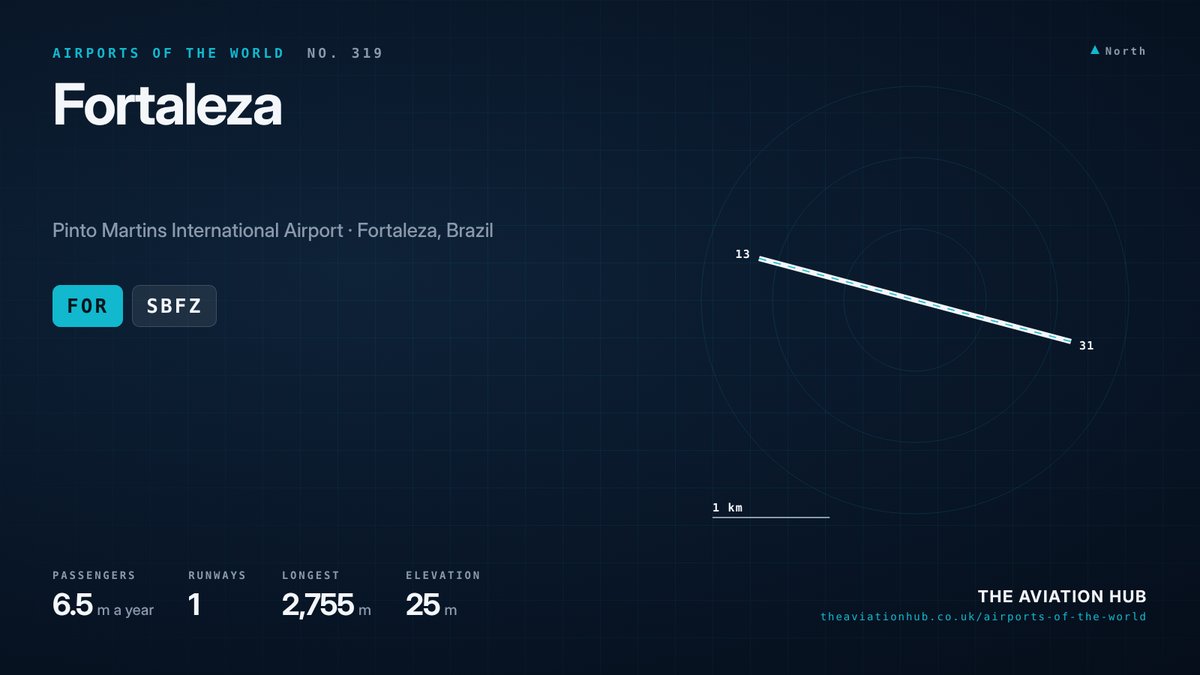
Fortaleza Airport, officially Pinto Martins International Airport, serves the capital of Ceara and much of Brazil’s northeast coast. It sits inside the city, just south of the centre, and handled more than six million passengers in 2025. Its position on the bulge of South America puts it closer to Europe than any of Brazil’s big southern airports, which has made it a target for transatlantic airlines and hub strategies.
Fortaleza Airport at a Glance
The IATA code is FOR and the ICAO code is SBFZ. The terminal lies about 4 miles (6 km) south of downtown Fortaleza, within easy reach of the beachfront hotel districts. Elevation is 83 feet (25 m). There is one runway and one passenger terminal, with the older 1966 building now serving private and executive aviation. Fraport Brasil, part of the Frankfurt airport group, has run the airport since January 2018 under a 30 year concession.
Fortaleza Airport handled 6,161,283 passengers in 2025, up from 5.6 million in 2024 but still below the 2019 record of 7.2 million. Cargo reached nearly 50,000 tonnes. Azul, LATAM and GOL carry most domestic passengers, and Azul alone operates around 680 flights a month. The airport shares some facilities with Fortaleza Air Force Base. Flight information and services are on the airport’s official website.
From Cocorote to Pinto Martins
The airport grew from a runway built in the 1930s, originally known as Cocorote. During the Second World War it became an important Allied base for South Atlantic operations, supporting aircraft crossing to Africa and patrols against submarines. The Ceara Flying School used the field for decades, staying until 2000.
On 13 May 1952 the airport was renamed after Euclides Pinto Martins, a Ceara born aviator who pioneered the 1922 air link between New York and Rio de Janeiro. A 1953 law kept the name despite national rules on airport naming. A passenger terminal and apron arrived in 1966, and the airport gained international status in June 1997.
A new 35,000 square metre terminal opened in February 1998. Infraero ran the airport from 1974 until the end of 2017. Fraport won the concession at auction in March 2017 for R$425 million and completed a major renovation on 14 April 2020, adding a two storey extension, 60 check in positions and a redesigned road system with a viaduct.
Runways at Fortaleza Airport
Fortaleza Airport has a single asphalt runway, 13/31, measuring 2,755 m (9,039 ft) by 45 m. That is adequate for the Airbus A330s and Boeing 787s used on European routes, though weight can be limited on the longest sectors in the heat. Most traffic is Airbus A320neo, Boeing 737 and Embraer E195-E2 equipment, with ATR 72 turboprops on regional links.
Steady easterly trade winds mean runway 13 is in use most of the time, with arrivals approaching from the northwest over the city. The hills south of Fortaleza demand care: on 8 June 1982 VASP Flight 168, a Boeing 727 from Rio de Janeiro, struck a mountain about 15 miles (25 km) south of the airport, killing all 137 people aboard. The concession contract includes a runway extension, which would help heavier long haul departures.
Terminals and Airlines
The 1998 terminal, extended by Fraport, handles all scheduled flights. Check in, security and gates spread over two levels, with jet bridges on the main pier and remote stands served by bus. There are 14 aircraft parking positions. Fraport has floated a commercial property project with warehouses, shops and hotels on airport land, but none has yet been built.
Azul runs the largest operation, with A320neos, E195-E2s and ATR 72s linking Fortaleza Airport with its Campinas hub and smaller cities in Ceara. LATAM is building up connecting banks here, linking domestic flights with international services, while GOL flies Boeing 737s to Sao Paulo and Brasilia. Air France flies to Paris Charles de Gaulle, and TAP serves Lisbon, and used World2Fly Portugal aircraft on some flights between May and September 2026.
Routes and Destinations
Sao Paulo is the biggest market, served from both Guarulhos and Campinas Viracopos, and Brasilia, Rio de Janeiro, Recife and Salvador are other important domestic routes. Azul’s regional flights connect the city with towns across the interior of Ceara and neighbouring states. Tourists from the south of Brazil arrive year round for the beaches of Jericoacoara, Canoa Quebrada and the city’s own waterfront.
The international map points to Europe. Paris, about 4,400 miles (7,080 km) away, is among the longest routes, and LATAM began nonstop Lisbon flights in 2025, since raised to five a week. LATAM’s Miami route is now seasonal, and its Santiago de Chile service is paused for the 2026 to 2027 northern winter season. Cargo through Fortaleza Airport rose sharply in 2025, by roughly a third.
Getting to and from Fortaleza Airport
Most passengers arrive by road along Avenida Senador Carlos Jereissati, the main airport access route. Ride hailing apps such as Uber and 99 are the usual choice, taking 20 to 30 minutes to the beachfront districts of Meireles and Iracema for roughly R$25 to R$40 (about £3.50 to £5.50). Official taxis wait outside arrivals and cost a little more.
City buses stop near the terminal and are the cheapest option, though they are slow and crowded with luggage. Fortaleza’s metro and light rail network does not provide a convenient terminal connection for most visitors. Car hire desks are in the arrivals hall, and parking is available in front of the terminal. Allow extra time at peak hours, when traffic around the airport can build quickly.
Spotting and Photography
Fortaleza Airport sits in a dense urban area, so spotters rely on streets and open ground near the runway ends. The northwestern approach to runway 13 crosses city neighbourhoods, giving low arrivals over rooftops. Equatorial light is harsh at midday, so early morning and late afternoon give the best results.
The mix is interesting for a regional airport. Azul’s colourful E2s and ATRs, LATAM and GOL narrow bodies, and Air France and TAP wide bodies all appear, along with Brazilian Air Force aircraft from the shared base. Avoid photographing military areas, stay on public land and keep a low profile in busy streets. Security staff will ask questions near the fence.
What Comes Next
Growth at Fortaleza Airport depends on airline strategy more than concrete. The Fraport terminal has room for more passengers, and the concession calls for further investment, including the long promised runway extension. LATAM’s new connecting banks and Air France’s extra flights show European and international demand is real.
The city’s geography is its trump card. A flight from Fortaleza to Lisbon is far shorter than one from Sao Paulo, making the airport a natural transfer point between Europe and northern Brazil. The verdict: steady recovery towards the 2019 peak, with international routes the key to going beyond it. See how it compares with Recife and Natal on our Airports of the World map.
Continue to follow The Aviation Hub for more analysis and insight.
Advertise with us Your brand, in front of an aviation audience Home page and in-article placements, sold directly, one advertiser per slot. From £250 a year. See the rates

