
Fuerteventura Airport Guide: Dunes, Winds and a Long Runway
Fuerteventura Airport at El Matorral handles around seven million holiday passengers a year. Runway, terminal, routes, buses and spotting spots covered.
 By The Aviation Hub
7 min read
Updated October 20, 2026
Fuerteventura Airport lies at El Matorral on the east coast of the second largest Canary Island, a few minutes south of the capital Puerto del Rosario. It is the island’s only commercial airport and the sole practical way in for the millions of Europeans who come for its beaches and winds. Around seven million passengers a year pass through one long terminal and one long runway. The schedule is a roll call of British, German and Spanish leisure airlines, with Binter and Canaryfly stitching the island to its neighbours.
Fuerteventura Airport at a Glance
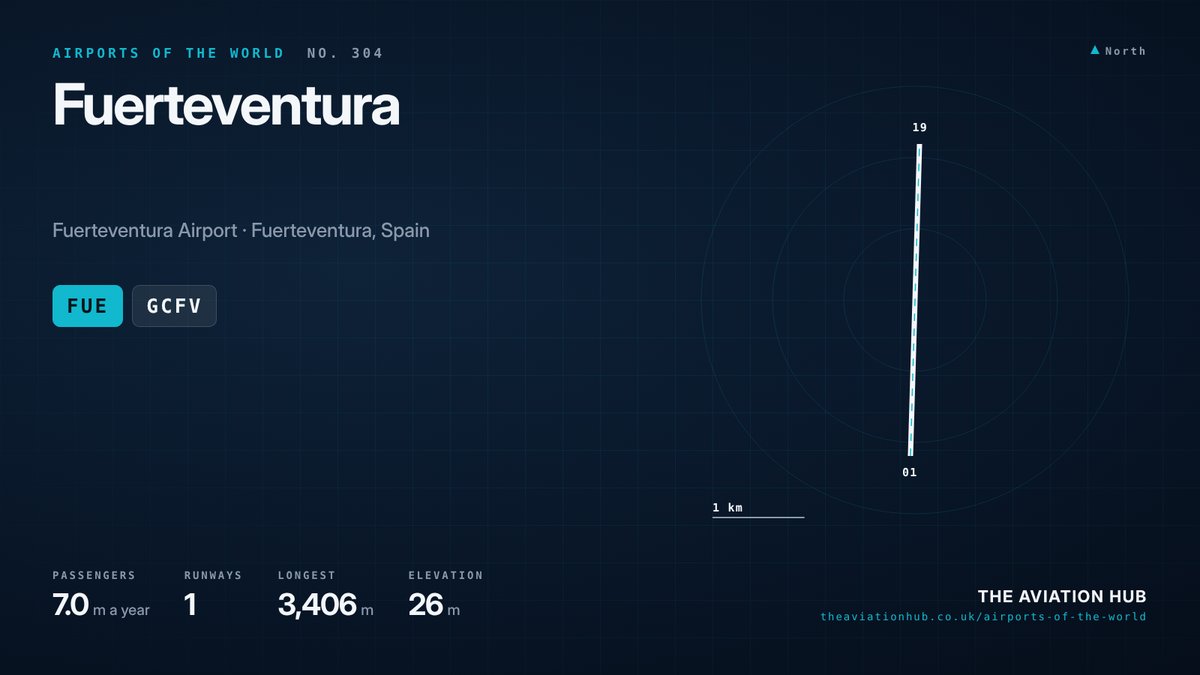
The IATA code is FUE and the ICAO code is GCFV. The terminal stands about 3 miles (5 km) southwest of Puerto del Rosario on the road to Caleta de Fuste, with the runway running parallel to the shoreline. Elevation is 85 feet (26 m). There is one asphalt runway and one two storey passenger terminal with 24 gates.
Aena, the Spanish state controlled airport company, owns and operates Fuerteventura Airport along with every other commercial airport in the Canaries. Traffic recovered to about 5.6 million in 2022 and has pushed on towards seven million since, placing it fourth among the islands behind Gran Canaria, Tenerife South and Lanzarote. No airline keeps a large base here, though Binter Canarias flies ATR 72-600s to the other islands many times a day and Ryanair, Jet2.com and easyJet are the biggest foreign carriers. Parking, flight status and terminal maps are on the airport’s official website.
How Fuerteventura’s Airport Came to Be
Fuerteventura was the quietest of the big Canary Islands well into the 1960s. A military strip at Tefia inland took the first commercial flights in 1950, and from 1952 a small aerodrome at Los Estancos near the capital took over. The current site at El Matorral opened officially on 14 September 1969 with a short runway and a small terminal aimed at inter island traffic. The first direct European service came in 1973, when the German charter carrier Condor linked Dusseldorf with the island.
German tour operators built the resorts at Jandia and Corralejo, and the airport grew with them. The runway was lengthened in stages to take the Boeing 757s and 767s that charter airlines favoured in the 1980s and 1990s. By the early 1990s the original buildings were overwhelmed.
A major rebuild began in 1994 and delivered a new terminal, a parallel taxiway, a larger apron, a power plant and a new access road. That project lifted capacity to about five million passengers a year. Later works added a new control tower, a cargo terminal and a runway extension, and Aena now rates the terminal for 8.2 million.
Runways at Fuerteventura Airport
Fuerteventura Airport has a single asphalt runway, 01/19, which at 3,406 m (11,175 ft) is one of the longest in the Canary Islands. It is 45 m wide and has a full length parallel taxiway, so the runway itself is rarely blocked by backtracking aircraft. The length is generous for the Boeing 737 MAX 8 and Airbus A321neo fleets that dominate, and it allows wide bodies such as the Airbus A330 and Boeing 787 to operate without restriction.
The northeast trade winds that make the island a windsurfing capital blow for most of the year, so runway 01 is the default. Aircraft approach from the south over Caleta de Fuste and Costa de Antigua, then depart north towards Puerto del Rosario. Winter southerlies and the occasional calima dust storm swing operations onto runway 19, which brings arrivals in over the capital. Crosswinds are a fact of life for crews here, and gusty afternoons regularly produce the sort of crabbed landings that fill spotters’ memory cards.
Terminals and Airlines
Everything happens in one terminal of more than 92,000 square metres. The ground floor is divided into an arrivals hall at one end and a check in hall at the other. Upstairs, a single long departure lounge feeds 24 boarding gates, a mix of air bridges and walk out stands. Security is centralised and queues build on summer Saturday mornings when the German and British waves overlap. Schengen and non Schengen passengers are separated after security, which matters because the United Kingdom is now the largest non Schengen market.
More than 30 airlines use Fuerteventura Airport across the year. Ryanair, Jet2.com, easyJet and TUI Airways carry the British, with Jet2.com serving nearly every regional airport in the United Kingdom. Condor, Eurowings, TUI fly, Discover Airlines and Edelweiss cover the German speaking countries. Vueling, Iberia and Iberia Express link the island to Madrid and Barcelona, while Binter Canarias and Canaryfly run the inter island shuttle to Gran Canaria and Tenerife North, with Binter adding La Palma. Transavia, SAS and Finnair add Dutch, Scandinavian and Nordic winter sun capacity. There is one pay in lounge airside.
Routes and Destinations
The busiest route by a distance is the short hop to Gran Canaria, which carried more than 650,000 passengers in 2023 on Binter and Canaryfly turboprops. Madrid followed with around 414,000 and Tenerife North with about 324,000. Internationally, Dusseldorf led with roughly 298,000 passengers, ahead of Manchester at 271,000 and Frankfurt at 252,000. London Stansted, London Gatwick, Birmingham, Hamburg and Munich all sit in the next tier.
The longest scheduled flight is Finnair’s seasonal service to Helsinki, about 2,840 miles (4,580 km) away. Seasonality is less extreme than on the Spanish mainland, because the island markets itself as a year round destination. Winter is actually the busier half for the British and Nordic airlines, while July and August belong to the Germans and the Spanish. Cargo is limited to belly freight and a small amount of fresh produce and fish.
Getting to and from Fuerteventura Airport
Fuerteventura Airport opens straight onto the FV-2 road, which runs north to Puerto del Rosario and south to Caleta de Fuste, Costa Calma and Morro Jable. Most visitors collect a hire car, and the desks in the arrivals hall belong to every major brand plus local firms such as Cicar. Puerto del Rosario is a ten minute drive, Corralejo about 40 minutes and Morro Jable around 75 minutes.
Public buses are the cheapest option. Tiadhe line 3 links the airport with Puerto del Rosario bus station in roughly 15 minutes for about €1.50, and from there line 6 continues to Corralejo. Line 10 runs directly to Caleta de Fuste, Costa Calma and Morro Jable, and line 16 connects with Gran Tarajal. Taxis wait outside arrivals and suit short hops, but the long run south to Morro Jable is expensive. Parking spreads across short and long stay car parks in front of the terminal. There is no rail on the island.
Spotting and Photography
This is one of the better spotting airports in Spain because dirt tracks and low hills run close to the fence. The classic approach shots for runway 01 come from the hill with a memorial at the entrance to Costa de Antigua, south of the field, where arrivals pass low with the volcanic hills behind them. Morning light is on the correct side for this angle. Unpaved roads off the FV-2 run beside the fence and give views of aircraft lining up on runway 01.
On the rare runway 19 days the approach passes over the capital, and a small hill near the radar station, along the same dirt road, gives close views of movements in both directions. The traffic is a wide mix of European narrow bodies, Binter ATRs and the occasional Airbus A330 or A350, with Condor’s striped liveries a highlight. Keep off the airport’s own access roads, respect the fences, and remember that the Guardia Civil patrols the perimeter. A tripod on the beach raises no eyebrows; one against the fence does.
What Comes Next
Fuerteventura Airport has room to grow, which is unusual in the Canaries. The terminal is rated for 8.2 million passengers against around seven million today, and Aena’s investment plan concentrates on upgrading the apron, the baggage system and the security hall rather than on new buildings. Airlines keep adding routes; easyJet adds Newcastle from October 2026 and Jet2.com has expanded its winter programme year after year.
The real constraint is the island itself. Water, housing and the fragile dune systems at Corralejo and Jandia limit how many more hotel beds the Cabildo will allow. Expect the airport to drift towards eight million passengers over the coming decade with the same single runway and the same long terminal. See how it ranks among the islands on our Airports of the World map.
Continue to follow The Aviation Hub for more analysis and insight.
Advertise with us Your brand, in front of an aviation audience Home page and in-article placements, sold directly, one advertiser per slot. From £250 a year. See the rates

