
Fukuoka Airport Guide: Japan’s Busy City Centre Field
Fukuoka Airport sits ten minutes by subway from downtown and opened a second runway in 2025. Read how Kyushu's main gateway copes with a curfew and slot limits.
 By The Aviation Hub
6 min read
Updated October 20, 2026
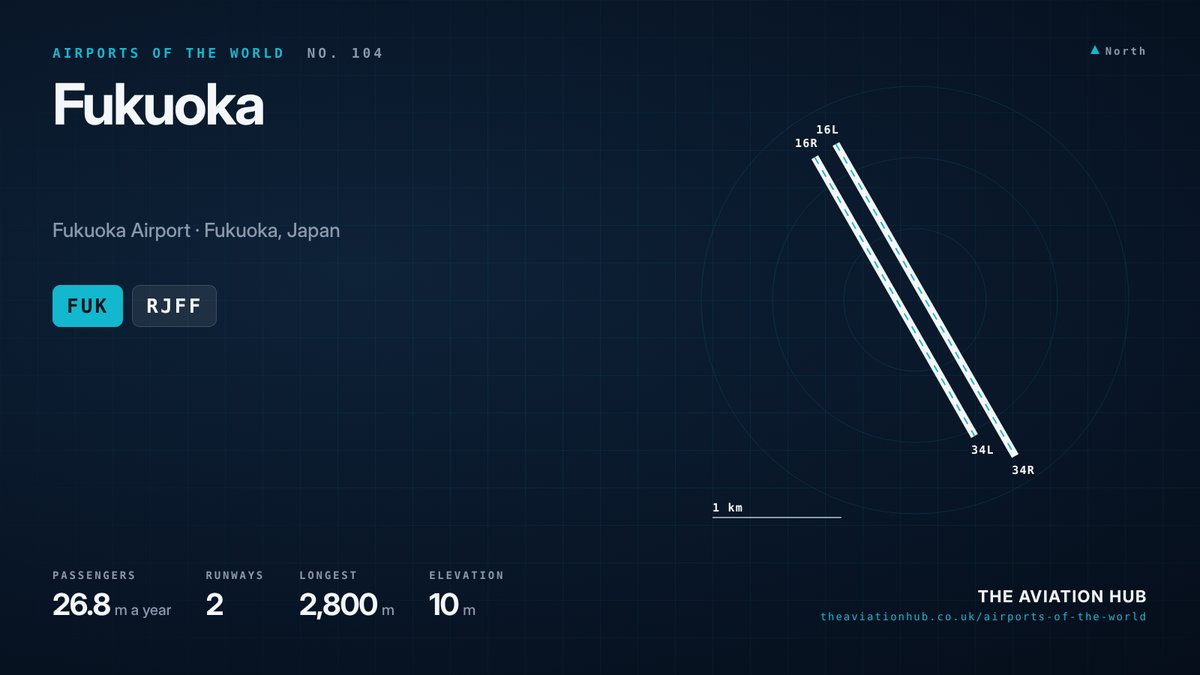
Fukuoka Airport is the main gateway to Kyushu, the southernmost of Japan’s four main islands, and one of the busiest airports in the country. It lies inside the city limits of Fukuoka, so close to the centre that the subway ride to the business district takes around ten minutes. Fukuoka Airport handled roughly 26.8 million passengers in 2024 on what was then a single runway, which made it one of the most congested fields in Japan. A second runway opened in March 2025 and should change the picture.
Fukuoka Airport at a Glance
The codes are FUK and RJFF. The airport sits in Hakata ward, about 2 miles (3 km) east of Hakata Station and the city centre, at an elevation of 10 m (32 ft). Two parallel asphalt runways now serve a domestic terminal on the west side and an international terminal on the east side, separated by the runways themselves.
In 2024 Fukuoka Airport handled around 26.8 million passengers, about 153,000 tonnes of cargo and roughly 186,000 aircraft movements. All Nippon Airways and Japan Airlines both treat it as a focus city, and Skymark Airlines has an operating base. More than 50 airlines serve the field in total. Since 2019 it has been run by Fukuoka International Airport Company, a private consortium that took over under Japan’s airport concession programme. Flight status and transport details are on the airport’s official website.
How Fukuoka’s Airport Came to Be
The field opened in 1944 as Mushiroda Airfield, built by the Imperial Japanese Army on former rice paddies with labour from Allied prisoners of war. Flooding made the site unsafe for trainee pilots, although the base stayed busy until late in the war. The United States Air Force took it over in 1945 and ran it as Itazuke Air Base, a major fighter station during the Korean War.
Civil flights grew alongside the military presence through the 1950s and 1960s. In 1968 a US Air Force Phantom crashed into a building at Kyushu University, an event that helped ignite the student protests of that era. The US Air Force sharply reduced its presence in 1972, leaving the field largely to civil aviation.
The international terminal opened in 1999 on the opposite side of the runway from the domestic buildings. Traffic kept rising through the 2000s and 2010s, driven by Korean and Taiwanese tourism, and in 2016 the government designated Fukuoka a congested airport subject to slot restrictions. The answer was a second runway, which opened on 20 March 2025 after years of construction squeezed into a tight urban site.
Runways at Fukuoka Airport
Fukuoka Airport has two parallel asphalt runways. The original runway 16L/34R is 2,800 m (9,186 ft) long and 60 m wide and still handles the bulk of movements. The new runway 16R/34L is 2,500 m (8,202 ft) long and 60 m wide. It lies only a short distance west of the original, which means the two cannot be used at the same time for independent operations.
At opening the new runway was reserved for international departures, which lets the controllers separate taxiing traffic and squeeze a few more movements into each hour. Both directions see regular use. Arrivals on the 16s cross the bay and the northern suburbs, while arrivals on the 34s come in from the south over the city’s southern districts.
The field is unusual among big Japanese airports in having no sea or reclaimed land to grow into. Housing presses up against the fence on every side, which is why a curfew runs from 22.00 to 07.00. Aircraft that cannot make the curfew divert to Kitakyushu, which sits on an artificial island and operates around the clock, or to Saga.
Terminals and Airlines
The domestic terminal on the western side of Fukuoka Airport is the heart of the operation. It was rebuilt and consolidated into a single building during the 2010s and connects directly to the subway station beneath. JAL, ANA, Skymark, Starflyer, Jetstar Japan, Peach and the regional carriers all operate from here.
The international terminal on the eastern side was doubled in size in a project completed in March 2025. It serves a long list of Asian carriers, including Korean Air, Asiana, Jeju Air, T’way, China Airlines, EVA Air, Cathay Pacific, Singapore Airlines, Thai Airways, Vietnam Airlines and the low cost operators that have flooded into Japan since the tourism boom. Finnair and KLM have flown to Europe at various times. A dedicated bus road for airport vehicles opened in November 2024 to link the two sides more quickly.
Routes and Destinations
Tokyo Haneda is the busiest route by a wide margin and one of the heaviest domestic air corridors on earth, with JAL, ANA and Skymark running departures every few minutes at peak. Naha, Sapporo New Chitose, Nagoya and Osaka are also busy. The shinkansen competes hard on Osaka but is slower than the aircraft to Tokyo, which keeps the air route healthy.
Internationally the airport looks west. Seoul Incheon is the leading foreign destination, and Busan, Taipei, Hong Kong, Shanghai and Bangkok are also served. The short hop to Korea, barely an hour in the air, has made Fukuoka a weekend destination for Korean travellers. Long haul is limited by the runway length and the curfew. Cargo of around 153,000 tonnes a year moves mostly in the bellies of passenger aircraft.
Getting to and from Fukuoka Airport
The subway is the answer for almost everyone. The Kuko Line runs from a station under the domestic terminal to Hakata Station in about five minutes and on to Tenjin, the main shopping district, in around ten minutes. The fare is about JPY 260 to 300 (roughly £1.40 to £1.60), which makes it by far the cheapest and fastest option.
Passengers for the international terminal take the free shuttle bus across the airfield from the domestic side, a ride of around ten minutes. Scheduled buses also link the international terminal directly to Hakata Station and Tenjin. Taxis to the city centre take 15 minutes and cost around JPY 1,500 to 2,000.
Driving is straightforward via the Fukuoka Urban Expressway, which has an exit beside the airport. Parking has expanded sharply, with an eight storey garage completed in January 2023 and a nine storey building opened in April 2024 to serve Fukuoka Airport’s growing car borne traffic.
Spotting and Photography
Fukuoka is a superb spotting airport because the city wraps around it. The domestic terminal has an observation deck with views across the aprons and the main runway, and it is free to enter. The international terminal has its own deck facing west, which catches the afternoon light on aircraft taxiing and departing.
Outside the fence, parks and roads along the approach to runway 16 in the northern suburbs give close views of arriving aircraft. The best known spot is near the threshold at the northern end, where aircraft pass only a few hundred feet overhead. Morning light favours the eastern side of the field and the afternoon favours the west. Japanese spotters are numerous and well behaved, and visitors should follow their lead, stay on pavements and never use ladders or tripods that block paths.
What Comes Next
The second runway is the big change, and the next few years will show how much extra capacity it unlocks within the limits of the curfew and the shared airspace. The concession company is building a shopping mall and hotel complex at the domestic terminal to raise non aeronautical revenue.
There is no room for a third runway or a longer one, so Fukuoka Airport will remain a short and medium haul field. Its strength is its location, which no other Japanese airport can match. The verdict is that it has bought itself a decade of growth. Compare it with Kyushu’s other fields on the Airports of the World map.
Continue to follow The Aviation Hub for more analysis and insight.
Advertise with us Your brand, in front of an aviation audience Home page and in-article placements, sold directly, one advertiser per slot. From £250 a year. See the rates

