
Geneva Airport Guide: One Runway on the French Border
Geneva Airport sits on the Swiss and French border with a single runway and a huge London market. Terminals, routes, rail access and spotting explained.
 By The Aviation Hub
6 min read
Updated October 20, 2026
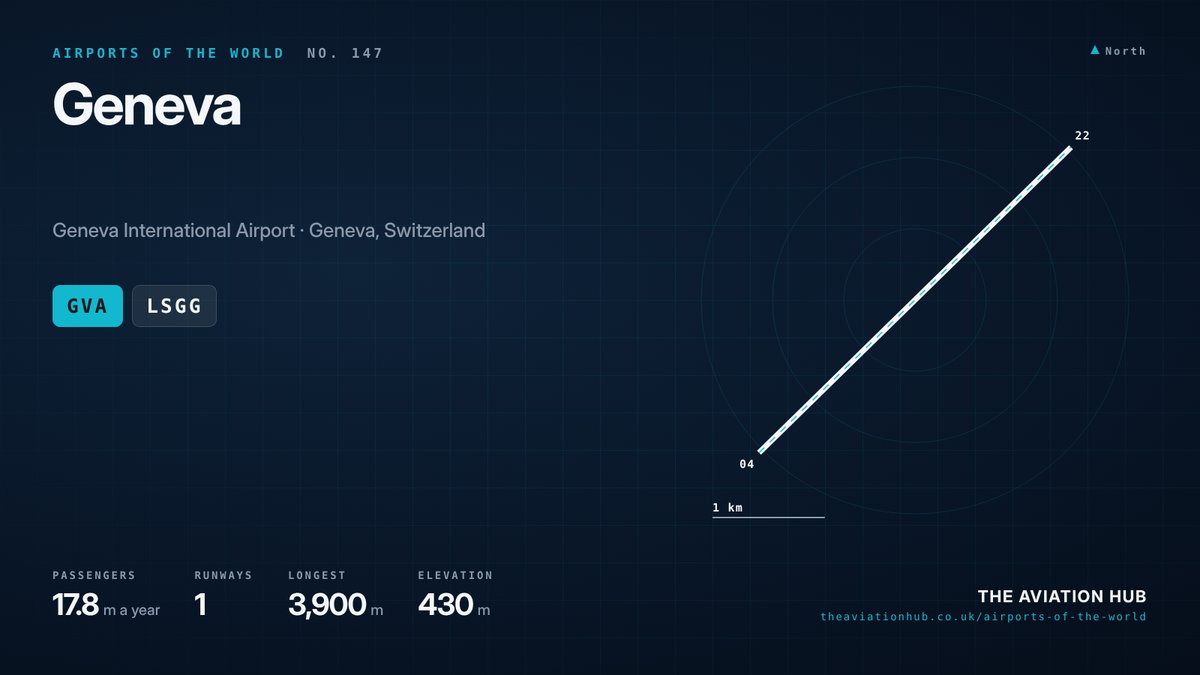
Geneva Airport is Switzerland’s second gateway and one of the more unusual airfields in Europe. It sits at Cointrin, barely 2.5 miles (4 km) from the city centre, with its northern boundary running along the French border. The field handles close to 18 million passengers a year on a single runway, serves the diplomatic world of the United Nations and the banks of the old town, and turns into a ski airport every winter. Its London traffic alone exceeds two million passengers a year.
Geneva Airport at a Glance
The IATA code is GVA and the ICAO code is LSGG. The airport lies about 2.5 miles (4 km) north west of the centre, at an elevation of 430 m (1,411 ft) on the plain between the Jura and Lake Geneva. There is one runway and three terminals: the main Terminal 1, the small Terminal 2 used only for winter charters, and a business aviation Terminal 3 about 2 km away. Older locals still call the place Cointrin.
Geneva Airport handled roughly 17.8 million passengers in 2024, along with around 179,000 aircraft movements and some 93,000 tonnes of cargo. Swiss International Air Lines operates a hub, and easyJet Switzerland has its largest base here, carrying more passengers than any other airline. Geneve Aeroport, a public body owned by the Canton of Geneva, operates the site. Flight and parking information is on the airport’s official website.
How Geneva’s Airport Came to Be
The Grand Council of Geneva approved an airfield at Meyrin on 11 October 1919, and a simple grass strip was laid out at Cointrin on about 54 hectares. Concrete hangars followed between 1926 and 1931, and the first concrete runway arrived in 1937. The original terminal opened in 1946 and survives today as Terminal 2. It even appears in the Tintin adventure The Calculus Affair.
The 1950s and 1960s brought the agreements that make the airport what it is. France and the Canton of Geneva created a French sector so travellers from the Pays de Gex could reach the terminal without passing Swiss customs. The runway was extended to 3,900 m to take intercontinental jets, and the airport became a Swissair secondary hub. Two Air India flights, in 1950 and 1966, crashed into Mont Blanc while descending towards Geneva.
The modern Terminal 1 grew through the 1970s and 1980s, with the circular Pier D satellite and later the underground link to Pier B. The check in hall was enlarged by 2017, and the East Wing replaced the old Pier C in December 2021 as the new home for long haul flights. The runway was renumbered from 05/23 to 04/22 in September 2018 as the magnetic north pole drifted.
Runways at Geneva Airport
Geneva Airport has a single concrete runway, 04/22, which is 3,900 m (12,795 ft) long and 50 m wide. It is the longest in Switzerland and among the longest in Europe. It runs parallel to the French border, and the full length allows a Swiss Airbus A330-300 to depart for New York without weight penalties even on a warm summer afternoon.
Runway 22 is the default in calm conditions, bringing arrivals in from the north east over the lake shore towards the city. Runway 04 takes over when the wind exceeds about 4 knots from the north and east, and the bise, the cold north easterly that funnels down the lake, can keep it in use for days. The single strip is the limiting factor on capacity, and peak winter Saturdays are slot controlled and tightly managed.
Terminals and Airlines
Terminal 1 handles almost everything at Geneva Airport. Piers A and B handle most of the European flights, including the domestic link to Zurich. The East Wing, 520 m long and able to park six wide body aircraft, takes all long haul services and some non Schengen flights. Pier D is a circular satellite without jet bridges, split between Schengen and non Schengen passengers.
Pier F is the French sector, where passengers heading directly into France can leave without touching Swiss territory in a formal sense. Passport checks were dropped after Schengen but the arrangement survives. Swiss and its Star Alliance partners Lufthansa, Austrian, Brussels Airlines, United and Air Canada form one group. British Airways, Iberia and Qatar Airways cover Oneworld, while Air France, KLM and Saudia represent SkyTeam. easyJet dominates by volume with a large Airbus A320neo fleet based here. Terminal 2, the 1946 building, opens only for the winter charter season.
Routes and Destinations
London is in a league of its own, with about 2.15 million passengers in 2025 across Heathrow, Gatwick, Luton, Stansted and City. easyJet, British Airways and Swiss all compete, and Saturdays in ski season bring extra sections. Porto and Lisbon follow with roughly 820,000 and 700,000 passengers, a reflection of Geneva’s large Portuguese community. Paris and Amsterdam round out the top five.
Long haul is smaller than Zurich’s but growing. Swiss flies to New York JFK, its only intercontinental route outside its main hub, while United serves Newark and Washington, Air Canada flies to Montreal, and Emirates, Qatar Airways and Etihad link the Gulf. Ethiopian serves Addis Ababa, Air China flies to Beijing and China Eastern to Shanghai. The longest regular route is China Eastern’s Shanghai service at around 5,750 miles (9,260 km). Winter weekends are the capacity crunch, when the resorts of Verbier, Chamonix and the Three Valleys fill every seat.
Getting to and from Geneva Airport
The railway station beneath Terminal 1 is the quickest link to Geneva Airport. Trains run to Geneve Cornavin, the main station, in about seven minutes, and onward to Lausanne, Bern and Zurich. Arriving passengers can collect a free public transport ticket from a machine in the baggage hall, valid for 80 minutes across the city, which makes the train and bus free for most new arrivals. Local buses 5, 10 and 23 also serve the terminal.
By road, the airport sits beside the A1 motorway, and the French border crossing at Ferney is minutes away. A taxi to the centre takes 15 to 20 minutes and costs roughly CHF 35 to 45 (about £31 to £40). Coaches run to Annecy year round and to Chamonix, Verbier and the other resorts in winter. Multi storey parking is attached to the terminal, with long stay options a shuttle ride away.
Spotting and Photography
Geneva is a good single runway airport to watch because everything passes one spot. The classic location is the Terrasse Panorama on the fourth floor of Terminal 1, open to visitors after a security check from mid March to October, which looks across the apron to the runway with the Jura ridge behind. On the French side, the roads around Ferney Voltaire near the runway 22 threshold put arrivals directly overhead, and the fields along the Route de Meyrin give views of departures on 22 and arrivals on 04.
The runway runs roughly north east to south west, so morning light favours the terminal side and evening light the French side to the north west. Winter Saturdays bring the widest variety, from Gulf wide bodies to Scandinavian charter Boeing 737-800s and a parade of business jets. Mont Blanc is visible to the south east on clear days. Stay off the perimeter road, park legally in Ferney and remember that Swiss police patrol the fence line regularly.
What Comes Next
The East Wing was the big project. The constraint is political rather than physical. Residents in the surrounding communes oppose growth on noise grounds, and the canton has set out a noise cap that limits night flights and late evening departures. A second runway is off the table.
Geneva Airport will grow slowly, filling bigger aircraft rather than adding movements, and its future lies in A321neo and A330neo capacity rather than concrete. See how it compares with other constrained European airports on our Airports of the World map.
Continue to follow The Aviation Hub for more analysis and insight.
Advertise with us Your brand, in front of an aviation audience Home page and in-article placements, sold directly, one advertiser per slot. From £250 a year. See the rates

