
Goa Dabolim Airport Guide: Navy Base and Beach Gateway
Goa Dabolim Airport shares its runway with a Navy air base. Explore its history, terminal, IndiGo routes, taxis, spotting rules and the Mopa effect.
 By The Aviation Hub
6 min read
Updated October 20, 2026
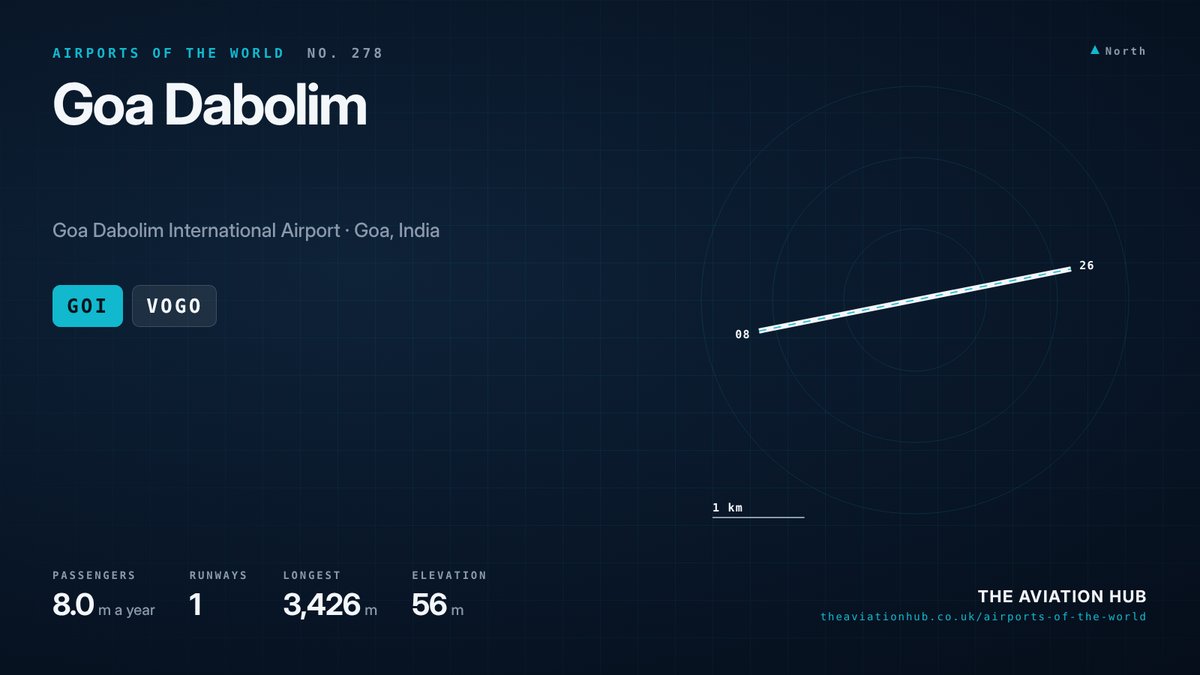
Goa Dabolim Airport sits on a low plateau above the port town of Vasco da Gama, in the south of India’s smallest state. For decades it was the only way to fly into Goa, carrying millions of beach holidaymakers, domestic tourists and Gulf workers. It is also a working naval air station, with fighters, patrol aircraft and helicopters sharing the runway with airliners. Since a second airport opened in north Goa in 2023, Dabolim has been adjusting to life with competition.
Goa Dabolim Airport at a Glance
The codes are GOI for IATA and VOGO for ICAO. The airport lies about 2.5 miles (4 km) from Vasco da Gama and roughly 18 miles (30 km) by road from the state capital, Panaji. Elevation is 56 metres (184 feet). There is one runway and one integrated passenger terminal. The Airports Authority of India runs the civil enclave inside INS Hansa, an Indian Navy air base, and the Navy controls the air traffic.
Traffic passed 7.2 million passengers in the 2024 to 2025 financial year, then fell by about 15 per cent to roughly 6.1 million in the year to March 2026 as airlines moved flights to the new airport at Mopa. IndiGo and Air India Express treat Goa Dabolim Airport as a focus city, and IndiGo serves the most destinations. Current schedules are on the airport’s official website.
A Short History of Dabolim
The Portuguese administration of Goa built the airport in 1955 on 249 acres of land, naming it Aeroporto de Dabolim. It was later renamed Aeroporto General Bénard Guedes. Flights linked the territory with other Portuguese enclaves and with the wider region at a time when relations with India were tense.
Those tensions ended in war. In December 1961 Indian forces bombed the airport during the annexation of Goa, and the field then passed to the Indian Navy. Civil flights resumed in 1966 once the runway had been repaired and made fit for jets, and the Navy developed INS Hansa into a major air station, home in turn to Sea Harriers and later MiG-29K fighters.
The civil side grew with tourism. Charter flights from Europe and later low cost domestic airlines filled the old terminals, and a new integrated terminal opened on 3 December 2013 with eight aerobridges. A parallel taxiway followed in December 2019, lifting capacity from about 15 to as many as 20 movements an hour.
Runways at Goa Dabolim Airport
Goa Dabolim Airport has a single asphalt runway, 08/26, measuring 3,426 metres (11,240 feet) long and 45 metres wide. That length comfortably handles wide body aircraft, including the long haul charters that once brought European tourists. The parallel taxiway added in 2019 cut the need for aircraft to backtrack along the runway.
The Navy has priority. Naval flying training takes place on weekday mornings, and during those windows civil flights cannot operate. The base also straddles the runway, so naval personnel have long crossed it on foot, by bicycle or in vehicles. A perimeter road built in 2018 reduced that traffic. Night slots have also been restricted, one reason a second airport was needed.
The runway has seen dramatic moments. In 2002 two Navy Ilyushin Il-38s collided during an air show, killing 15 people. In December 2016 a Jet Airways Boeing 737 veered off the runway and spun through 360 degrees, with only minor injuries. In 2018 a MiG-29K crashed off the runway, without casualties.
Terminals and Airlines
The integrated terminal handles domestic and international flights under one roof. It can handle about 2,750 passengers in the peak hour, with 75 check in counters, and has often been stretched in peak season. The older terminal buildings closed once it opened.
IndiGo is the dominant airline at Goa Dabolim Airport, linking it with every major Indian city. Air India Express and Air India add domestic and Gulf services, and SpiceJet has also flown here. International carriers include Gulf Air from Bahrain, while seasonal charters bring tourists from Russia, Kazakhstan and other markets in the winter months.
Routes and Destinations
Mumbai, Delhi and Bengaluru are core domestic routes from Goa Dabolim Airport, alongside Hyderabad, Chennai and Kolkata. Demand is strongly seasonal. The dry season from October to March brings domestic and foreign tourists, while the monsoon from June to September brings heavy rain and quieter beaches.
The international network is smaller than it once was. Air India Express flies to Dubai, and Gulf links serve the many Goans working in the region. Air India moved its London flights to Mopa in July 2023, and much of the airport’s recent decline reflects similar shifts by other airlines. Seasonal charters from Russia and Central Asia, including flights to Perm, keep a foreign presence in winter, and Aeroflot moved its Moscow flights back to Dabolim in October 2026.
Getting to and from Goa Dabolim Airport
Most visitors take a taxi. Prepaid taxi counters in arrivals offer fixed fares, and app based services also operate. The drive to Panaji takes around 45 minutes, while the northern beaches of Calangute and Baga are 60 to 90 minutes away and the southern beaches around Colva are closer. A trip to Panaji typically costs ₹1,000 to ₹1,500 (roughly £9 to £14).
The cheapest sensible option is a public bus. Services run to Vasco da Gama, about 4 km away, and from the Chicalim bus stop around 1.5 km from the terminal, with onward buses across Goa. Dabolim railway station is nearby, and Konkan Railway trains serve Margao and other Goan stations. Car parks sit in front of the terminal.
Spotting and Photography
Spotting at Goa Dabolim Airport requires great care. The field is an active naval air station, and photographing military aircraft, facilities or the base itself is prohibited and can lead to arrest. The Navy’s Shore Based Test Facility, a land replica of an aircraft carrier deck built in 2014, is a fascinating sight but strictly off limits to cameras.
Civil traffic is dominated by IndiGo Airbus A320neos and A321neos, with Air India Express Boeing 737s and seasonal charter wide bodies. Views from the terminal and from the public roads around Vasco da Gama give glimpses of the runway. Keep cameras pointed only at civil aircraft, stay away from fences and comply immediately with any instruction from naval or police personnel.
What Comes Next
Mopa has changed everything. Manohar International Airport, about 37 miles (60 km) away in north Goa, opened on 5 January 2023 with modern facilities and no military restrictions. Dabolim’s passenger numbers have fallen as airlines have moved flights there, and a proposed round the clock cargo terminal still has no confirmed completion date.
Goa’s government has said Dabolim will stay open alongside Mopa, serving south Goa and the Navy. Goa Dabolim Airport will remain busy, but its days as the state’s only gateway are over. Compare it with Mopa and India’s other leisure airports on our Airports of the World map.
Continue to follow The Aviation Hub for more analysis and insight.
Advertise with us Your brand, in front of an aviation audience Home page and in-article placements, sold directly, one advertiser per slot. From £250 a year. See the rates

