
Gran Canaria Airport Guide: Trade Winds and Twin Runways
Gran Canaria Airport at Gando is the hub of the Canary Islands, with two runways, an air force base and year round sun. Runways, airlines, routes and access.
 By The Aviation Hub
7 min read
Updated October 20, 2026
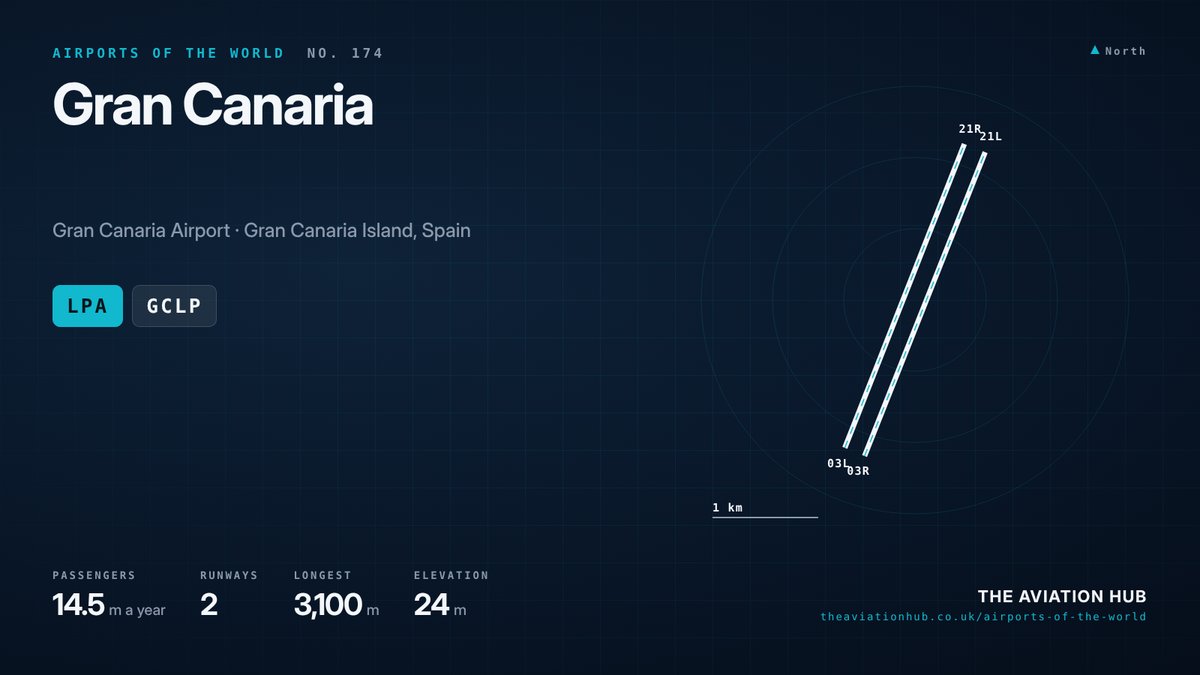
Gran Canaria Airport sits on the Bay of Gando on the east coast of the island, about 12 miles (19 km) south of Las Palmas and 16 miles (25 km) north of the resorts at Maspalomas. It is the busiest airport in the Canary Islands by passengers and movements and the inter island hub for the whole archipelago. Around 14.5 million passengers used it in the latest full year. Two parallel runways, a Spanish air force base and a steady northeasterly trade wind give the field a character all of its own.
Gran Canaria Airport at a Glance
The codes are LPA and GCLP. The airport lies 24 m (78 ft) above sea level on a flat coastal shelf, with the Atlantic along its eastern edge and the GC-1 motorway and the dry hills of the interior to the west. It has two parallel runways, one passenger terminal divided into zones and a cargo area, all on a site of about 553 hectares. Traffic ran to roughly 14.5 million passengers and about 130,000 movements in 2025, a record for the field.
Binter Canarias and Canaryfly base their inter island fleets here and operate hundreds of short hops a week. Vueling, Ryanair, Norwegian and airBaltic also keep aircraft on the island, with Iberia Express, Air Europa, easyJet, Jet2, TUI, Condor, Eurowings and Transavia among the bigger visitors. Aena, the state controlled Spanish airport company, runs Gran Canaria Airport as it does every commercial airport in Spain. Terminal maps and parking rates are on the airport’s official website.
How Gando Became the Island’s Airport
The story starts with the French pioneer Pierre Georges Latecoere, whose 1919 Toulouse to Casablanca airmail line soon looked for a stepping stone towards West Africa and South America. Spanish military aviation established itself on the Bay of Gando, and on 7 April 1930 King Alfonso XIII ordered the installations opened to civil traffic. Gando, the name of the bay and headland, has stuck to the airport ever since, even though Aena uses the island name officially.
A proper passenger terminal opened in 1946 as Iberia built up its routes to the peninsula. The arrival of jets and the package holiday boom of the 1960s forced a complete rebuild, and the present terminal, started in 1970, opened in March 1973. A bomb planted by the Canary Islands separatist group MPAIAC exploded in a florist’s shop in that terminal in March 1977, injuring eight. The second runway was completed in 1980.
The airport was for decades a designated emergency landing site for the NASA Space Shuttle, a role that ended with the programme in 2011. The terminal has been extended and refurbished repeatedly since the 1990s, and a new boarding zone and apron expansion in the 2010s brought the field to its present shape.
Runways at Gran Canaria Airport
Two parallel asphalt runways run roughly north to south along the coast, each 3,100 m (10,171 ft) long and 45 m wide. Runway 03L/21R is the western strip nearest the terminal and runway 03R/21L the eastern one beside the sea and the air base. The separation is modest, so they are generally used in segregated mode, with one for arrivals and the other for departures, rather than as fully independent parallels.
The trade winds blow from the northeast for most of the year, so the 03 runways are in use far more often than not. Arrivals approach from the south over the beach and village of Ojos de Garza, and departures climb out over the bay towards Las Palmas before turning. Strong gusty winds funnelling down the island’s valleys can make the approach lively, and the occasional calima, a dust laden easterly wind from the Sahara, cuts visibility and brings heat.
Gando Air Base shares the runways from the eastern side. Ala 46 of the Spanish Air and Space Force flies F/A-18 Hornets alongside CASA 212 transports and AS532 Cougar search and rescue helicopters, and the base became a key NATO platform for West African operations after the Mali intervention of 2013. Military movements are mixed in with the civil traffic throughout the day.
Terminals and Airlines
Gran Canaria Airport has one terminal, long and low, with the check in hall on the upper level and the arrivals hall below. The inter island flights of Binter and Canaryfly have their own gates, from where their ATR 72-600 and Embraer E195-E2 aircraft shuttle to Tenerife, Lanzarote, Fuerteventura, La Palma and the smaller islands.
The rest of the building handles the peninsula and European flights, with the non Schengen gates for British, Irish and other traffic grouped together. Vueling, Iberia Express and Air Europa dominate the mainland routes, Ryanair and Norwegian the low cost northern European ones, and Jet2, easyJet and TUI the British holiday flow. The Aena VIP lounge serves passengers of all airlines.
Routes and Destinations
Madrid is the busiest route from Gran Canaria Airport by a wide margin, carrying around 1.6 million passengers a year on Iberia Express, Air Europa, Vueling and Ryanair. Tenerife North and Lanzarote are other heavy routes, on inter island hops of 20 to 40 minutes. Barcelona, Seville, Malaga and Bilbao complete the strong domestic network.
Dusseldorf was the busiest European route in 2023 with around 355,000 passengers, and Amsterdam, Frankfurt, Munich, Hamburg, Manchester, London Gatwick, Dublin, Oslo, Stockholm and Copenhagen are other big markets. Helsinki, at roughly 2,900 miles (4,700 km), is among the longest routes flown, and Air Transat plans seasonal Montreal and Toronto flights from December 2026. Binter adds African and Atlantic links to Laayoune, Marrakech, Dakar, Nouakchott and the Cape Verde islands. Winter is the peak season for northern Europeans, and summer for Spanish mainland traffic, so the field stays busy year round. Cargo is modest, mainly fish, flowers and express freight.
Getting to and from Gran Canaria Airport
Global buses are the cheapest sensible option from Gran Canaria Airport. Line 60 runs to Las Palmas, reaching the San Telmo and Santa Catalina terminals in 25 to 40 minutes for a fare of around 3 euros (£2.60), and line 66 heads south to Maspalomas and Playa del Ingles in about 40 minutes. Buses stop directly outside arrivals and run from early morning until late evening.
The GC-1 motorway passes the airport gate and puts both Las Palmas and the southern resorts within 20 to 30 minutes by car. A taxi to the capital costs around 30 euros (£26) and to Maspalomas around 40 euros. Car hire is enormous here and the rental compounds stand beside the terminal. Covered short stay parking faces the departures hall and a long stay car park lies to the north. The long promised Tren de Gran Canaria rail line to the capital and Maspalomas remains unbuilt.
Spotting and Photography
The beach at Ojos de Garza, south of Gran Canaria Airport, sits directly under the approach to the 03 runways and gives classic shots of aircraft a few hundred feet up with the sea behind. The rough ground and side roads near the GC-1 to the west overlook the apron and the western runway, though the motorway fences limit the angles. The northern end near the Gando headland catches the rarer 21 operations.
The traffic is varied for a holiday airport, with Airbus A320 family jets and Boeing 737-800s in the colours of a dozen European carriers, TUI Boeing 787s, Binter turboprops and Hornets from the air base. Morning light from the sea favours the beach, and afternoons suit the western side. Do not photograph the military base, stay off the perimeter road and keep drones away, as the whole site is a restricted military zone as well as a civil airport.
What Comes Next
Aena’s regulated investment plan funds a steady programme of terminal refurbishment, apron extension and runway resurfacing rather than any grand project. Gran Canaria Airport has capacity to spare on its runways, and the constraint is the terminal and the island’s tolerance for more tourism. A 2011 programme to extend the terminal and add a new runway has not been revived. Growth will come from larger aircraft and better year round loads rather than more concrete.
The field looks set to remain the busy, windy hub of the Canaries, feeding the islands and the whole of northern Europe. Compare it with Tenerife South and the Spanish mainland on the Airports of the World map.
Continue to follow The Aviation Hub for more analysis and insight.
Advertise with us Your brand, in front of an aviation audience Home page and in-article placements, sold directly, one advertiser per slot. From £250 a year. See the rates

