
Guangzhou Airport Guide: China Southern’s Five Runway Hub
Guangzhou Airport is the home of China Southern and one of the biggest airfields in Asia. Five runways, three terminals, the FedEx hub and spotting advice.
 By The Aviation Hub
6 min read
Updated October 20, 2026
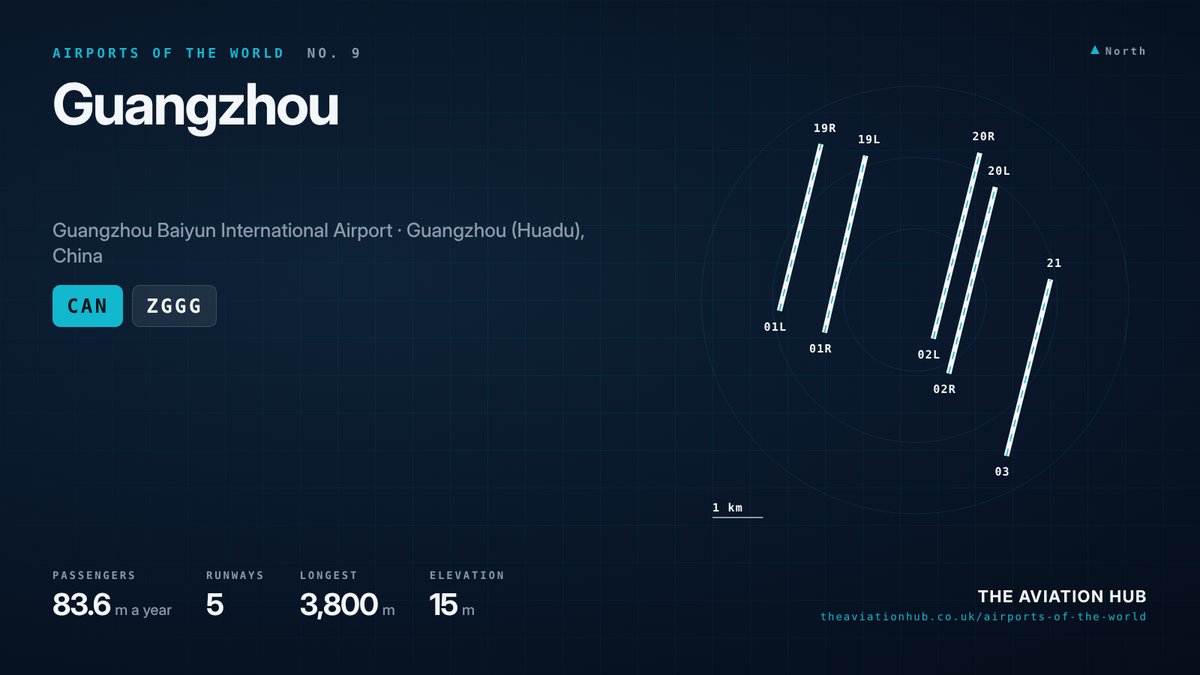
Guangzhou Baiyun International sits in the Huadu and Baiyun districts about 17 miles (28 km) north of the city centre, in the heart of the Pearl River Delta. Guangzhou Airport is the main hub of China Southern Airlines, the largest carrier in Asia by fleet, and the Asia Pacific hub of FedEx Express. Around 83.6 million passengers used it in 2025 and the airport briefly held the title of busiest in the world during 2020. With a third terminal and a fifth runway opening in late 2025, it is built for far more.
Guangzhou Airport at a Glance
The IATA code is CAN, from the old romanisation Canton, and the ICAO code is ZGGG. Both were inherited from the original Baiyun airport. The terminals lie roughly 17 miles (28 km) north of Tianhe, the modern commercial centre, at an elevation of 50 feet (15 m) on flat ground.
Five runways serve three terminals. Traffic in 2025 was around 83.6 million passengers and 2.44 million tonnes of cargo, ranking ninth in the world. China Southern, Shenzhen Airlines, Hainan Airlines and 9 Air are all based here, China Eastern treats it as a focus city, and FedEx runs its regional hub here. The Guangdong Airport Authority operates the field on behalf of its owner, Guangzhou Baiyun International Airport Company. Gate information and transport maps are published on the airport’s official website.
How Guangzhou’s Airport Came to Be
The original Baiyun Airport opened in 1932 at the foot of Baiyun Mountain, whose name means white cloud. For 70 years it served Guangzhou from a site that was gradually swallowed by the city, until surrounding buildings and hills left it no room to grow. The decision to build a replacement further north was taken in the 1990s, and construction cost about 19.8 billion yuan.
The new airport opened on 5 August 2004 with a single terminal and two runways, taking over the old name and codes in a single overnight move. A third runway followed in 2015, Terminal 2 opened on 26 April 2018 as China Southern’s new home, and a fourth runway opened in January 2025. The third phase of expansion was completed on 30 October 2025 with the opening of Terminal 3 and the fifth runway.
FedEx moved its Asia Pacific hub here from Subic Bay in the Philippines in 2009, bringing a nightly bank of freighters. The airport is also one of only two in China with five runways. It operates around the clock, which allows China Southern to run overnight intercontinental departures.
Runways at Guangzhou Airport
Guangzhou Airport has five runways, all aligned roughly north northeast to south southwest. The two longest, 02L/20R in asphalt and 02R/20L in concrete, each measure 3,800 metres (12,467 feet) and are 60 metres wide, suitable for the Airbus A380 and fully loaded Boeing 777F freighters. Runways 01R/19L and 03/21 are each 3,600 metres (11,811 feet) of concrete, and 01L/19R is 3,400 metres (11,155 feet).
In normal operations the inner runways handle departures and the outer runways take arrivals, which keeps taxi times reasonable across a very wide field. The third runway was restricted to landings for several years because of airspace conflicts with the military airfield at Foshan Shadi to the southwest, a reminder that Chinese civil aviation shares its sky with the air force. Southerly flow on the 02s and 01s is typical during the humid summer, with northerlies on the 20s and 19s in winter.
Terminals and Airlines
Terminal 2 at Guangzhou Airport is the heart of the China Southern operation, a vast building opened in 2018 with domestic gates on its western B side and international gates on the eastern A side. International carriers such as Korean Air, Japan Airlines, Singapore Airlines and Vietnam Airlines also use it. Terminal 1, the original 2004 building with its A and B areas, closed for renovation in May 2026 and its flights moved to the other two terminals.
Terminal 3 opened in October 2025 with a design inspired by the kapok flower, Guangzhou’s emblem, and the first open air observation deck at a mainland Chinese airport. Air China, Shenzhen Airlines, Hainan Airlines and China Eastern operate from it, alongside international carriers including Emirates, Cathay Pacific, ANA and Turkish Airlines. A free shuttle bus links all three terminals, and the intercity railway has a station at each.
Routes and Destinations
More than 200 destinations are served from Guangzhou Airport, most of them domestic. Beijing, Shanghai, Chengdu, Chongqing and Hangzhou are the heaviest trunk routes, frequently flown with Airbus A330-300 and Boeing 787-9 wide bodies even on sectors of two or three hours. Within the delta, high speed rail has taken most short distance traffic, so flights to Shenzhen and Hong Kong are few.
Internationally, Southeast Asia dominates, with Bangkok, Kuala Lumpur, Singapore, Manila and Ho Chi Minh City all served many times a day. China Southern’s long haul network reaches Sydney, Melbourne, Auckland, Los Angeles, San Francisco, New York, London, Paris and Amsterdam, and the carrier has built a strong Australasia connection known as the Canton Route. Cargo volumes of roughly 2.4 million tonnes rank among the busiest in the world, driven by the FedEx hub and the electronics factories of Guangdong.
Getting to and from Guangzhou Airport
The Guangzhou to Foshan intercity railway stops at every terminal and connects to the wider Guangdong rail network, while Metro Line 3 serves Airport North station at Terminal 2 and runs to Tianhe in around 45 minutes. The metro costs a few yuan and is the cheapest sensible option. Airport South station at Terminal 1 is closed during the renovation, and Terminal 3 awaits its own metro link on the planned Line 22.
Airport express buses run to hotels and railway stations across the city and to Foshan, Dongguan, Zhongshan and Shenzhen. A taxi to Tianhe costs around 120 to 150 yuan (£13 to £16) and takes 40 to 60 minutes via the S41 Airport Expressway. Car parks sit in front of each terminal. Transit passengers from many countries can use the visa free stopover scheme, but immigration queues can still be long at peak times.
Spotting and Photography
Terminal 3 has changed the game for enthusiasts in southern China. Its open air observation deck looks out across the eastern runways, and it is free to use. Elsewhere, the Pullman hotel beside Terminal 1 is the closest place to stay. Morning light favours the eastern side and late afternoon the west.
The appeal of Guangzhou Airport lies in the fleet mix. China Southern operates the Airbus A350-900 alongside the Boeing 787-9 and 777-300ER, and the FedEx night bank brings 777F and 767F freighters from across Asia. Chinese airport perimeters are policed closely, and photography from public roads near the fence can attract attention quickly. Stick to the deck, the hotels and the terminal windows, avoid pointing lenses at military aircraft, and comply immediately with any request from security staff.
What Comes Next
The third phase lifted design capacity to around 140 million passengers and six million tonnes of cargo a year, which gives the airport enormous headroom. Guangzhou Airport finished 2025 only narrowly behind Shanghai Pudong, and with Terminal 1 due to return from renovation it is well placed to challenge for the title of China’s busiest airport.
Constraints are airspace rather than concrete. Shared military airspace limits how many of the five runways can be used fully at once, and the nearby Shenzhen and Hong Kong fields compete for the same sky. Even so, the trajectory is firmly upwards. Explore its neighbours on our Airports of the World map.
Continue to follow The Aviation Hub for more analysis and insight.
Advertise with us Your brand, in front of an aviation audience Home page and in-article placements, sold directly, one advertiser per slot. From £250 a year. See the rates

