
Guayaquil Airport Guide: Ecuador’s Gateway to the Galapagos
Guayaquil Airport is one of Ecuador's two main gateways and a key stop for the Galapagos. Read about its history, runway, airlines, routes and city access.
 By The Aviation Hub
5 min read
Updated October 20, 2026
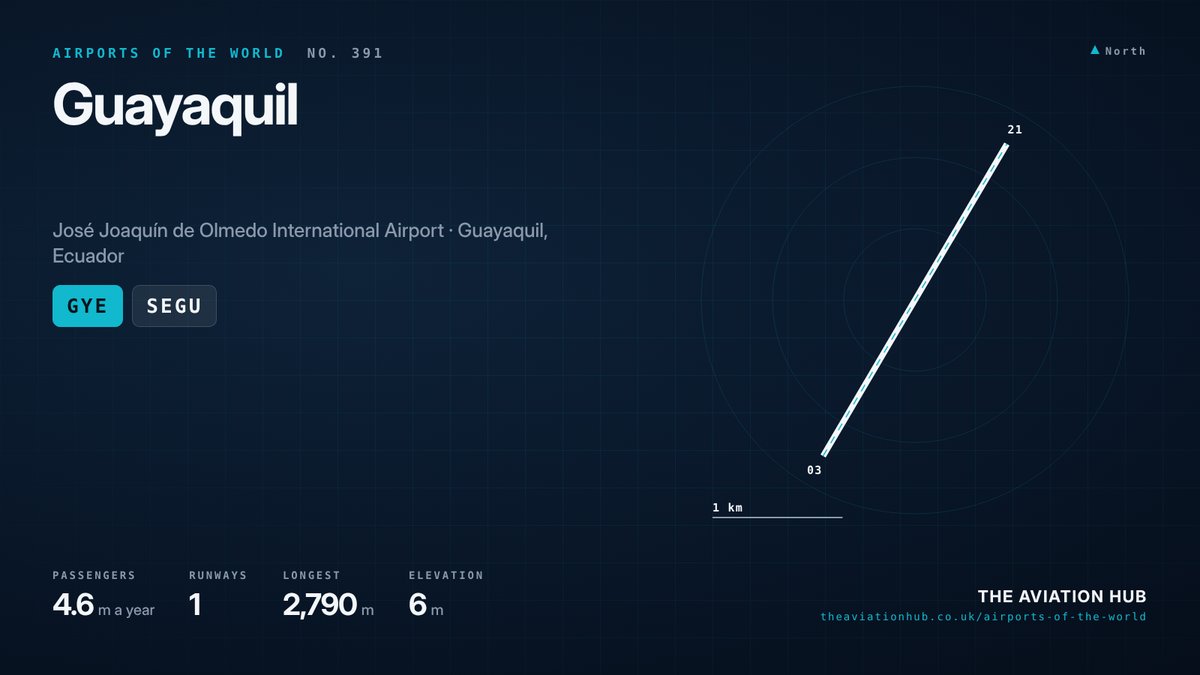
Guayaquil is one of Ecuador’s two largest cities and its commercial heart, a busy Pacific port on the banks of the Guayas river. Guayaquil Airport, officially José Joaquín de Olmedo International Airport, sits almost in the middle of it. The airport handles more than four million passengers a year and is the main mainland departure point for the Galapagos Islands. Its terminal, opened in 2006, won regional awards, and plans already exist for a replacement airport outside the city.
Guayaquil Airport at a Glance
The IATA code is GYE and the ICAO code is SEGU. The airport lies on Avenida de las Américas, about 3 miles (5 km) north of central Guayaquil, at an elevation of just 6 m (19 ft). It has one runway and a single terminal handling both domestic and international flights. Guayaquil Airport recorded about 3.75 million passengers in 2022, of which roughly 2.1 million were international, and traffic has grown since then. Avianca Ecuador and LATAM Ecuador use it as a hub. The concession is run by TAGSA under the oversight of the city’s airport authority, and services are listed on the airport’s official website.
How Guayaquil’s Airport Came to Be
For decades the field was known as Simón Bolívar International Airport, after the liberator of much of South America. The city grew around it, leaving the runway hemmed in by homes and avenues. Its old terminal became badly congested as traffic rose.
The turning point came in 2006. A new terminal of about 50,000 square metres opened in July that year, and most airlines had moved across by August. The old building closed and was converted into a convention centre. At the same time the airport was renamed after José Joaquín de Olmedo, a poet, the first mayor of Guayaquil and a former president of Ecuador.
The new building quickly drew praise. BusinessWeek named Guayaquil Airport the best in Latin America for 2008 and 2009. The domestic area was enlarged in July 2014, raising capacity to around 7.5 million passengers a year. The worst accident came in 1983, when SAN Flight 832, a Sud Aviation Caravelle, crashed near the end of the runway after engine failures. Eight of the 100 people aboard died, and a muddy pool left by El Niño rains helped cushion the impact.
Runways at Guayaquil Airport
A single asphalt runway, 03/21, handles every flight. It is 2,790 m (9,154 ft) long and 46 m wide. Displaced thresholds of 240 m on Runway 21 and 100 m on Runway 03 reduce the distance available for landing, keeping arriving aircraft higher over the surrounding neighbourhoods.
Despite the modest length, the runway can accept aircraft as large as the Boeing 747 and Airbus A340-600. The city’s heat and humidity reduce aircraft performance, so long haul departures can face payload limits on the hottest days. Approaches pass low over dense urban districts, making arrivals here a striking sight. The runway’s urban setting leaves no room for an extension, which is why a new site has been chosen for the future.
Terminals and Airlines
All passengers use the 2006 terminal, which handles domestic and international flights under one roof. It is bright, efficient and easy to navigate, with shops and food outlets on both sides of security. An exit tax applies to international tickets and is normally included in the fare.
LATAM Ecuador and Avianca Ecuador are the leading airlines at Guayaquil Airport, running both domestic services and regional routes. Copa Airlines connects the city with its Panama City hub, while Avianca links it with Bogotá and San Salvador. American Airlines and JetBlue serve the United States, and Iberia, Air Europa and KLM fly to Europe. Arajet and JetSmart Perú add low cost options within Latin America.
Routes and Destinations
Panama City and Bogotá were the busiest international routes in 2018, reflecting the strength of the Copa and Avianca hubs. Miami, Lima, New York JFK, Madrid and Fort Lauderdale followed. Spain and the United States are home to large Ecuadorian communities, which keeps transatlantic and North American flights full.
Quito is the busiest domestic route, linking the coastal business capital with the political capital in the Andes. The Galapagos are the other key market. Flights to Baltra and San Cristóbal depart from Guayaquil Airport, and many services from Quito stop here to refuel and pick up passengers, since it is the closest mainland point to the islands.
Getting to and from Guayaquil Airport
There is no rail link. Taxis are the standard choice, and the airport’s official taxi service is the safest option for visitors. The ride to the city centre and the Malecón 2000 riverfront usually takes 15 to 25 minutes, depending on traffic.
App based cars are widely used and often cheaper. City buses run along Avenida de las Américas outside Guayaquil Airport, though they are crowded and less suited to travellers with luggage. The bus terminal, with coaches to the rest of Ecuador, lies just north of the airport and is a short taxi ride away. Car hire desks and parking sit beside the terminal.
Spotting and Photography
The urban setting gives Guayaquil some unusual vantage points. Streets and buildings near both ends of the runway put photographers close to arriving aircraft, and the low approach over rooftops produces dramatic images. The terminal also offers apron views through its glass.
Expect Airbus A320 family jets from LATAM and Avianca, Copa Boeing 737s and wide body visitors such as Iberia and KLM. The equatorial sun is harsh around midday, so early morning and late afternoon give the best light. Stay on public land around Guayaquil Airport, keep valuables out of sight and follow any instruction from police or airport security.
What Comes Next
The current site cannot grow much further. A new airport is planned in the Daular area, about 12 miles (20 km) outside the city, with the move expected once traffic reaches around five million passengers a year. That milestone is close, but funding and construction timelines remain uncertain.
Until then, the 2006 terminal has spare capacity thanks to the 2014 expansion. The airport will remain a vital gateway for Galapagos visitors and for Ecuador’s commercial traffic. Expect steady growth and a long debate over Daular. Discover more airports on the Airports of the World map.
Continue to follow The Aviation Hub for more analysis and insight.
Advertise with us Your brand, in front of an aviation audience Home page and in-article placements, sold directly, one advertiser per slot. From £250 a year. See the rates

