
Guilin Airport Guide: Gateway to the Karst Hills and Li River
Guilin Airport is the gateway to the Li River, Yangshuo and southern China's karst hills. Read about its runway, Terminal 2, airlines, routes and access.
 By The Aviation Hub
5 min read
Updated October 20, 2026
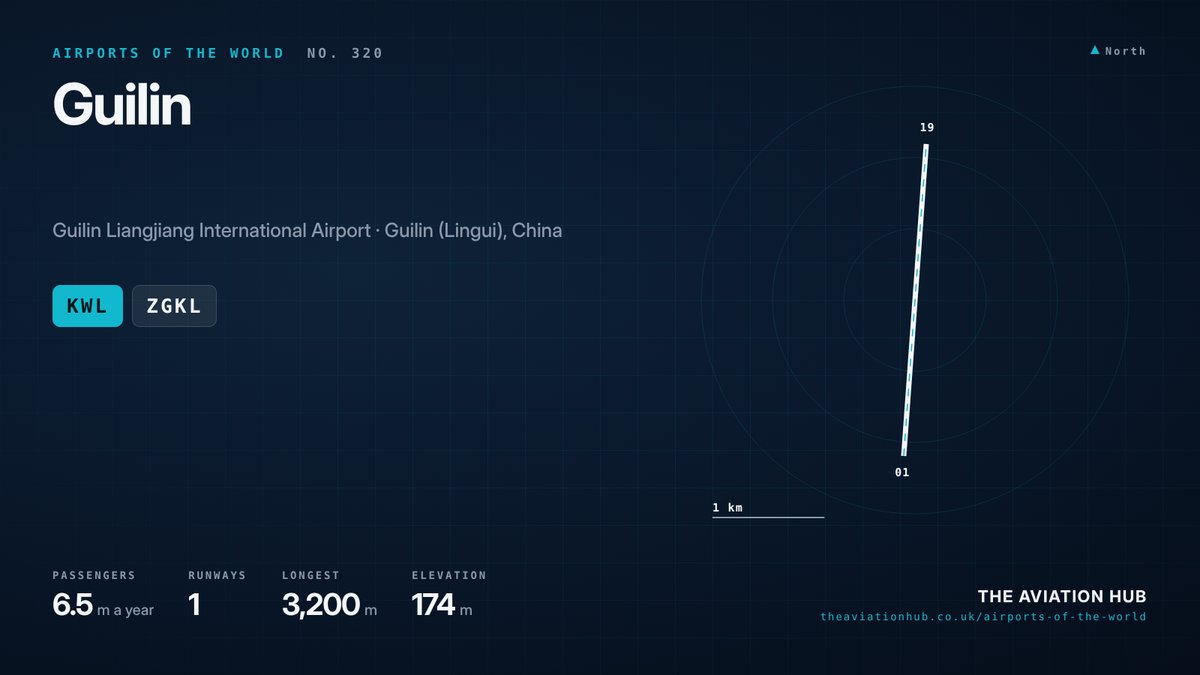
Guilin Airport, officially Guilin Liangjiang International Airport, is the gateway to one of China’s most famous landscapes. It serves the city of Guilin in the Guangxi Zhuang Autonomous Region, the starting point for Li River cruises, Yangshuo and the Longji rice terraces. About 6.5 million passengers used it in 2025, the highest total since the pandemic and a sign that domestic tourism has bounced back strongly.
Guilin Airport at a Glance
The IATA code is KWL and the ICAO code is ZGKL. The airport lies about 17 miles (28 km) southwest of Guilin city centre, in Liangjiang Town in Lingui District, from which it takes its name. Elevation is 570 feet (174 m). There is one runway and one active passenger terminal, Terminal 2, which opened in 2018. Terminal 1 has been closed for renovation since the move.
Guilin Airport handled 6,504,366 passengers in 2025, up from about 5.9 million in 2024, ranking it 48th among Chinese airports. It also recorded more than 47,000 aircraft movements and about 14,400 tonnes of cargo. Air Guilin uses it as its hub, and the big three state groups, Air China, China Eastern and China Southern, all fly in. Flight information is available on the airport’s official website.
How Guilin’s Airport Came to Be
For decades Guilin’s civil flights used Qifengling Airport, much closer to the city. As tourism grew after China opened up in the 1980s, the old field could not keep pace. In September 1991 the State Council and the Central Military Commission approved a 1.85 billion yuan project for a new airport on open land southwest of the city.
Construction began in July 1993, and Liangjiang opened on 1 October 1996, China’s National Day. Its 3,200 m runway and original terminal handled domestic trunk routes and charter flights from across Asia. Through the 2000s the airport grew with the city’s reputation, and foreign tour groups made Guilin one of China’s best known destinations outside the big cities.
By the 2010s the original terminal was overwhelmed. Work on Terminal 2 began in December 2015, and the 3.258 billion yuan building opened on 30 September 2018. All flights moved across that day, and a new apron and taxiways opened alongside. The terminal was designed for 12 million passengers a year, giving plenty of room for growth.
Runways at Guilin Airport
Guilin Airport has a single concrete runway, 01/19, measuring 3,200 m (10,499 ft) by 45 m. It is long enough for wide body aircraft, though most traffic is Airbus A320 family and Boeing 737 equipment on domestic routes. The runway runs roughly north to south across the flat valley floor, with karst peaks rising on the horizon.
Weather is the main operational factor. Guangxi’s humid subtropical climate brings heavy spring rain, summer thunderstorms and occasional low cloud. Wind direction decides whether runway 01 or 19 is in use. With fewer than 50,000 movements a year, the single runway has ample spare capacity and is far from congested. The airport has not published firm plans for a second runway.
Terminals and Airlines
Terminal 2 covers about 100,000 square metres and has 25 boarding gates and 22 security lanes, 17 for domestic and five for international passengers. Its design capacity is 12 million passengers and 95,000 tonnes of cargo a year, so it is running at little more than half its potential. Facilities are modern and spacious, with domestic and international areas clearly separated.
Air Guilin serves the most destinations from Guilin Airport, around 20 cities including Chongqing, Harbin, Xi’an and Yinchuan. China Southern, China Eastern and Air China cover the major trunk routes. Shandong Airlines, Spring Airlines and Juneyao Air add low cost and regional capacity. AirAsia, Jin Air and GX Airlines provide the international links.
Routes and Destinations
The airport offers around 48 domestic and international nonstop destinations. Beijing, Shanghai, Chengdu, Chongqing and Xi’an are among the core domestic markets, bringing tourists from the north and west. High speed rail has taken much of the short haul traffic to Guangzhou and Shenzhen, so flights focus on longer domestic sectors. Harbin, about 1,670 miles (2,690 km) away, is among the longest.
International flying is limited but growing. AirAsia flies to Kuala Lumpur, about 1,650 miles (2,650 km) away, and Batik Air Malaysia has operated charters. Jin Air serves Seoul Incheon year round, with Jeju Air adding seasonal flights, and GX Airlines links Guilin with Hanoi. Peak seasons follow Chinese holidays, especially the October Golden Week and the summer school holidays.
Getting to and from Guilin Airport
Most visitors use the airport shuttle bus, which runs to central Guilin in around 40 to 50 minutes and is the cheapest sensible option at roughly CNY 20 (about £2). Taxis and ride hailing through DiDi take a similar time for around CNY 100 to 130 (£10 to £14). Expressways link Guilin Airport with the city and with Yangshuo, about an hour’s drive to the south.
There is no direct rail link to the terminal. Travellers heading onwards by high speed train must first reach Guilin North or Guilin West station by road. Many tour groups book private transfers straight to Yangshuo or Longsheng. Parking is available beside the terminal, and car hire is limited for foreign visitors because of Chinese licensing rules.
Spotting and Photography
Guilin Airport offers a backdrop few airports can match. Limestone karst peaks surround the valley, and aircraft on approach can be framed against the distinctive hills on clear days. Humid haze often softens the view, so the best conditions follow rain, when the air is clean and the peaks are sharp.
The traffic is mostly Chinese domestic jets, with Air Guilin’s jets the most common sight and AirAsia and Korean carriers adding colour. Spotting in China is not formally organised, and photographing airports from public land can draw questions. Stay on public roads, avoid any military installations and comply politely with police or security staff.
What Comes Next
Filling Terminal 2 is the immediate challenge for Guilin Airport, since the building runs well below capacity. China’s widening visa free access for foreign tourists and continued growth in domestic travel both favour the city. Airlines will look for more international links to Southeast Asia, Korea and Japan.
The airport has invested in environmental and aesthetic improvements, and the renovation of Terminal 1 could eventually add flexibility. Route churn remains a feature: Air Guilin’s Taiyuan service ended on 18 October 2026. The verdict: Guilin has the runway and the terminal to grow, and tourism will decide how fast. Compare it with other Chinese airports on our Airports of the World map.
Continue to follow The Aviation Hub for more analysis and insight.
Advertise with us Your brand, in front of an aviation audience Home page and in-article placements, sold directly, one advertiser per slot. From £250 a year. See the rates

