
Guiyang Airport Guide: Highland Hub of China’s South West
Guiyang Airport sits more than 1,100 metres up in the hills of Guizhou and handles around 23 million passengers a year. Here is how the airport works.
 By The Aviation Hub
7 min read
Updated October 20, 2026
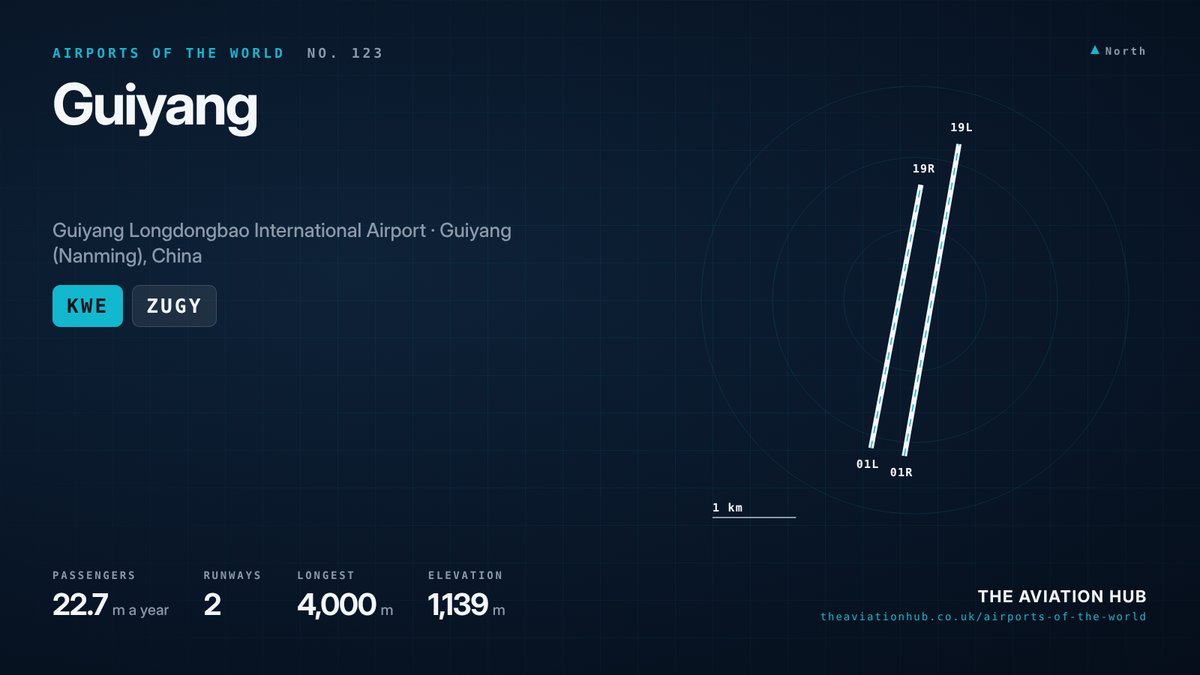
Guiyang Longdongbao International Airport serves the capital of Guizhou, one of the most mountainous provinces in China. It lies about 7 miles (11 km) south east of the city centre, on a plateau cut into the karst hills. Guiyang Airport handles around 23 million passengers a year, which places it in the top 25 airports in mainland China and makes it the air gateway to a province that had almost no long distance transport links a generation ago. Two parallel runways and three terminals have arrived in under three decades.
Guiyang Airport at a Glance
The codes are KWE and ZUGY. The field sits at 1,139 m (3,736 ft) above sea level, high enough to affect take off performance on hot summer afternoons. It has two parallel concrete runways, 01R/19L and 01L/19R, and three passenger terminals built in 1997, 2013 and 2021. The most recent figures put traffic at roughly 22.7 million passengers, around 159,000 aircraft movements and close to 120,000 tonnes of cargo a year.
Colorful Guizhou Airlines, the province’s own carrier, has its hub at the airport. China Southern also bases aircraft there through its Guizhou branch, and China Express Airlines once had its head office on the site. Guizhou Airport Group, a provincial state owned company, operates Guiyang Airport along with the smaller fields across Guizhou. Timetables and transport details are published on the airport’s official website.
How Guiyang’s Airport Came to Be
Before Longdongbao, Guiyang relied on the older Leizhuang airfield, which could not meet the city’s needs. Construction of a replacement at Longdongbao began in the early 1990s, and the new airport opened on 28 May 1997 with a single 3,200 m runway and a terminal of about 34,000 square metres. It was designed for 5 million passengers a year, a figure that seemed generous for a poor inland province.
Growth proved the planners wrong. The airport passed its design capacity in 2010, and a 3.4 billion yuan expansion began that September. Terminal 2, far larger than the original, opened in 2013 and lifted capacity to about 15.5 million passengers. The airport took its current name on 19 January 2006, Longdongbao being the district in which it sits.
The third phase was bigger still. A second runway and the sprawling Terminal 3 opened in 2021, the same year Metro Line 2 reached the airport. Longdongbao railway station, beneath the airport, had already opened in 2015. Hainan Airlines had already opened the first long haul route from the province in March 2019, a weekly flight to Paris.
Runways at Guiyang Airport
The newer runway, 01R/19L, is 4,000 m (13,123 ft) long and 45 m wide, surfaced in concrete. Its length reflects the altitude, where thin air lengthens take off rolls, and it comfortably handles the Airbus A330 and Boeing 787 wide bodies that appear on busier trunk routes. The original runway, 01L/19R, is 3,200 m (10,499 ft) by 45 m, also concrete.
The two runways sit only a few hundred metres apart, too close for fully independent parallel approaches. In the usual configuration one runway takes arrivals and the other departures. Southerly operations on 19 are common in summer, with northerly flow on 01 more frequent in winter when cold air drains off the plateau.
Guiyang’s weather is the runway’s main enemy. Guizhou is famously cloudy, and low stratus with drizzle sits over the plateau for weeks at a time. Both runways carry instrument landing systems, but fog and low cloud still cause delays, and the airport introduced an airport collaborative decision making system in June 2017 to improve punctuality.
Terminals and Airlines
Terminal 1, the 1997 building, now handles international flights. Terminal 2 serves domestic carriers including Hainan Airlines, China Eastern, Spring Airlines and Tianjin Airlines. The building is efficient rather than memorable, and it sits a short walk from Terminal 1.
Terminal 3 is the showpiece, a curving roof structure opened in 2021 that links directly to the ground transport centre. China Southern, Sichuan Airlines, Air China, Xiamen Airlines and Shenzhen Airlines run their domestic flights from here. The handful of foreign carriers and Chinese airlines flying to destinations such as Singapore, Osaka and Hanoi use Terminal 1.
The three terminals are connected by walkways and shuttle buses. Lounges are standard Chinese airport fare, and Guiyang Airport has not yet attracted the alliance branded lounges of the coastal hubs.
Routes and Destinations
Domestic trunk routes dominate. Beijing, Shanghai, Guangzhou, Shenzhen, Chengdu, Chongqing, Kunming, Hangzhou and Xi’an are all served many times a day, with Beijing the busiest at more than 22 flights a day. Guizhou’s tourism boom, driven by the Huangguoshu waterfall and the Miao and Dong villages of the south east, has added leisure traffic from the eastern seaboard.
Colorful Guizhou Airlines uses the airport as the centre of a web of thinner routes to provincial cities and to the smaller airports within Guizhou itself. The weekly Hainan Airlines flight to Paris, launched in 2019, has dropped out of recent schedules. The international network now rests on about ten regional routes, including Singapore, Osaka and Hanoi.
Cargo is modest at under 120,000 tonnes a year, most of it belly freight. Guizhou’s data centre industry and its fresh produce exports have begun to generate dedicated freighter interest, but Guiyang Airport remains a passenger field first.
Getting to and from Guiyang Airport
Metro Line 2 stops at Longdongbao International Airport station beneath the ground transport centre, with trains to the city centre every few minutes for a fare of a few yuan. The ride to the central business district takes around 30 minutes. This is the cheapest sensible option and the one most locals use.
Longdongbao railway station sits directly under the airport, with high speed trains to Guiyang North, the city’s main rail hub, and south towards Guilin and Guangzhou. Intercity coaches from the airport bus station serve Zunyi, Anshun, Duyun, Kaili and Bijie.
By road, the airport expressway runs into the city in about 25 minutes outside rush hour. Taxis to the centre cost around CNY 40 to 60 (roughly £4 to £7), and Didi ride hailing is widely used. Airport buses serve the main railway stations and hotel districts. Multi storey car parks sit beside Terminals 2 and 3.
Spotting and Photography
Spotting at Guiyang Airport is possible but needs patience and discretion. The hills to the east of the field give elevated views across both runways, and the roads climbing out of the Longdongbao district offer spots where aircraft on approach to the 01 runways pass close overhead. The terminals’ upper level windows look out onto the aprons, and the departure gates in Terminal 3 give good shots of taxiing traffic.
The fleet mix is mostly Airbus A320 and Boeing 737-800 narrow bodies, with Colorful Guizhou’s regional jets adding variety and the occasional Airbus A330 on the Beijing and Shanghai routes. Light is a problem because Guizhou is overcast so often. Clear days in late autumn give the best chance of sunshine, with the morning light favouring the eastern side.
Security around Chinese airports is strict. Photograph from public roads and the terminal only, keep away from the perimeter fence and do not use a tripod or long lens outside the airport without expecting questions. Follow instructions from police promptly.
What Comes Next
The 2021 expansion gave the airport room to grow. Terminal 3 and the second runway were designed for about 30 million passengers a year, so capacity is not an immediate concern. Future work focuses on more international routes, with links to South Korea and Cambodia planned, and Colorful Guizhou’s growth as a regional feeder.
The province’s wider ambition is to make Guiyang an inland hub between the south west and the coast, a role that Chengdu, Chongqing and Kunming also want. Guizhou’s cloud cover and its small population base limit how far that can go. The province also keeps building smaller airports, which spread traffic rather than concentrate it.
Guiyang Airport is a highland field that has grown faster than anyone expected and now has the infrastructure to keep going. See where it sits among the Chinese giants on the Airports of the World map.
Continue to follow The Aviation Hub for more analysis and insight.
Advertise with us Your brand, in front of an aviation audience Home page and in-article placements, sold directly, one advertiser per slot. From £250 a year. See the rates

