
Guwahati Airport Guide: Bamboo Terminal of the Northeast
Guwahati Airport is the hub of Northeast India, with a new bamboo themed terminal. Runway, airlines, routes, transport and expansion plans.
 By The Aviation Hub
5 min read
Updated October 20, 2026
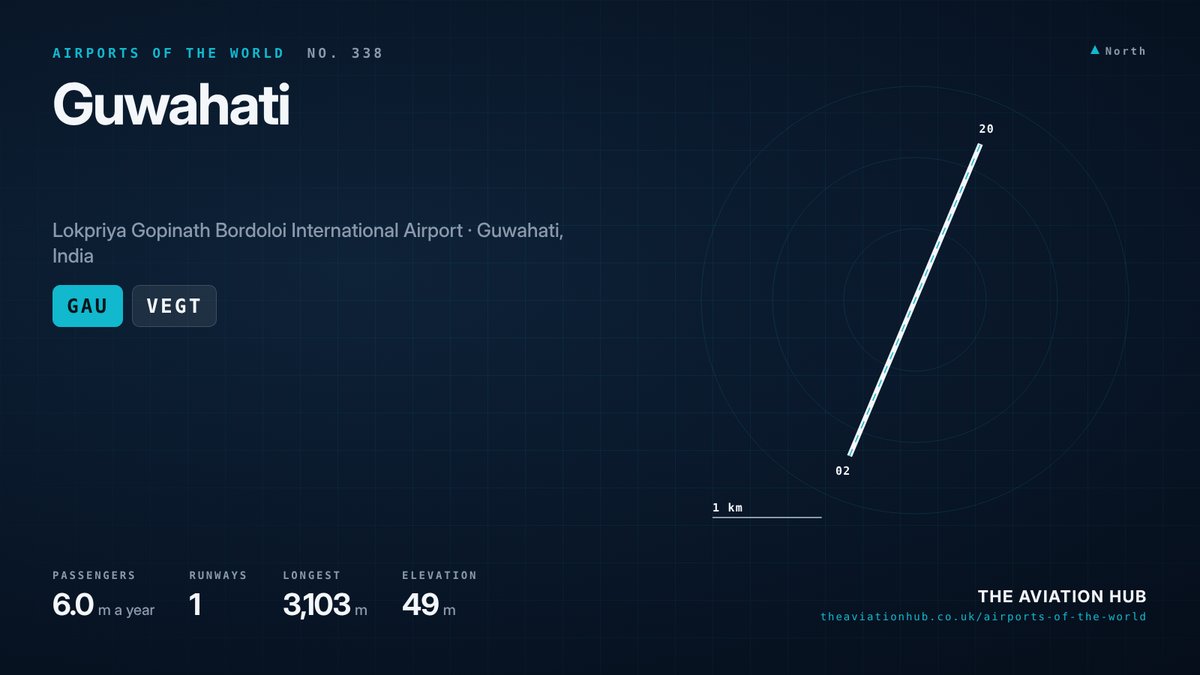
Guwahati Airport, officially Lokpriya Gopinath Bordoloi International Airport, is the main air hub for Northeast India. It sits at Borjhar, about 17 miles (28 km) west of central Guwahati, south of the Brahmaputra. A striking new terminal built with more than 140 tonnes of bamboo was inaugurated in December 2025. Around 6.6 million passengers used the airport in the 2025 to 2026 financial year, many of them connecting to smaller cities across the region.
Guwahati Airport at a Glance
The airport uses the IATA code GAU and the ICAO code VEGT. It stands 49 m (162 ft) above sea level in the Brahmaputra valley. One runway serves two terminals, the original 1958 building and the new integrated terminal. The Airports Authority of India owns the site, and Guwahati International Airport Limited, part of the Adani Group, operates it under a 50 year lease. The Indian Air Force also uses the field.
Guwahati Airport handled 6,622,784 passengers between April 2025 and March 2026, up 7.5 per cent, with 46,418 aircraft movements and almost 33,000 tonnes of cargo. IndiGo and Alliance Air treat it as a focus city, and Air India Express and Air India also fly here. Flight information appears on the airport’s official website.
How Guwahati’s Airport Came to Be
The airport opened in 1958 at Borjhar, west of the city. It is named after Gopinath Bordoloi, an independence campaigner and the first Chief Minister of Assam after independence, honoured with the title Lokpriya, meaning beloved of the people. The original terminal grew over the decades to around 28,685 square metres, with four aerobridges and capacity for about 6 million passengers a year.
In 2002 Air India launched a flight to Bangkok, making Guwahati the first international airport in the Northeast, though weak loads soon ended the service. Regional connectivity schemes revived the idea. Under the UDAN programme, the airport won route awards in 2019 and 2021 for destinations including Dhaka, Bangkok, Kuala Lumpur, Singapore and Yangon. The Adani Group won the lease in February 2019 with a bid of ₹160 per passenger.
Construction of a new terminal began in March 2018. The pandemic delayed it well beyond the original June 2021 target. Prime Minister Narendra Modi finally inaugurated the integrated terminal on 20 December 2025, at a cost of about ₹4,000 crore (well over £300 million). Air India moved its operations there from 16 March 2026.
Runways at Guwahati Airport
A single runway serves Guwahati Airport. Runway 02/20 is 3,103 m (10,180 ft) long and 45 m wide with an asphalt surface. It can take wide body aircraft such as the Boeing 787. CAT III instrument landing equipment, a DVOR and PAPI lighting allow operations at night and in fog or rain.
The runway runs roughly north to south, with the Brahmaputra to the north and wooded hills nearby. The monsoon from June to September brings heavy rain and low cloud, while winter mornings can bring fog. The aprons can park 25 narrow body aircraft. Indian Air Force movements mix with civil traffic.
Terminals and Airlines
The new integrated terminal is the showpiece of Guwahati Airport. Its 140,000 square metres follow a Bamboo Orchids theme, with bamboo, japi motifs from traditional Assamese hats and designs inspired by the one horned rhino. Designed by Nuru Karim, it has 10 aerobridges and an annual capacity of 13.1 million passengers. IndiGo, the largest airline, moved all its flights there on 20 July 2026.
IndiGo runs the largest operation, linking the city with Delhi, Kolkata, Bengaluru, Mumbai, Hyderabad, Chennai and Pune, plus Agartala, Aizawl, Imphal, Dimapur and Itanagar across the Northeast. Air India Express flies domestic routes and to Dubai and Abu Dhabi. Alliance Air serves smaller regional airports such as Dibrugarh and Pasighat. Thai AirAsia links the city with Bangkok Don Mueang.
Routes and Destinations
Delhi and Kolkata are the trunk routes from Guwahati Airport, with Bengaluru, Mumbai and Hyderabad close behind. Many passengers connect onward to the seven sister states, where hilly terrain makes road journeys slow. Regional routes link the city with Imphal, Agartala, Aizawl and Dimapur.
International links are growing from a small base. Thai AirAsia flies to Bangkok Don Mueang, and IndiGo adds a Bangkok Suvarnabhumi route from 27 October 2026. Air India Express serves Dubai and Abu Dhabi. Drukair of Bhutan has used Guwahati on connecting services between Paro and Singapore. Cargo, at around 33,000 tonnes a year, carries goods into and out of the region.
Getting to and from Guwahati Airport
Road is the only option. The airport road leads east into the city, and taxis and app based rides reach Paltan Bazaar and the railway station in around 45 minutes to an hour, depending on traffic. Prepaid taxi counters in arrivals take the uncertainty out of fares. Hotels in the city commonly offer pickups.
Airport buses run by the state transport corporation link the terminal with central Guwahati and are the cheapest sensible option. Guwahati railway station, around 17 miles (28 km) away, handles trains to Delhi, Kolkata and across the Northeast. Shillong, the capital of Meghalaya, is about three hours away by road, and shared taxis serve it from the city.
Spotting and Photography
Spotting at Guwahati Airport needs care. The field doubles as an Indian Air Force base, and Indian security rules treat airports as sensitive sites. Photographing military aircraft or installations is strictly off limits. The safest views come from inside the terminals and from window seats.
The setting is the draw. Green hills and the Brahmaputra plain make attractive backdrops, especially in the clear air after the monsoon in October and November. Window seats often give good views of the river on approach. Keep cameras discreet, stay on public land and comply at once with the Central Industrial Security Force or police.
What Comes Next
The new terminal gives Guwahati Airport capacity for 13.1 million passengers a year, roughly double current traffic. The priority now is filling it with more routes, especially international links to Southeast Asia that build on the Act East policy. Bangkok, Singapore, Kuala Lumpur, Dhaka and Yangon have all featured in regional connectivity awards.
The moves by Air India in March 2026 and IndiGo in July 2026 show the transfer to the new building gathering pace. The airport looks set to strengthen its role as the gateway to the Northeast and a potential bridge to Southeast Asia. Compare it with other Indian airports on the Airports of the World map.
Continue to follow The Aviation Hub for more analysis and insight.
Advertise with us Your brand, in front of an aviation audience Home page and in-article placements, sold directly, one advertiser per slot. From £250 a year. See the rates

