
Hamburg Airport Guide: A Working Airfield Since 1911
Hamburg Airport has flown since 1911 and sits inside the city at Fuhlsbuttel. Runways, terminals, routes, Lufthansa Technik and city rail access explained.
 By The Aviation Hub
6 min read
Updated October 20, 2026
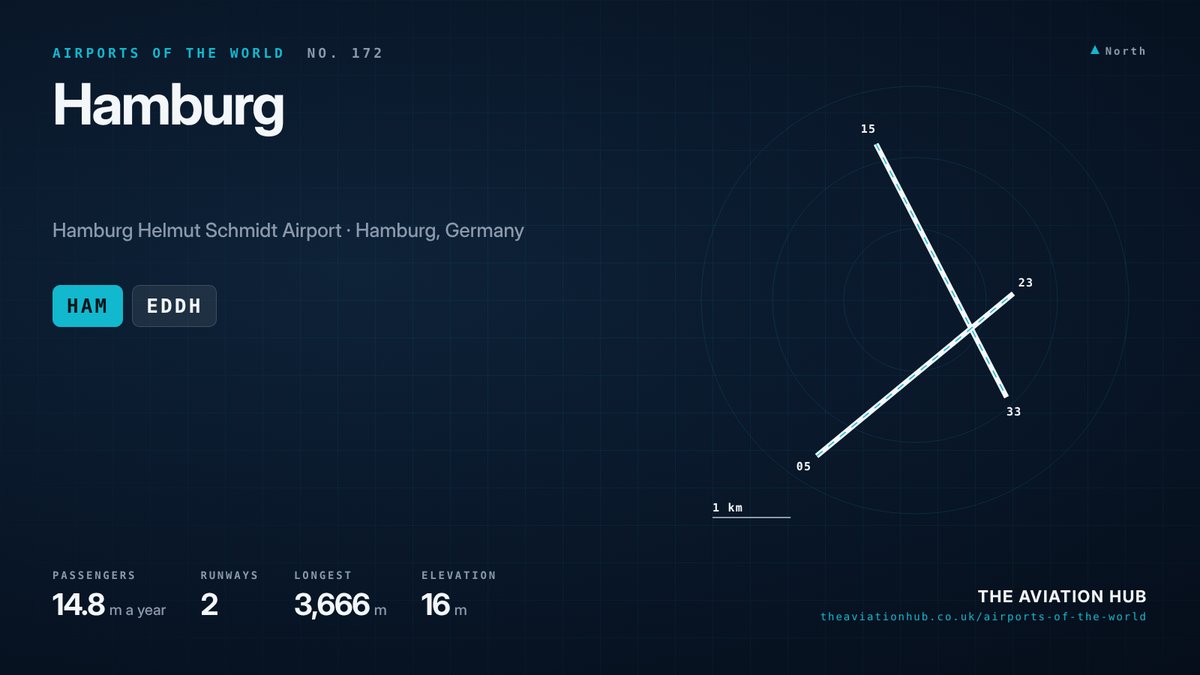
Hamburg Airport lies in the Fuhlsbuttel district about 5 miles (8.5 km) north of the city hall, entirely surrounded by suburbs. Opened in 1911 as an airship field, it is Germany’s fifth busiest airport and carried about 14.8 million passengers in 2025. The field is home to a large Eurowings base, the headquarters of Lufthansa Technik and a flow of traffic from Munich to Dubai. Its two crossing runways, tight curfew and city centre rail link make it a compact and distinctive operation.
Hamburg Airport at a Glance
The codes are HAM and EDDH. The airport sits 16 m (53 ft) above sea level on the flat land of the Alster valley, with the Lufthansa Technik complex on site and housing pressing in around it. It has two intersecting runways and two terminals joined by the Airport Plaza. In 2025 it recorded around 14.77 million passengers, about 126,700 aircraft movements and roughly 31,000 tonnes of cargo. The passenger total was fractionally below the previous year and still short of the 17.3 million seen in 2019.
Eurowings is the largest airline and treats the city as a hub, with Condor and its sister airline Marabu also basing aircraft here. Lufthansa, easyJet, Ryanair, Turkish Airlines and Emirates make up most of the rest. Flughafen Hamburg GmbH runs the field, owned 51 per cent by the City of Hamburg and 49 per cent by AviAlliance. Parking and flight information live on the airport’s official website.
How Fuhlsbuttel Became an Airport
Hamburg Airport opened in January 1911, financed privately by Hamburger Luftschiffhallen GmbH to house Zeppelins. Aeroplanes followed, and by the 1920s the new Deutsche Luft Hansa was flying from the grass. It is often described as the oldest international airport in the world still in operation. Fuhlsbuttel, the district name, stuck to the airport for a century and locals still use it.
The Royal Air Force ran the field after the Second World War and it became a vital base during the Berlin Airlift of 1948 and 1949. Jets arrived in the 1960s and the runways were extended, but a plan to build a replacement airport at Kaltenkirchen, north of the city, dragged on for decades before being shelved. Hamburg chose instead to rebuild in place.
That decision shaped the modern layout. Terminal 2 opened in 1993 and Terminal 1 in 2005, with the Airport Plaza joining them in 2008, the same year the S-Bahn finally reached the terminal. The airport was renamed after former chancellor Helmut Schmidt, a son of the city, in November 2016. In November 2023 a man drove a car through a gate onto the apron with his young daughter during a custody dispute, closing the field for many hours.
Runways at Hamburg Airport
Two asphalt runways cross near the centre of the site. Runway 15/33 is the longer at 3,666 m (12,028 ft) by 46 m and runs roughly north to south. Runway 05/23 measures 3,250 m (10,663 ft) by 46 m and runs southwest to northeast past the terminals. Both can take the largest aircraft, and the Emirates Airbus A380 is a daily visitor.
Because the runways intersect, Hamburg Airport cannot run simultaneous independent operations, so controllers typically use one for arrivals and the other for departures depending on wind. A common westerly pattern lands traffic on runway 23 over the northeastern suburbs and launches departures on 33 towards open country to the north. Other winds bring arrivals on 05 over the western districts of the city or on 15 over Norderstedt, configurations residents dislike and the airport tries to limit.
Night rules are strict. Scheduled operations end at 23:00 and resume at 06:00, with delayed arrivals tolerated until midnight only under penalty. Those late landings have become a political issue, and the airport now publishes every night exception. Lufthansa Technik test flights and VIP wide bodies arriving for refit add an unusual flavour to the daily movements.
Terminals and Airlines
Terminal 1 at Hamburg Airport, the newer and larger building, handles most carriers outside Star Alliance. Eurowings, Condor, easyJet, Turkish Airlines, Emirates, KLM and Air France all operate here, along with most other airlines. Terminal 2 is the Star Alliance building, so Lufthansa, Swiss, Austrian and their partners use its gates.
The Airport Plaza between the two terminals contains the central security checkpoint, the main shopping area and the escalators down to the S-Bahn, so passengers for either terminal pass through it. There are 44 departure gates in total, many served by bus to remote stands at peak times. Lounges include the Lufthansa Senator and Business lounges in Terminal 2 and the Airport Lounge in Terminal 1, open to any passenger for a fee.
Routes and Destinations
Munich and Frankfurt are the busiest routes from Hamburg Airport, flown by Lufthansa and Eurowings many times a day as feeders to the long haul hubs. London across all its airports comes next, with British Airways to Heathrow, easyJet to Gatwick and Luton and Ryanair to Stansted. Palma de Mallorca and Stuttgart complete the top five, and Zurich, Vienna, Amsterdam, Istanbul and Paris sit just behind.
Long haul is thin. Emirates to Dubai, flown with the A380, is the longest route at roughly 3,000 miles (4,900 km). Turkish Airlines, Pegasus and AJet connect the city to Istanbul and onward, and Condor and Marabu carry holidaymakers to the Canaries, Greece and Egypt. Summer swells the leisure network sharply. The 2026 season brought new routes, notably from easyJet. Cargo is modest, with most Hamburg freight trucked to Frankfurt.
Getting to and from Hamburg Airport
The S1 S-Bahn is the cheapest sensible option and the fastest for most journeys. Trains leave from beneath the Airport Plaza every ten minutes and reach the Hauptbahnhof in about 25 minutes for a standard HVV fare of under 4 euros (£3.40). Note that S1 trains divide at Ohlsdorf, so check the carriage. The S1 continues through the central stations to Altona and the western suburbs.
HVV buses link the terminal to Langenhorn, Niendorf and the northern districts, and long distance coaches run to Kiel and Neumunster. By road the A7 motorway is reached at the Schnelsen junction and the B433 passes the airport gate. A taxi to the centre takes 20 to 30 minutes and costs around 30 euros (£26). Several multistorey car parks stand opposite the terminals and cheaper long stay parking lies to the north.
Spotting and Photography
The observation decks above both terminals at Hamburg Airport overlook the apron and the runway 33 line up, and they work best in the morning. Outside the fence, the Umlaufstrasse roadside catches 33 line ups and heavy 23 touchdowns, Ostfalenweg covers 23 approaches and movements on 15/33, and the Haldenstieg fence is the place for arrivals on 05.
The Lufthansa Technik hangars are the real draw. Government VIP aircraft, Gulf airlines and wide bodies in primer arrive for maintenance and completion, and any unusual visitor to Hamburg Airport usually has the same destination. Morning light suits the terraces, while many of the spots around the northern end work best from noon onwards. Keep off private land near the Technik gates, stay clear of the perimeter road and remember that drones are banned across the area.
What Comes Next
There is no room for a new runway and no plan for one. Hamburg Airport is focused on refilling the capacity it lost after 2019, with Eurowings adding aircraft and new low cost entrants arriving in 2026. The city has pressed the airport to cut night exceptions and to reach net zero emissions in its own operations by 2035, and ground power, electric vehicles and a hydrogen trial with Lufthansa Technik are already in place.
The field will remain a point to point airport feeding the German hubs and Dubai rather than a hub in its own right, and that suits a city of its size. See how it compares with Berlin, Munich and the rest of Europe on the Airports of the World map.
Continue to follow The Aviation Hub for more analysis and insight.
Advertise with us Your brand, in front of an aviation audience Home page and in-article placements, sold directly, one advertiser per slot. From £250 a year. See the rates

