
Hangzhou Airport Guide: Zhejiang’s Lotus Shaped Gateway
Hangzhou Airport handles more than 50 million passengers a year on two runways. Read about its terminals, airlines, routes, metro access and spotting.
 By The Aviation Hub
7 min read
Updated October 20, 2026
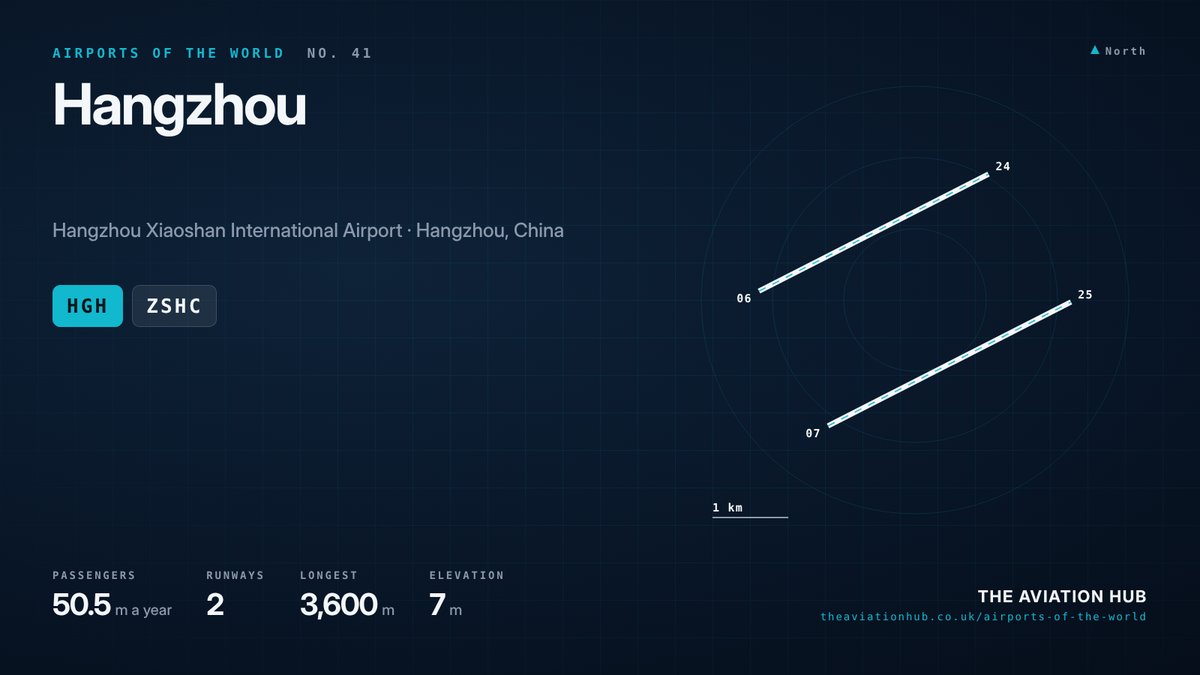
Hangzhou Xiaoshan International Airport sits on the south bank of the Qiantang River, about 17 miles (27 km) east of downtown Hangzhou in Zhejiang Province. It handled just over 50 million passengers in 2025, which places it seventh among mainland Chinese airports. Hangzhou Airport has grown from a modest replacement for a dual use military field into one of the main gateways to the Yangtze River Delta. Many visitors to West Lake, the Alibaba campus and the wider province now arrive here rather than through Shanghai.
Hangzhou Airport at a Glance
The airport carries the IATA code HGH and the ICAO code ZSHC. It lies in Xiaoshan District at an elevation of just 7 metres (23 feet), on flat reclaimed land near the river mouth. Two concrete runways and four terminal buildings make up the passenger side of the site. Hangzhou Xiaoshan International Airport Co. Ltd operates the field on behalf of the provincial and municipal governments.
Traffic in 2025 reached around 50.5 million passengers, up roughly five per cent on the previous year, with close to 330,000 aircraft movements. Cargo throughput of roughly 790,000 tonnes reflects the presence of SF Airlines, the express carrier that uses the field as a hub. Loong Air and XiamenAir also base aircraft here. Air China, China Eastern, China Southern, Hainan Airlines and Sichuan Airlines treat Hangzhou Airport as a focus city. Practical details on parking and terminal maps are on the airport’s official website.
How Hangzhou’s Airport Came to Be
Before 2000, commercial flights used Jianqiao Airport, a cramped field shared with the military on the north side of the city. Construction of the new civil airport in Xiaoshan began in July 1997. The first phase opened on 30 December 2000 and Jianqiao reverted to purely military use. International status followed in March 2004, opening the door to flights to Hong Kong, Macau, Taiwan and the wider region.
The field inherited a hub role from CNAC Zhejiang, a regional carrier later folded into Air China. KLM started the first intercontinental service in May 2010 with a route to Amsterdam, although that link no longer runs. The second runway and Terminal 3 arrived under Phase II, with the runway entering service on 30 December 2012.
Phase III was timed for the 19th Asian Games, which Hangzhou hosted in 2023. It passed acceptance in March 2022 and formally opened on 22 September that year. The centrepiece is Terminal 4, a 720,000 square metre building whose roof draws on the lotus flowers of West Lake. That project lifted Hangzhou Airport into a different league and set it up as East China’s second major hub after Shanghai.
Runways at Hangzhou Airport
Two parallel concrete runways serve the field. Runway 07/25 is the original strip at 3,600 metres (11,811 feet) long and 45 metres wide. Runway 06/24 is the 2012 addition at 3,400 metres (11,155 feet) long and 60 metres wide, built from the outset to accept the Airbus A380. The two are parallel and widely spaced, yet they carry different numbers rather than an L and R suffix.
Both runways are long enough for fully laden wide body departures to Europe and North America. The flow tends to follow the monsoon, with easterly operations on 07 and 06 in summer and westerlies in winter switching the flow to 25 and 24.
The low lying coastal site rarely troubles pilots with terrain, but fog and typhoon season can disrupt schedules. Hangzhou Airport also has a reputation for the mysterious. In July 2010 controllers closed the field for about an hour after radar detected an unidentified object, delaying 18 flights and sparking worldwide media speculation that was never fully explained.
Terminals and Airlines
Terminal 1 and Terminal 3 handle domestic traffic and sit side by side on the original terminal apron. These two buildings absorb the bulk of the trunk routes to Beijing, Guangzhou, Shenzhen and Chengdu, with Air China, China Eastern and China Southern filling most gates. Loong Air, the home town carrier whose headquarters sits on airport property, also operates from this complex.
Terminal 2 is the smallest of the four. For years it was the international and regional building, handling Hong Kong, Macau and Taiwan flights. Terminal 4 took over that role when it opened for trial operations in September 2022. The newest building was designed for 50 million passengers on its own and hosts international and regional services alongside a growing share of domestic flights.
XiamenAir runs a sizeable base here as its northern foothold in the Yangtze River Delta, while Hainan Airlines and Sichuan Airlines use the field for secondary hub flying. Cathay Pacific, Korean Air, All Nippon Airways, Singapore Airlines, Emirates and Qatar Airways are among the foreign carriers present. Beijing Capital Airlines provides the European links, with flights to Lisbon and Madrid.
Routes and Destinations
Domestic flying dominates the schedule. Beijing, Guangzhou, Shenzhen, Chengdu, Chongqing, Xi’an and Kunming are the thickest routes, with departures every hour or better on the busiest. Shanghai is too close to justify air service, so the Pudong and Hongqiao connection runs by high speed rail instead.
International service concentrates on East and Southeast Asia. Tokyo, Osaka, Seoul, Bangkok, Singapore, Kuala Lumpur and Hong Kong all see regular departures. Beyond the region, Hangzhou Airport offers direct flights to Doha with Qatar Airways, Dubai with Emirates, Cairo with Egyptair and a growing list of Chinese carrier routes to Europe and Oceania. The longest sectors run to Lisbon, Madrid and Auckland.
Cargo matters more here than at most Chinese airports of similar size. SF Airlines, the airline arm of the express giant SF Express, routes a large share of its night network through its Hangzhou hub. That brings a steady stream of Boeing 757 and 767 freighters, plus occasional larger types, to the cargo apron.
Getting to and from Hangzhou Airport
Hangzhou Metro reaches the terminals at Xiaoshan International Airport station, which connects to Lines 1, 7 and 19. Line 19 is the quickest option to the city centre and Hangzhou East railway station, with a journey of around 25 minutes. Line 1 runs to the historic core near West Lake in roughly 50 minutes. Fares are a few yuan, making the metro the cheapest sensible option.
Airport buses leave from outside the arrivals halls for the downtown ticketing office on Tiyuchang Road and for cities across Zhejiang and into Jiangsu. By road, the Airport Expressway crosses the Qiantang River via Xixing Bridge and reaches the city in 30 to 45 minutes outside peak hours. The G92 Hangzhou Bay Ring Expressway has a dedicated airport exit for traffic from Ningbo and Shaoxing. A taxi to the West Lake area costs roughly CNY 120 to 150 (around £13 to £17). Multi storey car parks serve each terminal.
Spotting and Photography
Spotting at Chinese airports requires discretion, and Hangzhou is no exception. The best public views come from the departure road elevated ramps and the car park roofs, which overlook the aprons outside Terminal 3 and Terminal 4. Window seats in the Terminal 4 departure lounges give clean views across the international stands and the A380 capable Runway 06/24.
Fields and lanes to the west of the runways offer approach shots when easterly operations put arrivals on 07 and 06. Morning light favours the southern side of the field, while late afternoon suits the northern perimeter. Keep cameras pointed at aircraft rather than security infrastructure, stay well back from fences and move on if asked by police. Long lenses and tripods attract attention, so a compact setup works best.
What Comes Next
With Terminal 4 open and the second runway long established, the airport has capacity to grow for several years. Planners have discussed a third runway, although no construction date has been confirmed. Nearer term work focuses on filling Terminal 4 with more international routes and improving transfer links with Shanghai Pudong.
The main constraint is competition rather than concrete. Shanghai Pudong, within reach by train, still attracts most of the region’s intercontinental traffic. Yet the growth of Hangzhou as a technology capital gives Hangzhou Airport a strong local market that Shanghai cannot serve directly. Expect steady expansion of Asian and European routes rather than dramatic change. Compare it with its neighbours on our Airports of the World map.
Continue to follow The Aviation Hub for more analysis and insight.
Advertise with us Your brand, in front of an aviation audience Home page and in-article placements, sold directly, one advertiser per slot. From £250 a year. See the rates

