
Hanoi Airport Guide: Vietnam’s Northern Gateway at Noi Bai
Hanoi Airport at Noi Bai is the hub of Vietnam Airlines and the gateway to northern Vietnam. Read about its runways, terminals, routes, access and spotting.
 By The Aviation Hub
6 min read
Updated October 20, 2026
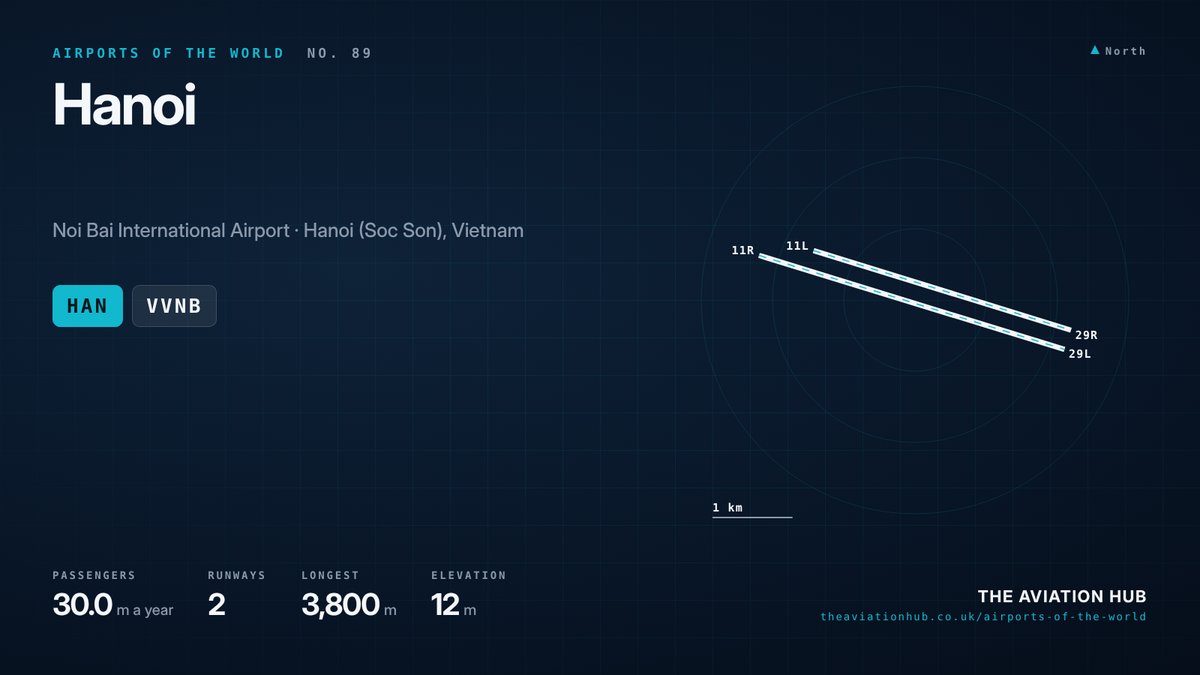
Noi Bai International Airport is the main airport for Hanoi and the whole of northern Vietnam. It lies in Soc Son District, about 22 miles (35 km) north of the Old Quarter, on the far side of the Red River. Around 30 million passengers a year pass through Hanoi Airport, and the figure is climbing fast as Vietnam’s tourism and manufacturing boom. Vietnam Airlines runs its northern hub here, VietJet and Bamboo Airways base aircraft, and the route to Ho Chi Minh City is one of the busiest air corridors on the planet.
Hanoi Airport at a Glance
The codes are HAN and VVNB. The field sits at 39 ft (12 m) above sea level on the flat alluvial plain of the Red River delta, 22 miles (35 km) from the city centre via the Nhat Tan Bridge and the airport expressway. Phuc Yen Air Base, home to Vietnamese air force fighters, lies immediately to the north and shares the airspace.
Hanoi Airport has two parallel runways and two terminals, one domestic and one international. Traffic was 29.3 million in 2019 and has returned to around 30 million since the post pandemic recovery, with the busiest months in summer and around the Tet holiday. Vietnam Airlines is the hub carrier and a SkyTeam member, and VietJet Air, Bamboo Airways and Vietravel Airlines all have bases. The state owned Airports Corporation of Vietnam operates the field. Flight information is on the airport’s official website.
How Hanoi’s Airport Came to Be
Hanoi flew from Gia Lam, a French colonial airfield on the east bank of the Red River, through the colonial era and the war years. Gia Lam was cramped and exposed, so after reunification the government built a civil airport beside the existing military base at Noi Bai, taking its name from the local commune. The new field opened on 2 January 1978.
In its early years the airport served flights only to friendly states, with airlines from the communist bloc the main foreign visitors. Economic reforms in the late 1980s opened the country, and traffic grew steadily through the 1990s. A new domestic terminal, now Terminal 1, was completed in 2001 and expanded in 2013. The second runway opened in August 2006.
The turning point was Terminal 2, built with Japanese development loans and inaugurated on 4 January 2015 together with the Nhat Tan Bridge and a new expressway to the city. Passenger numbers have roughly doubled since.
Runways at Hanoi Airport
Runway 11R/29L is the main strip at 3,800 m (12,466 ft) long and 45 m (148 ft) wide, with a concrete surface. It opened in 2006 and takes the heavy departures, including the Vietnam Airlines Boeing 787-9 and Airbus A350-900 flights to Europe and Australia. Runway 11L/29R is the original at 3,200 m (10,499 ft) long and the same width, also in concrete. Both have Category II instrument landing systems.
The two runways are only 250 m apart, which is the airport’s structural weakness. ICAO rules do not allow independent parallel operations at that spacing, so Hanoi Airport effectively works as a single runway field with a spare. That limits movements per hour and explains why the master plan calls for a third runway much further away.
The wind decides whether the 11 or the 29 ends are in use. Low cloud and drizzle in the cool season, from December to March, cause the most delays. Summer brings heavy thunderstorms and the occasional typhoon off the Gulf of Tonkin.
Terminals and Airlines
Terminal 1 handles all domestic flights. It is the older building, enlarged several times, and is dominated by the three big Vietnamese carriers. Vietnam Airlines occupies the central halls with its Airbus A321neo fleet, while VietJet’s bright red A320 and A321 aircraft fill the remaining gates. Bamboo Airways and Vietravel Airlines use the remaining desks. The building is busy and functional rather than beautiful.
Terminal 2 takes every international flight at Hanoi Airport. It was built by the Japanese contractor Taisei, has a long curved roof and opened in 2015 with a capacity of 10 million passengers. Vietnam Airlines and its SkyTeam partners, including Korean Air and China Airlines, share it with Emirates, Qatar Airways, Cathay Pacific, Singapore Airlines, ANA, Japan Airlines, Thai Airways and the regional low cost carriers. Free electric shuttle buses link the two terminals in about five minutes.
Transit passengers can connect through Terminal 2 without a visa if they stay airside. Work began in May 2025 to raise its capacity to 15 million.
Routes and Destinations
The Hanoi to Ho Chi Minh City route is the headline act. With around 475 flights a week and close to 11 million passengers in 2023, it is the busiest route in South East Asia and the fourth busiest in the world. Da Nang follows at around 320 weekly flights, with Nha Trang, Phu Quoc, Da Lat and Hue also strong. Domestic flying accounts for roughly two thirds of all traffic.
Seoul Incheon is the busiest international destination at more than 100 flights a week, reflecting the huge Korean investment presence in the north. Singapore, Bangkok, Taipei and Kuala Lumpur follow. Vietnam Airlines flies Boeing 787s and A350s to Paris, Frankfurt, London Heathrow, Munich, Milan, Sydney and Melbourne. The London Heathrow route, at around 5,750 miles (9,250 km), is the longest from Hanoi Airport.
Getting to and from Hanoi Airport
There is no rail link yet. Hanoi Metro lines 2 and 6 are planned to reach the airport, but neither is built. Road is the only way in, and the Nhat Tan Bridge expressway has cut the journey to the Old Quarter to around 35 to 45 minutes in normal traffic.
The cheapest sensible option is bus 86, an express service that runs from both terminals to the Old Quarter and Hanoi Railway Station for 45,000 dong (around £1.40), taking 50 to 60 minutes. Airport minibuses run by the airlines serve the city for a little more. Taxis and Grab ride hailing cars cost roughly 250,000 to 400,000 dong (£8 to £12) to the centre.
Both terminals have car parks in front, and most hotels offer pre booked transfers. National Road 3 gives a slower alternative route into eastern Hanoi.
Spotting and Photography
Hanoi Airport is an awkward place to spot because the air force base next door makes the authorities nervous. The best views are from inside Terminal 2, where the departure piers have large windows facing the international apron and the runways beyond. The Vietnam Airlines 787s, Emirates Boeing 777s and the colourful VietJet fleet pass close by.
Outside, the roads beyond the eastern end of the runways in Soc Son give views of arrivals when the airport lands to the west. Morning light favours the south side. Winter haze and drizzle flatten the light for weeks at a time, so autumn gives the clearest conditions.
Never photograph the military side of the field or anything in air force markings. Keep away from the perimeter fence, stay on public roads and comply at once if police ask you to stop. Airside photography from the terminal is generally tolerated.
What Comes Next
The master plan is ambitious. The government targets 63 million passengers a year by 2030 and 100 million by 2050, which means a Terminal 3, a third runway well away from the current pair, and eventually a fourth. The Terminal 2 expansion to 15 million is the first step, and a new southern terminal area is under study.
The constraint is the runway spacing, and nothing short of a new runway fixes it. The metro extension would relieve the expressway, and the long awaited rail link is now a matter of when rather than whether. Vietnam Airlines’ long haul growth and VietJet’s regional expansion will keep demand rising.
Hanoi Airport is bursting at the seams and Vietnam knows it. Compare it with the other South East Asian hubs on the Airports of the World map.
Continue to follow The Aviation Hub for more analysis and insight.
Advertise with us Your brand, in front of an aviation audience Home page and in-article placements, sold directly, one advertiser per slot. From £250 a year. See the rates

