
Hartford Airport Guide: New England’s Quiet Transatlantic Gateway
Hartford Airport, better known as Bradley International, serves Connecticut and western Massachusetts. Runways, airlines, routes and spotting spots explained.
 By The Aviation Hub
7 min read
Updated October 20, 2026
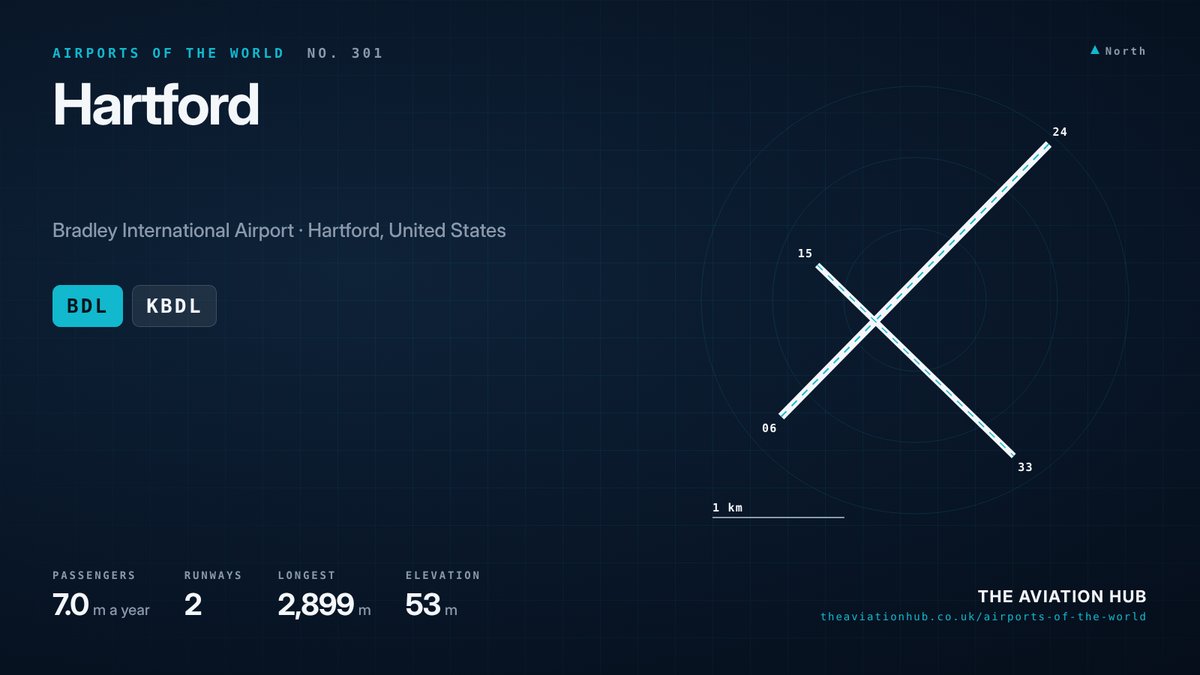
Bradley International sits in Windsor Locks, Connecticut, roughly halfway between Hartford and Springfield, Massachusetts. Most travellers simply call it Hartford Airport, and it is the main commercial gateway for Connecticut and the Pioneer Valley. Around 6.7 million passengers used it in 2025, which puts it well behind Boston Logan but comfortably ahead of every other New England field. Breeze Airways runs a base here, Aer Lingus flies to Dublin, and the Connecticut Air National Guard shares the runways. It is a calm, easy airport with a surprisingly deep history.
Hartford Airport at a Glance
The IATA code is BDL and the ICAO code is KBDL. The field lies about 15 miles (24 km) north of downtown Hartford and roughly 12 miles (19 km) south of Springfield. Elevation is 173 feet (53 m). There are two asphalt runways and a single main passenger terminal, Terminal A, plus a small International Arrivals Building known as Terminal B.
The Connecticut Airport Authority has run Hartford Airport since 2013, taking it over from the state Department of Transportation. Passenger numbers in 2025 came in at roughly 6.66 million, almost flat on 2024. American, Delta, Southwest, JetBlue and Breeze carry the bulk of the traffic. Operational details, parking rates and flight status are published on the airport’s official website.
How Hartford’s Airport Came to Be
Connecticut bought around 1,700 acres of tobacco farmland at Windsor Locks in 1940 with a civil airport in mind. The United States Army took the land in 1941 as the country prepared for war, and it became an Army Air Forces base. That August a 24 year old pilot, Lieutenant Eugene M. Bradley, died when his Curtiss P-40 crashed during a training dogfight. The base took his name, and Bradley Field it remained for decades.
Civil flying began in 1947, when Eastern Air Lines operated the first scheduled service. The federal government handed the field to the state a year later. The Murphy Terminal opened in 1952, and the airport grew steadily through the jet age as Hartford’s insurance industry generated business traffic. A tornado tore through the site in 1979, damaging the neighbouring New England Air Museum.
Terminal A opened in 1986 and has been extended several times since. The old Murphy Terminal was demolished in the 2010s, and a $210 million Ground Transportation Center opened in 2022. One oddity from the 1970s is a people mover system that was built but never carried a passenger. Its cars survive at a trolley museum.
Runways at Hartford Airport
Hartford Airport operates two intersecting asphalt runways. The main runway, 06/24, measures 2,899 m (9,510 ft) and is 61 m wide. It handles virtually all airline traffic and is long enough for wide body jets. Runway 24 is the usual landing direction when westerly winds prevail, bringing aircraft in from the north east across the Connecticut River valley.
The crosswind runway, 15/33, runs 2,087 m (6,847 ft) with a width of 46 m. It comes into its own when strong northwesterly or southerly winds make 06/24 uncomfortable, and it also serves general aviation and the Air National Guard’s Lockheed C-130H Hercules fleet. The 103rd Airlift Wing leases 144 acres in the south west corner of the field. The surrounding grassland is also important habitat for grassland birds.
Terminals and Airlines
Terminal A is the heart of Hartford Airport and splits into an East Concourse and a West Concourse. The East Concourse has gates 1 to 12, and the West Concourse covers gates 18 to 30. A 2026 extension added a new pier with three further gates, and an in line baggage screening hall of about 80,000 square feet opened in 2025 along with new exit corridors.
Terminal B is the International Arrivals Building. It has a single gate and exists to process inbound flights that need United States Customs clearance, chiefly the Aer Lingus arrival from Dublin. Outbound international passengers still depart from Terminal A. The Escape Lounge reopened in February 2026 after an expansion, and it remains the only proper pay in lounge on the field.
Breeze Airways is the one carrier with a crew and aircraft base at Bradley, flying Airbus A220-300s to leisure cities along the East Coast and across to the Midwest. Avelo Airlines announced a base in 2024 but pulled out entirely in October 2025. Southwest operates its Boeing 737-700 and 737-800 fleet, while the big three network carriers send a mix of Embraer E175s, Airbus A320 family jets and Boeing 737s.
Routes and Destinations
Hartford Airport is a spoke rather than a hub, so its busiest routes point at the major connecting airports. Atlanta leads, followed by Orlando, Charlotte, Chicago O’Hare and Baltimore. Delta feeds Atlanta and Detroit, American concentrates on Charlotte and Dallas Fort Worth, and United serves Chicago, Houston, Denver and Washington Dulles. JetBlue and Southwest fill in the Florida leisure market with heavy winter frequencies to Orlando, Fort Lauderdale, Tampa and Fort Myers.
The longest route by distance is the Aer Lingus service to Dublin, which started in 2016 and has run year round. It gives Connecticut passengers a one stop path to most of Europe. The longest westbound flights reach Las Vegas and, seasonally, Phoenix with Breeze, and Breeze also adds thinner markets such as Charleston, Savannah and Norfolk.
Seasonality is pronounced. Winter brings Florida sun flights and Sun Country’s seasonal Minneapolis service, while summer brings seasonal Breeze routes to the Carolinas and the Midwest. Cargo is a growing side business. FedEx and UPS operate freighters, and the Connecticut Airport Authority is actively courting more.
Getting to and from Hartford Airport
Driving remains the default. Hartford Airport sits a short distance off Interstate 91 at exit 40, and the 15 mile run into central Hartford takes about 25 minutes outside rush hour. Springfield is a similar drive north. Parking spreads across the garage next to the terminal, surface lots and economy lots served by shuttle, with the lowest long stay rates in the economy lots.
Public transport works if you plan ahead. CTtransit Route 30, branded the Bradley Flyer, runs a semi express bus to Hartford Union Station for a standard fare of $1.75, the cheapest sensible option by a distance. Route 24 links the terminal with Windsor Locks railway station on the Hartford Line, where CTrail and Amtrak trains reach Hartford, New Haven and Springfield. A taxi or ride share to downtown Hartford costs roughly $45 to $55. Hire cars and ride share pickups gather in the Ground Transportation Center across from Terminal A.
Spotting and Photography
Bradley is a relaxed place to watch aircraft, and the New England Air Museum on the western edge of the field is the natural starting point. Its car park and the surrounding roads give a line of sight to the approach to runway 06 and towards the C-130 ramp. Roads on the south side offer views of runway 24 arrivals, with afternoon sun behind the photographer for most of the year.
Runway 24 arrivals are the most photogenic, especially on winter afternoons when the light is low and clear. On easterly winds, traffic flips to runway 06 and arrivals come in from the south west, past the air museum side. Expect a steady diet of Airbus A220s, A320s, Boeing 737s and Embraer E175s, with the Aer Lingus Airbus and the occasional military visitor as highlights. Stay outside the fence, keep clear of the National Guard gates, and expect airport police to ask what you are doing. A polite answer usually ends the conversation.
What Comes Next
Hartford Airport has spent the 2020s rebuilding its landside and airside piece by piece. The Ground Transportation Center, the new baggage screening hall and the Terminal A extension have added capacity without the disruption of a wholesale rebuild. A long standing plan to redevelop the Terminal B site into a second passenger terminal remains on paper, and it only makes sense if international traffic grows beyond a single daily Dublin flight.
The bigger opportunity lies in cargo and in winning back a second low cost base after Avelo’s exit. Bradley has a long runway, cheap parking, spare gates and a catchment of several million people within an hour’s drive. The verdict is that this is a stable mid sized airport with room to grow, and it is likely to keep adding routes rather than terminals. You can see how it compares with its neighbours on our Airports of the World map.
Continue to follow The Aviation Hub for more analysis and insight.
Advertise with us Your brand, in front of an aviation audience Home page and in-article placements, sold directly, one advertiser per slot. From £250 a year. See the rates

