

Every fast-jet pilot the Royal Air Force and Royal Navy produce passes through a single base, flying a single fleet of Hawk T2 aircraft. On 23 September, one of those aircraft crashed at RAF Valley shortly after take-off, and the entire UK fast-jet training system stopped with it.
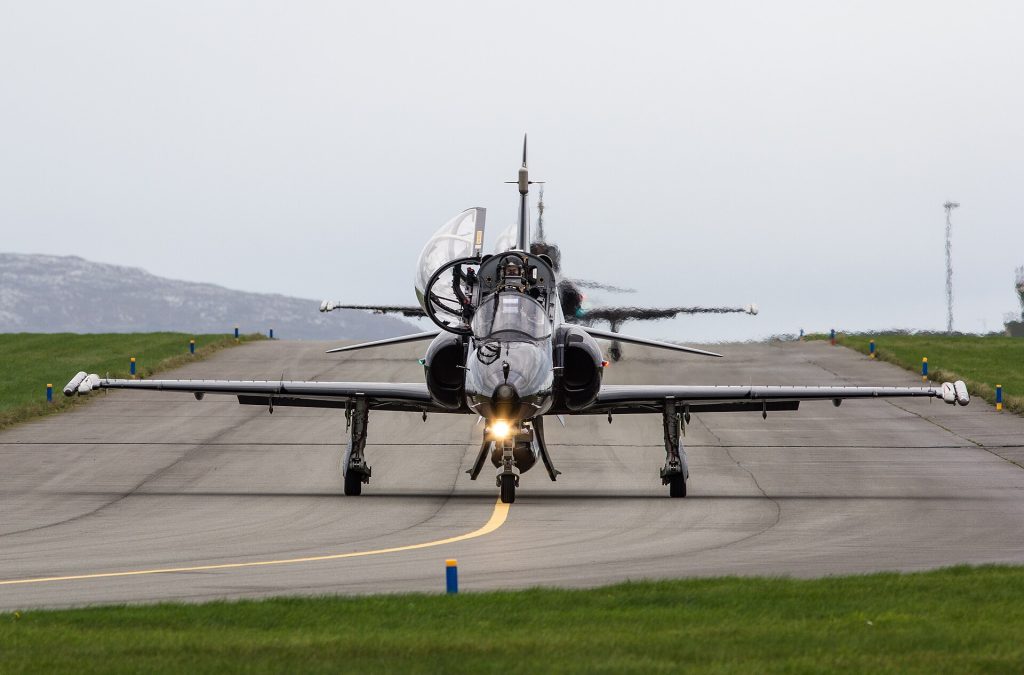
Both crew members ejected before the crash. The Royal Air Force said "Both pilots are doing well … and expected to make a full recovery," a statement Breaking Defense also reported. A formal investigation has been launched. No cause has been established, and we will not speculate about one. Track further developments in our Squawk 7700 incident archive.
One Base, One Hawk T2 Fleet, No Redundancy
Breaking Defense reports that No 4 Flying Training School at RAF Valley operates all 28 of the RAF's Hawk T2 aircraft, the sole platform for both RAF and Royal Navy fast-jet pilot training. The War Zone reported that the Hawk T2 fleet entered service in 2009, while the older Hawk T1, also based at Valley, first entered service in 1976. The RAF temporarily paused all Hawk T1 and T2 flying operations following the crash, meaning the grounding also covers the Red Arrows, who fly the T1, as ADS Advance (ADS Group's UK aerospace and defence trade body news platform) and Breaking Defense both reported.
ADS Advance reports that no timetable for resuming Hawk operations has been given. Defence Secretary Wes Streeting said: "We're investigating how and why this happened."
A Pipeline That Was Already Under Pressure
The 23 September crash did not create a fragile system. It exposed one that had been under strain for years. ADS Advance reports that the MoD has itself described the fast-jet training pipeline as "taut," which is a significant admission from the customer responsible for funding it.
The problems are rooted in the airframe itself. A fault discovered in 2022 in the low-pressure compressor of the Hawk T2's Rolls-Royce Adour 951 engine cut the aircraft's planned design life from 4,000 hours to just 1,700 hours, according to ADS Advance and The War Zone. The knock-on effect was severe: across 2022 and 2023, flying hours ran at roughly half the contracted level and an average of only eight Hawk T2s were serviceable on any given day, ADS Advance and The War Zone report. A further blow came in 2023, when The War Zone reported that the whole Hawk T2 fleet was stood down following a separate engine-related runway incident.
By the time of the September crash, the RAF had been managing a severely degraded fleet for the better part of three years.
Instructors, Overseas Courses and the Numbers Behind the Shortfall
A shortage of qualified instructors has made the aircraft availability crisis worse still. As cited by Aerospace Global News, The Telegraph reported that only 17 Hawk T2 flight instructors were qualified in the RAF at the close of 2024. By July 2025 that number had climbed to 23, with a further rise to 26 anticipated by January 2026.
To help close the gap, India has deployed three Qualified Flying Instructors to RAF Valley for an initial two-year posting, The Telegraph reported. India's Hawk fleet is licence-built by Hindustan Aeronautics Limited, The Telegraph noted, giving Indian QFIs direct type experience. Armada International (defence and technology journal) and The Telegraph both noted that this is the first time Indian QFIs have trained RAF fighter pilots in the UK.
Overseas postings have formed part of the RAF's response to the training backlog. Courses in the United States, Italy and Qatar have been used to supplement domestic fast-jet training, ADS Advance reports. According to Armada International, UK pilots began attending the International Flight Training School at Decimomannu in Sardinia from July 2023, while RAF instructors have also gone through the Euro-NATO Joint Jet Pilot Training programme at Sheppard Air Force Base in Texas. Six RAF pilots completed training at the IFTS across 2024 and 2025, with two more expected to do so in 2025 and 2026 and three in 2026 and 2027, Armada International reports.
A structural overhaul of the training pipeline has also been pursued. The Telegraph reported that the MoD cut the fast-jet pilot training timeline from 248 weeks in 2022 down to 187 weeks, a reform that underlines how acutely the bottleneck was being felt well before the latest grounding.
Ascent Flight Training, the contracted operator of the UK Military Flying Training System at RAF Valley, is investing in multi-year, multi-million-pound simulator upgrades for both Hawk and Texan training aircraft at the base, work that takes on added weight now that live flying is paused.
You can explore the Hawk T2's specifications and variants in our Aircraft Search.
The Replacement Question the Review Has Already Answered
Replacing the Hawk T2 with a cheaper fast-jet trainer was among the recommendations of the 2025 Strategic Defence Review, as noted by Armada International and The War Zone. In August the MoD put out a request for information covering both Hawk variants as a first move towards procuring a successor, Breaking Defense reports. Prime Minister Sir Keir Starmer said: "I do think it's right that we upgrade them – and that's what we're doing."
Among the contenders identified by Breaking Defense and The War Zone are the Leonardo M-346, the Lockheed Martin TF-50, the Turkish Aerospace Hürjet and British startup Aeralis. Boeing, Saab and BAE Systems have put their names to a letter of intent to pitch the T-7A Red Hawk to the RAF, with assembly planned to take place in the UK and deliveries targeted from 2030, The War Zone reported.
A 2030 delivery date means the RAF must sustain Hawk T2 operations for at least five more years. The crash and its investigation make the timeline for returning to flying entirely uncertain.
The Bottom Line
The Hawk T2 grounding is not simply a consequence of one accident. It is the latest stress on a system that the MoD's own language acknowledged was already under strain. A fleet of 28 aircraft, many with sharply reduced service lives, operated from a single base with an instructor corps that was only just reaching adequate strength, was never going to absorb a full grounding without consequence for the pilot pipeline.
The overseas training arrangements and the Indian QFI deployment show that contingency thinking has been underway. What they also show is that no single measure is sufficient on its own. The replacement programme is real, but the timelines are long. Until a successor aircraft enters service, the Hawk T2 remains the only bridge between a trainee and a front-line fast jet, and the events of 23 September have made that bridge look narrower than it was.
We will update our coverage if the RAF or the investigating authority releases further findings on the crash.
This article draws on information from Ascent Flight Training (UKMFTS contracted operator) and reporting by ADS Advance (ADS Group — UK aerospace & defence trade body's news platform), Breaking Defense, Armada International (defence & technology journal), Aerospace Global News and The War Zone.
Continue to follow The Aviation Hub for more analysis and insight.
Advertise with us Your brand, in front of an aviation audience Home page and in-article placements, sold directly, one advertiser per slot. From £250 a year. See the rates

This is a concerning look at the current state of RAF training. It’s alarming to think that operational preparedness could be impacted by a grounding crisis. Hopefully, we can find solutions quickly to ensure our pilots are ready for the challenges they face. Great post!