
Hefei Airport Guide: Xinqiao and the Rise of Anhui’s Capital
Hefei Airport opened in 2013 and now handles 12.6 million passengers a year. Explore its history, runway, airlines, routes, transport links and plans.
 By The Aviation Hub
5 min read
Updated October 20, 2026
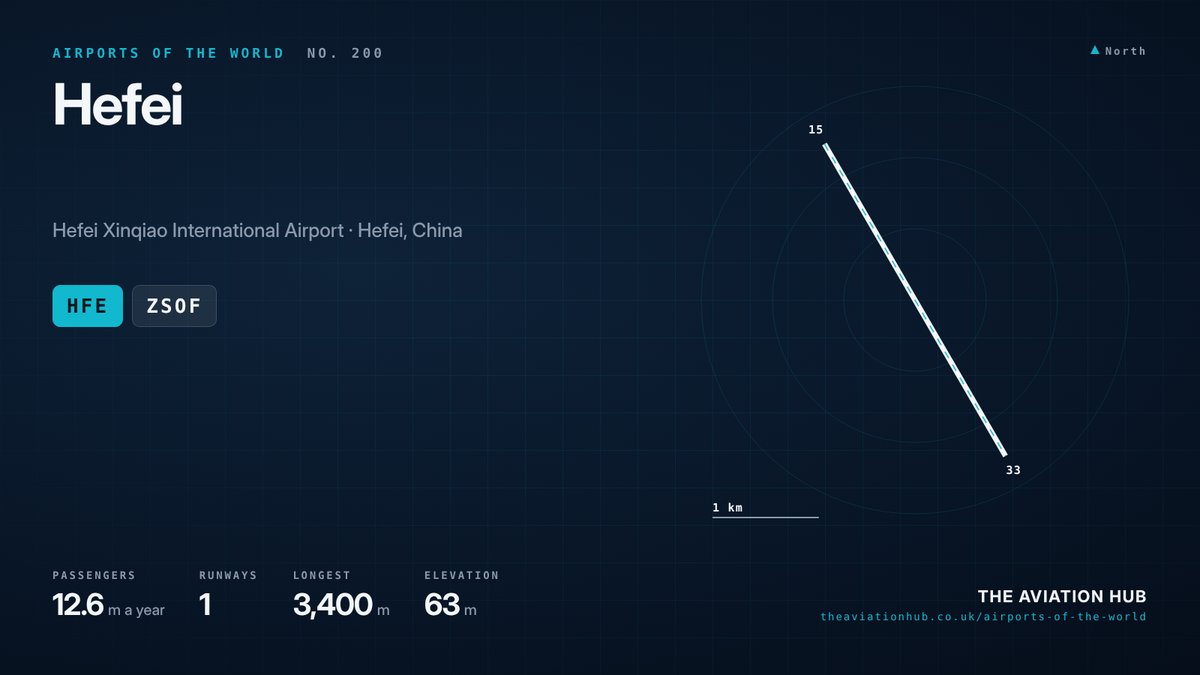
Hefei Airport, officially Hefei Xinqiao International Airport, is the main air gateway to Anhui province in eastern China. It opened in 2013 on open land northwest of Hefei, a city that has turned itself into a centre for electric vehicles, display panels and semiconductors. Around 12.6 million passengers used it in 2025. A single runway and one large terminal handle the traffic today, with a far bigger second phase planned.
Hefei Airport at a Glance
The IATA code is HFE and the ICAO code is ZSOF. The airport lies about 20 miles (32 km) northwest of central Hefei. Elevation is 63 metres (207 feet). There is one runway and one passenger terminal of 108,500 square metres.
Hefei Airport handled 12,644,989 passengers in 2025, up 1.3 per cent on the year before. Aircraft movements fell slightly to 97,281, while cargo reached about 136,500 tonnes. China Eastern Airlines treats Hefei as a focus city and has the widest network. The first phase was designed for 11 million passengers a year, a figure the airport has already passed. Flight information is available on the airport’s official website.
How Hefei’s Airport Came to Be
Hefei was a modest town when it became the capital of Anhui province in 1952, and its population grew rapidly in the decades that followed. For most of that time it relied on Luogang Airport, close to the city centre. As Hefei grew from a modest provincial capital into a major industrial city, Luogang ran out of room. Its runway and terminal could not be expanded, and the urban area had wrapped around the site.
Construction of a replacement at Xinqiao began in December 2008, with a total investment of 3.728 billion yuan. The new airport takes its name from the local area. It opened on 30 May 2013, and all flights moved across from Luogang. The old airfield has since been turned into a large urban park, giving the city a green space where runways once stood.
Growth since opening has been rapid. The city’s bets on industries such as electric cars, flat screens and chips drew investment and business travellers. In December 2022 Condor launched flights to Frankfurt, but the route ended after a few months.
Runways at Hefei Airport
Hefei Airport has one concrete runway, 15/33, which is 3,400 metres (11,155 feet) long. The first phase was built to class 4E standard, which covers wide body aircraft such as the Boeing 777 and Airbus A330. The runway runs roughly north northwest to south southeast across flat farmland.
Wind decides the direction in use. Northerly winds in winter tend to favour runway 33, bringing arrivals in from the south. Summer southerlies and the East Asian monsoon bring more use of runway 15. Fog in winter and heavy summer rain are the main weather hazards.
The single runway is the airport’s main limit. Movements fell slightly in 2025 even as passenger numbers rose. The planned second phase includes far more airfield capacity to handle long term growth.
Terminals and Airlines
The single terminal handles both domestic and international flights. Its 108,500 square metres include check in halls, separate international processing and gates with air bridges along the main piers. Facilities are modern but straightforward, and the building is now busier than its original design intended.
China Eastern Airlines is the leading carrier at Hefei Airport, flying mainly Airbus A320 family jets. Air China, China Southern, Hainan Airlines, Shenzhen Airlines and Sichuan Airlines all serve the airport, with smaller carriers adding point to point links. Korean Air and Thai Lion Air provide international passenger services. Air Incheon and Kalitta Air operate freighters, with Kalitta flying to Anchorage.
Routes and Destinations
Beijing, Guangzhou and Shenzhen are among the busiest routes, with Chengdu, Chongqing, Kunming, Xi’an and Haikou close behind. Flights to Shanghai Pudong mostly serve connections, since high speed trains reach Shanghai in around two to three hours. China Eastern’s network also includes Beijing Daxing, Hong Kong and Macau. Winter flights to Hainan and the warm south peak around the Lunar New Year.
International passenger routes remain limited. Seoul, Bangkok and Singapore are the main foreign links, and charters serve other Asian holiday spots. Singapore is among the longest scheduled passenger routes. Cargo is a growing strength, with freighters carrying electronics and components for factories across Anhui to North America and Asia.
Getting to and from Hefei Airport
Most passengers reach Hefei Airport by road. Expressways link the terminal with the city, and the drive to the centre takes 40 minutes to an hour, depending on traffic. Taxis cost around 100 yuan to the downtown area.
Four airport shuttle bus lines connect the terminal with points across Hefei, including bus stations and city centre hotels. Fares are a flat 25 yuan or so, which makes the shuttle the cheapest sensible option. Some lines stop running in the early evening, so late arrivals should plan for a taxi or a ride hailing car. Parking is available in front of the terminal for those driving.
Spotting and Photography
The flat farmland around the airport gives open views. Rural roads near both runway ends offer sightlines to aircraft on short final, and the terminal windows look over the apron. The traffic is mostly A320 family and 737 types, with Korean Air and freighters adding variety.
Morning light favours the eastern side of the runway, while afternoon sun suits the west. Chinese airports treat perimeter photography cautiously, so stay on public roads, keep away from fences and stop if security staff ask. Respect local rules at all times.
What Comes Next
A planned second phase would lift capacity to 42 million passengers and 580,000 tonnes of cargo a year by 2040. That would mean more runway capacity, a much larger terminal complex and expanded freight facilities. Hefei’s leaders want the airport to support the city’s ambitions as an industrial and technology centre.
High speed rail will keep pressure on short domestic routes, since Hefei sits at the junction of several major lines. That pushes Hefei Airport towards longer flights, leisure routes and freight, where trains cannot compete. International growth is the main gap, and the brief Frankfurt link showed both the demand and the difficulty. Hefei Airport is heading for steady domestic growth, with a bigger role in cargo as its industries expand. Explore other Chinese airports on the Airports of the World map.
Continue to follow The Aviation Hub for more analysis and insight.
Advertise with us Your brand, in front of an aviation audience Home page and in-article placements, sold directly, one advertiser per slot. From £250 a year. See the rates

