
Helsinki Airport Guide: Finnair’s Hub Between Europe and Asia
Helsinki Airport at Vantaa is Finland's main gateway and the Finnair hub built for Asian transfers. Three runways, one terminal, routes and spotting.
 By The Aviation Hub
7 min read
Updated October 20, 2026
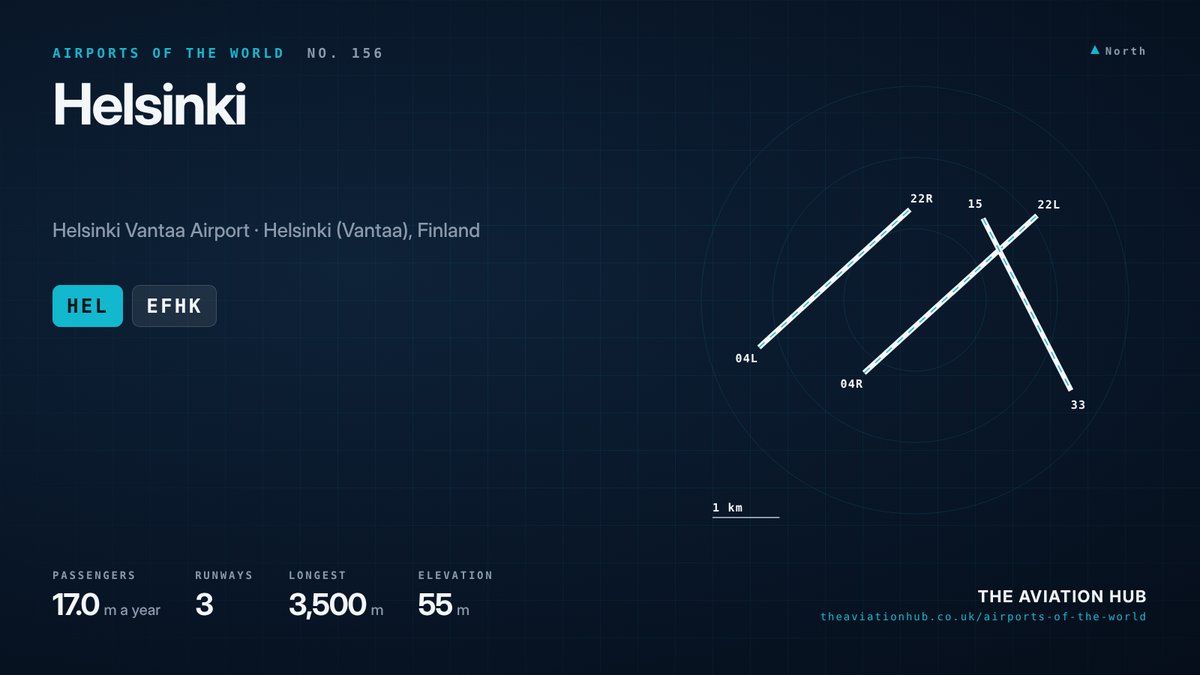
Helsinki Airport, long known as Helsinki Vantaa, sits in the city of Vantaa about 12 miles (20 km) north of the Finnish capital’s harbour front. It is the main airport of Finland and the hub of Finnair, which built its business on the short great circle route between Europe and north east Asia. Around 17 million passengers a year use its three runways and a single terminal completed in 2023 after a 900 million euro rebuild. The closure of Russian airspace in 2022 took away the geographical advantage, and the airport is still finding its new role.
Helsinki Airport at a Glance
The IATA code is HEL and the ICAO code is EFHK. The field lies in Vantaa, roughly 12 miles (20 km) north of central Helsinki, at an elevation of 55 m (179 ft) on a plateau beside Ring III. There are three runways and one terminal, divided into Schengen and non Schengen sections, after the former Terminals 1 and 2 were merged in June 2022. Gates 5 to 36 serve domestic and Schengen flights and gates 37 to 55 handle long haul and non Schengen traffic.
Helsinki Airport handled just under 17 million passengers in 2025, up about 4 per cent on 2024, with around 89 per cent of them international. That is still below the 21.9 million peak of 2019. Finnair and its regional partner Nordic Regional Airlines are the hub carriers, Norwegian keeps a base and SunClass Airlines uses it as a focus city. Finavia, the state owned airport company, operates it, and flight and parking details are on the airport’s official website.
A Short History of Helsinki Vantaa
Planning began in the 1940s because Helsinki Malmi, the pre war airport, could not take the heavier aircraft then arriving or the growth in passengers. The new site was chosen in open country at Seutula, and some of the construction was carried out by prison labour. The airport opened temporarily in July 1952 in time for the Helsinki Summer Olympics and became the city’s main airport soon after, with Malmi relegated to general aviation.
The name Helsinki Vantaa was adopted in 1977, the same year the Finnish Defence Forces surrounded the field over fears of a Red Army Faction attack and an Aeroflot aircraft was hijacked and forced to land here in a stand off that lasted three days. Finnair opened the Tokyo route in 1983 and built its Asian strategy around the short northern track, which drove the terminal expansions of the 1990s and 2000s.
A third runway opened in 2002, allowing parallel operations. In 2014 the airport introduced what was billed as the world’s first passenger tracking system, which monitored crowding in the terminal. The 900 million euro development programme, launched in 2014, delivered a new south pier, a west pier, a new check in and arrivals hall and the merger of the terminals, finishing in September 2023 with capacity for about 30 million passengers.
Runways at Helsinki Airport
Helsinki Airport has three asphalt runways, all 60 m wide. Runway 04R/22L is the longest at 3,500 m (11,483 ft) and the parallel 04L/22R measures 3,060 m (10,039 ft). The third, 15/33, is 2,901 m (9,518 ft) and crosses 04R/22L near its north eastern end. The parallels are far enough apart for independent operations, which gives the airport far more runway capacity than its traffic needs.
The preferred configuration has arrivals on 15 or 22L and departures on 22R towards the south west. In northerly or easterly winds, arrivals switch to 04L or 04R and departures use 04R. At night arrivals use 15 and departures 22R, keeping aircraft away from the densely populated areas to the south east. Finnair’s Airbus A350-900 fleet and the cargo Boeing 747-8 and 777F visitors use the long runway without restriction. Winter is the real test, and Finavia’s snow clearance teams can clear a runway in a matter of minutes, which is why Helsinki Airport almost never closes for weather.
Terminals and Airlines
The single terminal is long and linear, with the new Aukio plaza at its heart, a space with a circular screen that became the symbol of the rebuild. The Schengen area holds gates 5 to 36, and the non Schengen area runs through gates 37 to 55, where the wide body stands sit. Finnair’s premium and business lounges are in the non Schengen pier, with a separate Schengen lounge for European flights.
Finnair is by far the dominant airline, flying Airbus A320 family aircraft on European routes, Embraer E190 regional jets through Norra and A350s and A330-300s long haul. Its oneworld partners Qatar Airways and Japan Airlines are present. Norwegian is the largest low cost operator, Lufthansa, SAS, KLM, Air France and Turkish Airlines add the rival alliance networks, and Emirates flies to Dubai. Icelandair and airBaltic provide the Nordic and Baltic feed.
Routes and Destinations
Stockholm Arlanda is the busiest route, carrying around 1.07 million passengers in 2024, with London, Copenhagen, Amsterdam, Munich and Frankfurt behind it. Domestically, Rovaniemi leads with about 530,000 passengers a year, followed by Oulu, and the Lapland routes swell every winter with British and Asian visitors chasing the northern lights. Intercontinentally, Tokyo leads on roughly 354,000 passengers, with Bangkok and Seoul Incheon next.
The Russian airspace closure in 2022 added two to four hours to Asian routes and ended the airport’s role as the fastest link between Europe and north east Asia. Finnair has shifted capacity to the Middle East, India and North America, and Qatar Airways and Emirates now feed Asia via the Gulf. China Southern’s Beijing service from March 2026 and Finnair’s Melbourne route via Bangkok from October 2026 mark a partial rebuilding. Cargo is significant, with Finnair’s belly freight joined by freighters from Turkish Cargo, Qatar Airways Cargo, FedEx and UPS.
Getting to and from Helsinki Airport
The Ring Rail Line opened in July 2015 and put Helsinki Airport station directly under the terminal. HSL commuter trains I and P run in opposite directions around the loop every ten minutes through the day, reaching Helsinki Central in 29 to 34 minutes for an HSL zone ABC ticket of around 4 euros. That is the cheapest sensible option and the most reliable. Long distance VR trains connect at Tikkurila, about ten minutes down the line, for Tampere and the north.
HSL trunk buses 570 and 600 run around the clock, and night buses 415N and 431N fill the gaps. Coaches serve Tampere, Turku and other cities from the terminal forecourt. Taxis are limited to four Finavia contracted companies at the official rank, with the ride to the city centre costing roughly 45 to 55 euros (£38 to £47). Road access is from Ring III and national road 45, and multi storey car parks sit beside the terminal with cheaper long stay parking a shuttle ride away.
Spotting and Photography
Finavia welcomes spotters at Helsinki Airport more than most operators do. A scenic terrace by the terminal is open to all visitors and looks over the aprons and runways. Outside the fence, Finavia points photographers to the Tullimies cliff top, Ruskeasannantie near the old cemetery chapel and Sammonmäki at the junction of Puusepäntie and Kulomäentie. Katriinantie, opposite the DHL office, overlooks traffic on 04L/22R.
Summer gives almost continuous daylight, and the low midnight sun produces light that photographers elsewhere can only envy. Winter brings snow and the A350 fleet in dramatic conditions, but days are short and temperatures can fall below minus 20 degrees. Check which runways are in use before choosing a spot, as the airport switches between about twenty combinations. Stay on the terrace or public paths, keep clear of the cargo gates and remember that security patrols the perimeter.
What Comes Next
The physical airport is complete for now, with the 2023 programme leaving room for 30 million passengers against fewer than 17 million today. The question is demand, and that depends on when Russian airspace reopens and whether Finnair can rebuild its Asian network via longer routings. On the ground, the planned Lentorata rail tunnel would bring long distance trains directly under the terminal, and the Suomi rata high speed line to Tampere would connect it to the rest of Finland.
Helsinki Airport is heading into a decade of spare capacity, with its future tied to geopolitics rather than concrete. Compare it with the other Nordic hubs on our Airports of the World map.
Continue to follow The Aviation Hub for more analysis and insight.
Advertise with us Your brand, in front of an aviation audience Home page and in-article placements, sold directly, one advertiser per slot. From £250 a year. See the rates

