
Hohhot Airport Guide: Inner Mongolia’s White Pagoda Gateway
Hohhot Airport is the main gateway to Inner Mongolia, with 12.7 million passengers in 2025. Explore its history, runway, routes, metro link and future.
 By The Aviation Hub
5 min read
Updated October 20, 2026
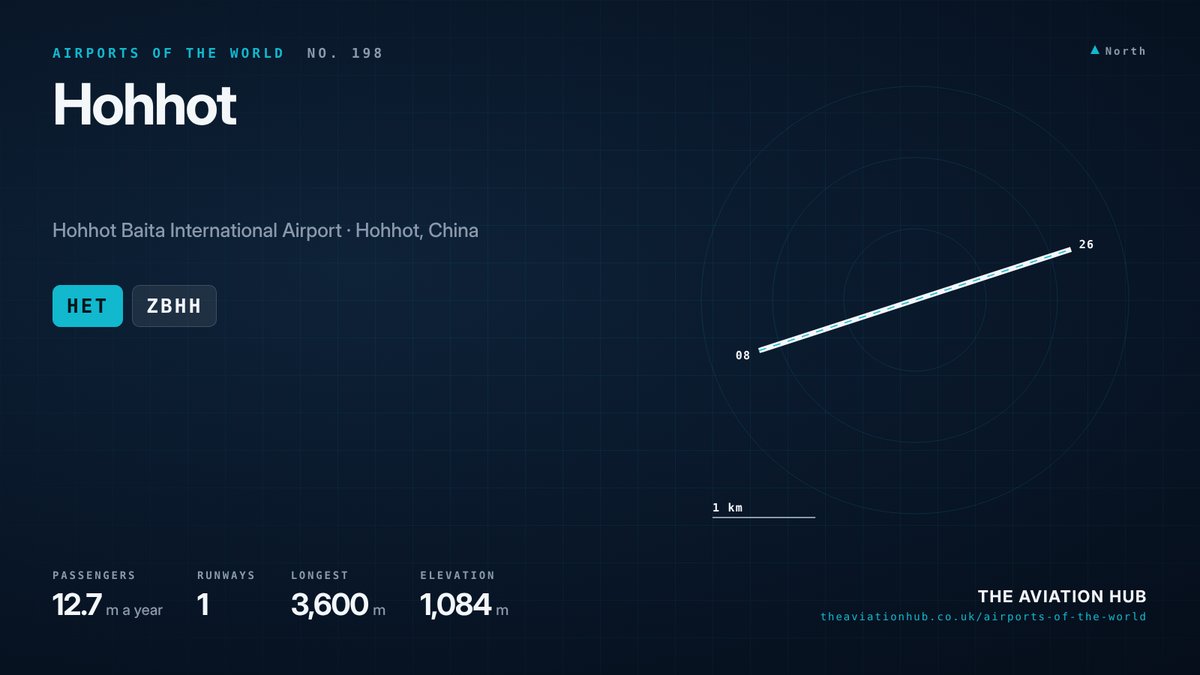
Hohhot Airport, officially Hohhot Baita International Airport, is the main air gateway to China’s Inner Mongolia Autonomous Region. It sits on the eastern edge of Hohhot, the regional capital, on the high plain north of the Yellow River. A record 12.7 million passengers used it in 2025. The city has grown around it so completely that a replacement airport takes over its flights from 26 November 2026.
Hohhot Airport at a Glance
The IATA code is HET and the ICAO code is ZBHH. The airport lies about 9 miles (14 km) east of downtown Hohhot. Elevation is 1,084 metres (3,556 feet), which makes it a moderately high field. There is one runway and a main passenger terminal opened in 2007, served by a metro station.
Hohhot Airport handled 12,722,692 passengers in 2025, along with 111,576 aircraft movements. Cargo passed 60,000 tonnes for the first time, reaching about 60,230 tonnes, and December 2025 set a monthly freight record. Air China has the largest network, supported by its regional subsidiary Air China Inner Mongolia. The airport planned 139 routes to 92 cities for 2025. Flight schedules are listed on the airport’s official website.
How Hohhot’s Airport Came to Be
The airport opened on 1 October 1958, the ninth anniversary of the People’s Republic. Facilities were basic: a dirt runway 1,500 metres long and 100 metres wide, three single storey buildings and five tents. For decades it handled a thin schedule of propeller flights to Beijing and other regional centres.
The name Baita means White Pagoda. It comes from the Wanbu Huayanjing Pagoda, a historic brick tower from the Liao dynasty standing about 3.5 miles (5.6 km) southeast of the airport. The pagoda remains one of the region’s best known landmarks.
Real growth arrived with China’s economic boom and Inner Mongolia’s coal and mining wealth. A new terminal opened in June 2007 with 54,499 square metres of floor space, 11 air bridges and capacity for 3 million passengers a year. The runway was later lengthened and widened to handle the largest aircraft. During the 2008 Beijing Olympics, the airport served as a diversion field for the capital’s traffic.
Runways at Hohhot Airport
Hohhot Airport has one concrete runway, 08/26, which is 3,600 metres (11,811 feet) long and 45 metres wide. It runs east to west across the plain. The upgrade work means it can accept aircraft up to the size of the Airbus A380, although daily traffic is dominated by Airbus A320 and Boeing 737 types.
The elevation matters. At more than 1,000 metres, thinner air lengthens take off runs, especially on hot summer afternoons. Winters are severe, with temperatures well below freezing, snow and strong winds. Spring brings dust storms off the Gobi and the Mongolian plateau, which can cut visibility sharply.
Wind direction decides which end is used, with westerly and northwesterly winds common through much of the year. That favours runway 26, bringing arrivals in from the east over open farmland. The single runway, with the city pressing in on every side, is now the airport’s hard limit.
Terminals and Airlines
The 2007 terminal is the heart of the airport and has been stretched far beyond its original design capacity. Its 11 air bridges serve the main apron, and remote stands handle the overflow at peak times. Facilities are practical, with regional food outlets and shops selling dairy products and Mongolian crafts.
Air China is the leading airline at Hohhot Airport, with around two dozen destinations including Beijing Capital, Shanghai Pudong and Ulaanbaatar. Air China Inner Mongolia flies Boeing 737 aircraft from a base here. China Eastern, China Southern, Hainan Airlines, Tianjin Airlines, Sichuan Airlines and Spring Airlines add domestic capacity. Genghis Khan Airlines, a regional carrier backed by the local government, links Hohhot with smaller towns across Inner Mongolia.
Routes and Destinations
Beijing is the most important route, though high speed rail now competes strongly on the journey to the capital. Shanghai, Guangzhou, Shenzhen, Chengdu, Hangzhou and Xi’an are the other trunk routes. The intra regional network is unusually dense, because Inner Mongolia stretches roughly 1,500 miles (2,400 km) from east to west. Flights reach Hailar, Manzhouli, Xilinhot, Chifeng, Tongliao, Ordos and Alxa, saving long road and rail journeys.
International services are limited. Ulaanbaatar, the Mongolian capital, is the signature foreign route. Seasonal and charter flights have linked Hohhot with Russia and Southeast Asia at various times. Summer is the peak season, when tourists head for the grasslands and the cooler northern climate.
Getting to and from Hohhot Airport
Metro Line 1 serves Hohhot Airport at Bayan station, also called Airport station. Trains run west into the city centre, reaching the main districts in around 30 minutes. Fares are a few yuan, which makes the metro the cheapest sensible option for most travellers.
Taxis wait outside arrivals and take around 20 to 30 minutes to the centre, longer at rush hour. Ride hailing apps are widely used and usually cost about the same. Airport buses have linked the terminal with the main railway station and city hotels. Parking is available in front of the terminal for those driving.
Spotting and Photography
Urban growth around Hohhot Airport has created plenty of vantage points. Roads and new housing estates along the perimeter look over the runway, and arrivals on runway 26 pass low over open ground to the east. The terminal windows overlook the apron and the Air China and Air China Inner Mongolia fleets.
Clear winter skies give crisp light, though temperatures can make long sessions punishing. Light favours the southern side for most of the day, since the sun stays low in the south for much of the year. Chinese airports treat perimeter photography cautiously, so stay on public land, keep away from fences and stop if security staff ask. Respect local rules at all times.
What Comes Next
The current site cannot grow any further. Hohhot Shengle International Airport, in Horinger County south of the city, takes over the HET code and all flights from Baita on 26 November 2026, when Baita closes to airline traffic. Shengle has two parallel runways of 3,800 and 3,400 metres and is planned for 28 million passengers a year by 2030.
The move ends airline flying at a field that opened in 1958. In its final years Hohhot Airport has squeezed ever more flights onto its single runway as traffic set new records. The verdict is simple: Baita retires at its busiest, handing its successor a growing market. Compare it with other Chinese airports on the Airports of the World map.
Continue to follow The Aviation Hub for more analysis and insight.
Advertise with us Your brand, in front of an aviation audience Home page and in-article placements, sold directly, one advertiser per slot. From £250 a year. See the rates

