
Hong Kong Airport Guide: The Three Runway Island Hub
Hong Kong Airport in detail: the Chek Lap Kok island site, three runways, Cathay Pacific's hub, the Airport Express and the best spotting locations.
 By The Aviation Hub
7 min read
Updated October 20, 2026
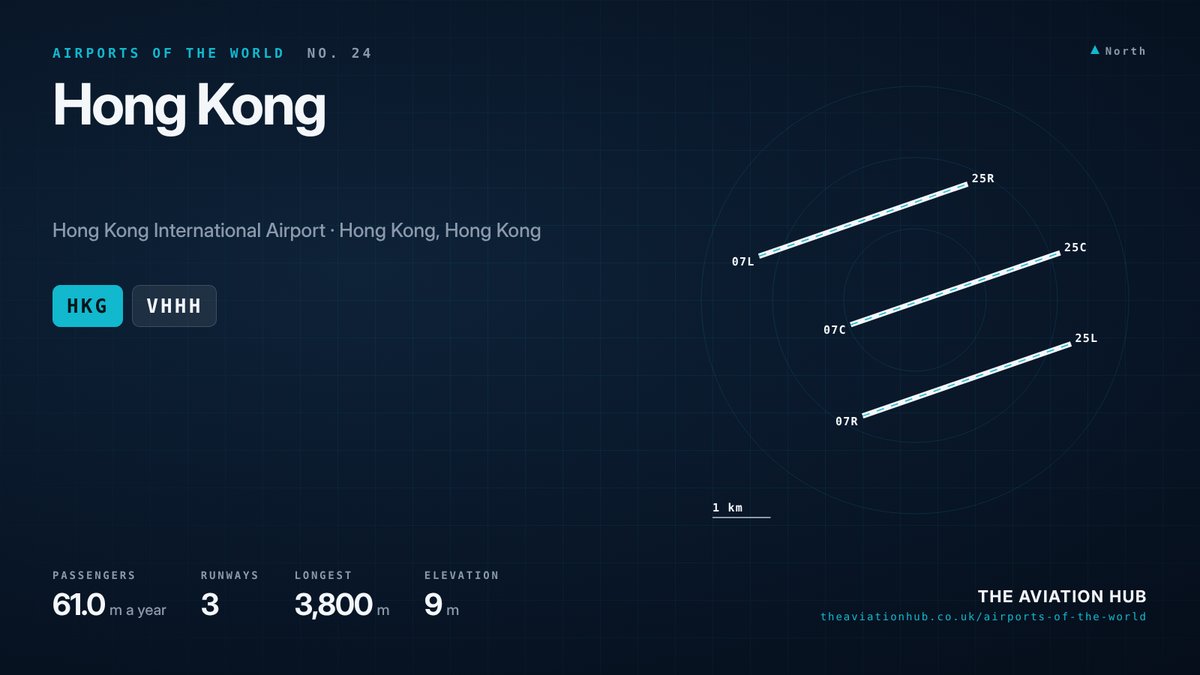
Hong Kong Airport stands on a largely artificial island off the north coast of Lantau, built in the 1990s to replace the cramped and famous Kai Tak. It is the home of Cathay Pacific, the world’s busiest cargo airport for most of the past 15 years, and a transfer point between mainland China, Southeast Asia and the rest of the world. Around 61 million passengers passed through in the latest full year. A third runway and a rebuilt Terminal 2 have given it room to grow again.
Hong Kong Airport at a Glance
The codes are HKG and VHHH. The airport sits at Chek Lap Kok in the New Territories, roughly 21 miles (34 km) west of Central on Hong Kong Island, at an elevation of 9 m (28 ft). The Airport Authority Hong Kong, a statutory body owned by the government, owns and runs the site. Many locals still call it Chek Lap Kok to distinguish it from Kai Tak.
Three parallel runways and two terminals, plus a satellite concourse and a midfield concourse, make up the passenger operation. Cathay Pacific, Hong Kong Airlines, HK Express, Greater Bay Airlines and the cargo carrier Air Hong Kong all use Hong Kong Airport as their hub. Air China and China Eastern treat it as a focus city, and UPS, DHL, Kalitta and Polar run large freight operations. Live arrivals, transport details and parking are on the airport’s official website.
From Kai Tak to Chek Lap Kok
Kai Tak, the old airport in Kowloon, had a single runway jutting into Victoria Harbour and an approach that turned sharply over apartment blocks. By the 1980s it was full and hemmed in by noise rules. The government chose Chek Lap Kok, a small island off Lantau, and in 1991 began the Airport Core Programme, a set of ten projects that included the airport, a new town at Tung Chung, the Tsing Ma Bridge and the Airport Express railway.
Engineers levelled Chek Lap Kok and the neighbouring island of Lam Chau and reclaimed the sea between them to form a platform of about 12 square km. The airport opened on 6 July 1998, a year after the handover, and the first weeks were chaotic. The flight information displays failed and the cargo system seized up, so the government briefly reopened the Kai Tak cargo terminal. Within months the systems settled and the field became a model for others.
The Satellite Concourse opened in 2009, the Midfield Concourse in 2015 and the third runway in July 2022. The centre runway reopened on 28 November 2024 after reconfiguration, and the expanded Terminal 2 reopened on 27 May 2026.
Runways at Hong Kong Airport
Hong Kong Airport now has three parallel asphalt runways, each 3,800 m (12,467 ft) long and 60 m wide. They are numbered 07L/25R to the north, 07C/25C in the centre and 07R/25L to the south. The north runway opened in 2022 on 650 hectares of new land reclaimed from the sea to the north of the original platform. The original north runway then became the centre runway and closed for reconfiguration until late 2024.
With all three in use the airport can handle around 102 movements an hour, or an estimated 620,000 movements a year. The south runway, close to the cargo terminals, handles passenger departures and cargo flights, while passenger arrivals use the other two. Easterly winds mean operations usually run on the 07s, though daytime sea breezes and the summer monsoon can switch traffic to the 25s.
The approaches are over water on both sides, which makes for smooth arrivals but exposes aircraft to crosswinds and typhoons. China Airlines Flight 642 rolled over and caught fire while landing in Typhoon Sam in 1999, killing three. In 2025 an Emirates SkyCargo Boeing 747 crashed on landing and killed two airport staff in a patrol vehicle.
Terminals and Airlines
Terminal 1 at Hong Kong Airport is the great Norman Foster building, still one of the largest passenger terminals in the world. Its glass walls are designed to shatter in extreme winds to relieve pressure on the structure. Cathay Pacific and its Oneworld partners, including British Airways, Qantas, Japan Airlines, Qatar Airways and Malaysia Airlines, fill most of the gates. Air Hong Kong flies the cargo on behalf of DHL.
The T1 Satellite Concourse handles narrow body aircraft, and the Midfield Concourse adds 20 gates for wide bodies, reached by the automated people mover. Terminal 2 closed as a low cost check in hall in 2019 and reopened in May 2026 as a full terminal, with the first 15 airlines moving across over two weeks. It is designed for 30 million passengers a year. HK Express provides the low cost traffic, Hong Kong Airlines the regional and leisure flights, and Greater Bay Airlines a growing network to mainland China and Japan.
Routes and Destinations
Around 220 destinations are served from Hong Kong Airport by more than 100 airlines. Taipei, Shanghai, Beijing, Tokyo, Seoul, Singapore and Bangkok are the heavyweight routes, each with several carriers and many daily flights. Mainland China is served by Cathay, Air China, China Eastern, China Southern and Greater Bay, although the high speed rail link to Shenzhen and Guangzhou has taken the shorter journeys.
Cathay Pacific flies the Airbus A350-900, A350-1000 and Boeing 777-300ER to London Heathrow, Manchester, Frankfurt, Paris, New York, Los Angeles, Vancouver, Sydney and Johannesburg. The route to New York JFK is one of the longest in its network. Cargo matters here more than anywhere else. The airport has been the busiest cargo airport in the world in most years since 2010, handling around five million tonnes a year, with UPS and DHL running Asian hubs on the southern side.
Getting to and from Hong Kong Airport
The MTR Airport Express is the fastest way in, reaching Kowloon in about 21 minutes and Hong Kong Station in Central in 24. In town check in with baggage drop is available at both stations for many airlines. The fare to Central is around HK$115 (about £12). The cheaper option is the Tung Chung Line from Tung Chung, reached by the S1 shuttle bus, which takes longer but costs a fraction of the price.
More than 40 bus routes serve the airport, with the A routes running to Hong Kong Island, Kowloon and the New Territories and night routes covering the small hours. A taxi to Central costs roughly HK$350 to HK$400 (about £35 to £40) and takes 35 to 45 minutes via the North Lantau Highway and the Tsing Ma Bridge. Cross border coaches run to Shenzhen, Guangzhou and Macau via the Hong Kong Zhuhai Macau Bridge, and SkyPier ferries carry transit passengers to mainland ports. Parking is in the multi storey car parks beside Terminal 1.
Spotting and Photography
Hong Kong Airport rewards spotters who are willing to walk. Scenic Hill, a hike from Tung Chung, looks down on departures from 07R with the whole airport platform in the frame, and the hills at Sha Lo Wan on the Lantau shore cover the south runway in both directions.
Morning light suits the hill spots, especially in summer, when haze builds after noon. The Regal Airport Hotel has rooms facing the taxiways, and its executive lounge overlooks arrivals on 25C. Stay on public paths, do not climb the perimeter fences on the reclaimed land, and be aware that the cargo and maintenance areas are patrolled.
What Comes Next
The Three Runway System, a HK$141.5 billion project, is now complete and lifts long term capacity towards 120 million passengers and ten million tonnes of cargo a year. The expanded Terminal 2 will grow from 30 million passengers towards a 50 million design target as more airlines move across. The sky bridge linking Terminal 1 and the satellite concourse opened in 2022, high enough for an A380 to taxi beneath it.
The SkyCity development beside Terminal 2 adds retail, hotels and an arena, and the airport authority is pitching the site as a bridgehead for the Greater Bay Area. Cathay Pacific is rebuilding its fleet with the A350 and the Boeing 777-9 on order. Hong Kong Airport has the runways, the terminal space and the cargo base to reclaim its place among the top tier of world hubs. Compare it with the rest of the region on the Airports of the World map.
Continue to follow The Aviation Hub for more analysis and insight.
Advertise with us Your brand, in front of an aviation audience Home page and in-article placements, sold directly, one advertiser per slot. From £250 a year. See the rates

