Houston Hard Landing: NTSB Blames JSX Trim Habit
 By The Aviation Hub
5 min read
Updated September 23, 2026
By The Aviation Hub
5 min read
Updated September 23, 2026 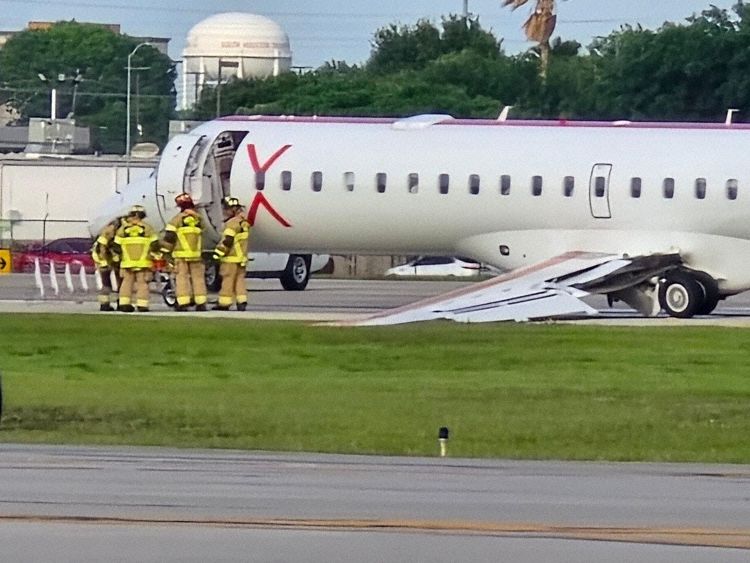
A short charter flight into Houston ended with a snapped landing gear leg, a punctured wing and a jet sliding to a halt on the runway.
Over two years later, the National Transportation Safety Board (NTSB) has published its final report into the JSX Embraer hard landing at Houston Hobby.
Its conclusion is striking.
The captain unintentionally trimmed the aircraft nose down on final approach, leaving too little elevator authority to flare.
A Short Hop From Dallas to Houston
On 3 May 2024, JSX flight 284 departed Dallas Love Field for William P. Hobby International Airport in Houston.
The operator, Delux Public Charter, flies as JSX under Part 135 rules as a nonscheduled public charter.
On board the Embraer EMB-145LR, registered N942JX, were three crew and 21 passengers.
The takeoff, climb and cruise passed without incident.
However, the weather at Houston was lively. Hobby reported wind from 130 degrees at 16 knots, gusting to 24 knots.
Air traffic control told the crew to expect runway 4.
That combination matters.
Runway 4 sits almost at right angles to a wind from 130 degrees. As a result, the crew faced a direct crosswind, whereas runway 13 was far better suited to the conditions.
Doubts on the Flight Deck Landing into Houston
The cockpit voice recorder captured the captain voicing concern about the crosswind.
In response, the first officer reassured her that it was “not that bad”. The first officer then asked whether she wanted to request another runway, but she declined.
Crucially, the gusts sat below the 30 knot maximum recommended crosswind for the type. Moreover, the crew later told investigators that Houston Hobby routinely used runway 4 for arrivals and runway 13 for departures.
In their words, the airport was “always pretty adamant on doing that”.
This is a familiar human factors pattern.
A pilot senses discomfort, yet the numbers are legal and the local habit is strong.
Consequently, the crew pressed on with an approach the captain was not fully happy with.
The Trim Runs the Wrong Way
The captain disconnected the autopilot at about 1,300 feet above ground, 93 seconds before touchdown into Houston Hobby.
At that moment, pitch trim sat at 3.72 degrees nose up. Roughly 25 seconds later, however, the trim began moving nose down.
To hold the attitude, the captain pulled back on the control column.
As she pulled harder, the column and elevator moved further nose up. Even so, the aircraft’s pitch did not respond.
Flight data shows why.
In the final 17 seconds, the captain made further nose down inputs.
By touchdown, the trim stood at 2.86 degrees nose down, and it kept running to about 4 degrees, its full nose down limit.
With the stabiliser set so far against her, the elevator could not deliver enough nose up authority to flare.
At impact, the column was at 20.1 degrees nose up. Nevertheless, the aircraft’s pitch attitude was zero.
A Go Around That Came Too Late

About two seconds before impact, the captain called for a go around.
The ground proximity warning system then sounded “sink rate” almost at the moment of touchdown.
Although the engines spooled up to high power, the jet was already on the ground.
The flight data recorder logged a vertical load of 3.9g.
For context, Embraer calculated the main gear limit for this landing at just 2.19g.
The left main gear therefore failed, and its strut punched up through the upper skin of the left wing.
Recovery teams later found the left flap beside the runway, more than 2,800 feet from the aircraft.
The jet finally stopped on the left side of the runway, about 567 feet from its end.
Remarkably, the only injury was a minor one to the first officer, who went to a local Houston hospital.
A Personal Technique, Not a Trained One
The most revealing section of the report concerns technique.
JSX did not train or encourage trimming after autopilot disconnect.
In fact, training staff described the practice below 500 feet as rare, and one check airman called it “a no-no”.
Yet the captain told investigators that she liked to trim towards the end “to help with the flare”.
Specifically, she said she tended to use more nose up trim in the flare.
Data from her previous landing at North Las Vegas confirmed this. On that flight, she added nose up trim in the last ten seconds.
On the Houston flight, by contrast, the inputs went the other way.
The NTSB concluded that the nose down trim was unintentional. Put simply, a habit meant to smooth the flare ended up removing it.
Notably, a functional test of the pitch trim system in June 2024 found every system working normally. There was no mechanical failure.
What the Report Rules Out
The captain held a first class medical certificate with a Statement of Demonstrated Ability for amblyopia, a longstanding condition in her right eye.
Ultimately, investigators found no clear evidence that it affected her depth perception or contributed to the accident.
Equally, the gear behaved exactly as Embraer designed it.
The main gear is built to break away at its trunnion joints to protect the fuel tank.
In this case, the tank stayed intact and no fire broke out. That design almost certainly helped keep all 24 people on board safe.
Lessons From Houston
The probable cause is clear.
However, the wider lessons deserve attention from every regional operator.
First, informal techniques spread quietly.
One pilot told investigators that a colleague had once recommended trimming on approach.
Habits like this rarely surface until something goes wrong.
Second, crosswind training has limits. Simulator checks at CAE typically used a steady 10 knot crosswind, with a 15 knot landing optional.
Gusty, real world conditions at Houston asked more of the crew than that syllabus demanded.
Finally, the report highlights the value of a firm runway decision.
Both pilots discussed the wind, and a better aligned runway existed. Since the NTSB listed the crosswind as a finding, that choice deserves reflection across the industry.
For JSX, the Houston accident shows how small, repeated inputs can quietly add up.
For everyone else, it proves that a technique written into no manual can still find its way onto the flight deck.
You can read the full NTSB investigation docket for the underlying data.
For more incident analysis, visit our Emergency and Accident Hub.
Advertise with us Your brand, in front of an aviation audience Home page and in-article placements, sold directly, one advertiser per slot. From £250 a year. See the rates