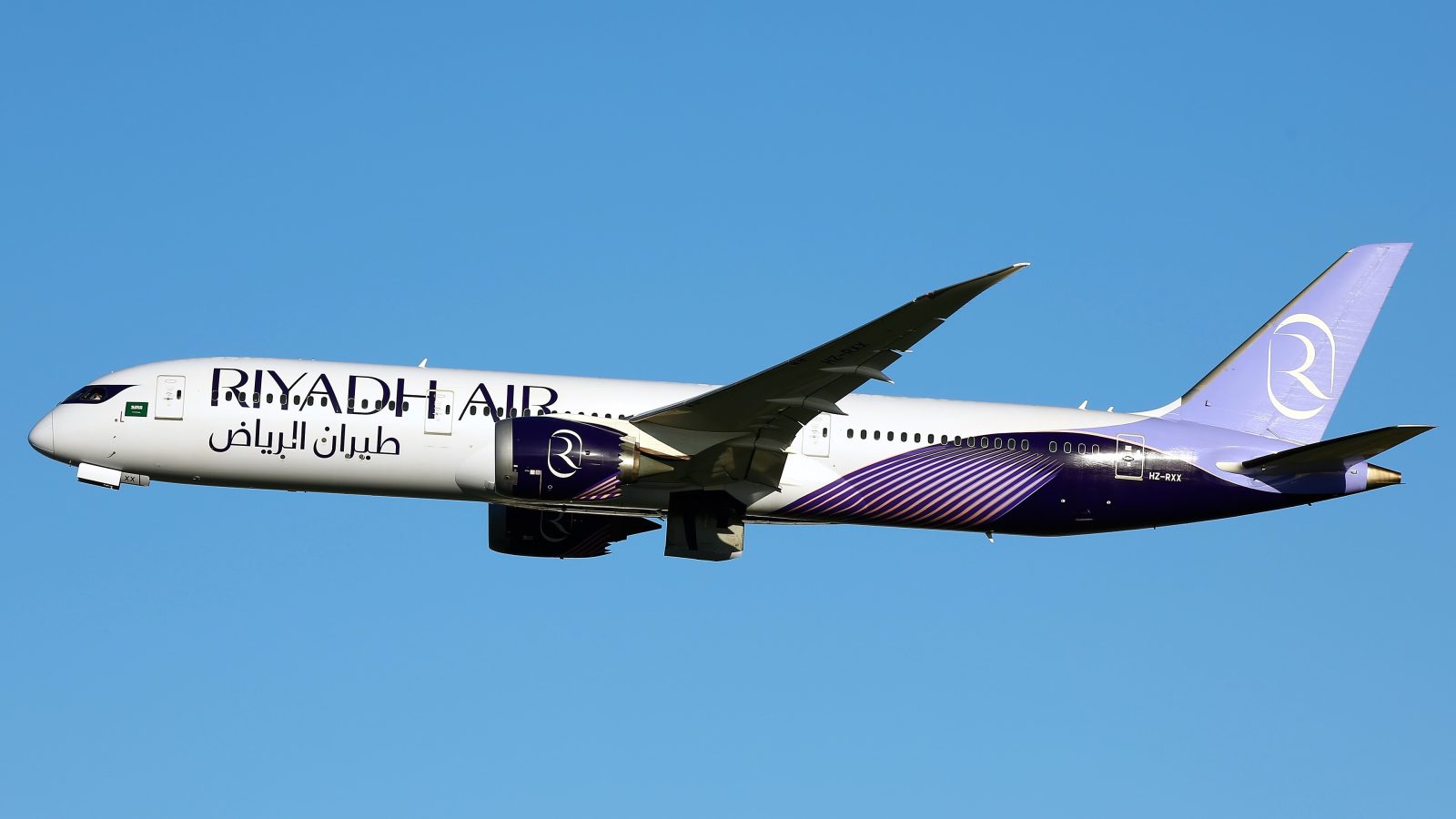
Riyadh Air has moved almost its entire Boeing 787-9 fleet away from Riyadh. The relocation follows a week of Houthi attacks on King Khalid International Airport, which remains closed to commercial traffic.
Flight tracking data shows three Dreamliners leaving Riyadh within 25 minutes of each other on Tuesday afternoon. Two headed for AlUla and one headed for Madinah. At the same time, a fourth aircraft departed Jeddah for an undisclosed destination.
As a result, only one of the airline’s aircraft now appears to remain at the airline’s home base.
We have followed up with Riyadh Air for comment, but below is what we know on this so far.
Three Attacks On Riyadh In One Week
The movements follow a sustained campaign against the Saudi capital’s main airport. On 8 October, two attacks struck King Khalid International, and the second hit a parked Saudia aircraft. Saudi authorities confirmed three deaths, including a pilot from the national airline.
Two days later, the airport came under attack again. The General Authority of Civil Aviation suspended operations while it assessed the damage and checked the safety of its facilities. That strike proved the deadliest so far, killing 12 people and injuring more than 300.
The attacks did not stop there. The authority reported another attack on 11 October that caused further injuries. Meanwhile, the Houthis issued what they called a final warning to international airlines to stop flying through Saudi airspace.
The disruption to passengers has been severe. Flightradar24 listed 655 flights to and from Riyadh as cancelled on Sunday alone. The crisis also has an aviation origin. A truce that held from 2022 broke down in July 2026, when the Houthis allowed an Iranian aircraft to land in Yemen despite Saudi control of its airspace.
Three Riyadh Air 787s Depart In 25 Minutes
The first departure came at 12:16 UTC. HZ-RXAG left Riyadh as RX8004 without a published destination. Around an hour later, the aircraft was on approach to AlUla in the northwest of the Kingdom.
HZ-RXAC followed at 12:32 UTC as RX8001. The aircraft tracked northwest across the desert before descending towards Madinah.
Finally, HZ-RXAA departed at 12:39 UTC as RX8002. It began its descent east of Khaybar, on a track that pointed directly at AlUla.
None of these flights showed a destination. In addition, all three used numbers in the RX8000 range instead of the airline’s scheduled flight numbers. That pattern typically indicates positioning flights rather than commercial services.
Jeddah Offers Only A Partial Solution
The airline has leaned on Jeddah throughout the crisis. HZ-RXAB last landed there on 10 October, and its return flight to the capital never operated. Flight tracking also shows HZ-RXAD and HZ-RXAF on the ground at Jeddah.
However, Jeddah does not appear to be the final stop for the whole fleet. At 12:23 UTC, HZ-RXAE departed Jeddah as RX9675 with no destination listed. That departure fell between the first and second movements out of the capital.
Four aircraft therefore moved from two airports within 23 minutes. That timing points to a coordinated fleet plan rather than a series of separate decisions.
Other airlines have also treated Jeddah with caution. Emirates cancelled flights to Riyadh, Jeddah and Dammam over the weekend, while several Indian carriers halted routes into both Saudi cities.
Why AlUla And Madinah?
Neither airport is a base for the airline, and neither appears among the destinations it has announced. AlUla mainly serves visitors to its heritage sites. As a result, the choice makes little commercial sense.
Instead, both airports offer quieter places to park aircraft while Riyadh remains closed. Spreading the fleet across several airports also reduces the risk of losing multiple aircraft in a single strike.
Even so, distance does not guarantee safety. The Houthis have previously fired missiles towards Eilat in southern Israel, far beyond western Saudi Arabia. The logic appears to rest on lower exposure rather than complete protection.
The Aircraft Left Behind In Riyadh
One aircraft has not moved. HZ-RXX last landed in Riyadh at 05:29 UTC on 8 October. Its next sector shows an unknown status, and every flight scheduled since then has been cancelled.
HZ-RXX holds an unusual place in the fleet. The airline leased the jet, which previously flew for Oman Air, as a technical spare and training aircraft. Later, the airline took delivery of its first new 787-9s in June 2026 and launched its London service on 10 June.
It remains unclear why HZ-RXX has stayed in Riyadh. The airline has not commented publicly on the movement of its fleet.
What Comes Next For Riyadh Air
Riyadh Air depends heavily on its home base. At first, the airline kept most of its schedule running through the attacks. Cirium data showed it cancelled only two of its 15 Riyadh departures on 8 October.
Since the closure, however, its schedule from the capital has stopped. During the weekend disruption, some flights diverted to Dammam and Jeddah instead. Other airlines also expect the problems to last, and Lufthansa Group has suspended Riyadh flights until 16 October.
For now, the fleet’s location tells its own story. Riyadh Air has moved its newest aircraft away from Riyadh, and they are unlikely to return until the threat to King Khalid International eases.
The Aviation Hub will continue to monitor the airline’s fleet movements. For live updates on incidents across the region, visit Squawk 7700.
Continue to follow The Aviation Hub for more analysis and insight.
Advertise with us Your brand, in front of an aviation audience Home page and in-article placements, sold directly, one advertiser per slot. From £250 a year. See the rates