
Hurghada International Airport is the gateway to Egypt’s Red Sea coast, a strip of resorts, reefs and desert mountains that draws millions of European sun seekers every year. Hurghada Airport is the second busiest in the country after Cairo, with more than 11 million passengers in its latest year. Almost all of them are tourists. Charter airlines and leisure carriers from Germany, the United Kingdom, Poland and Russia fill the apron, and the schedule runs year round thanks to reliable winter sunshine.
Hurghada Airport at a Glance
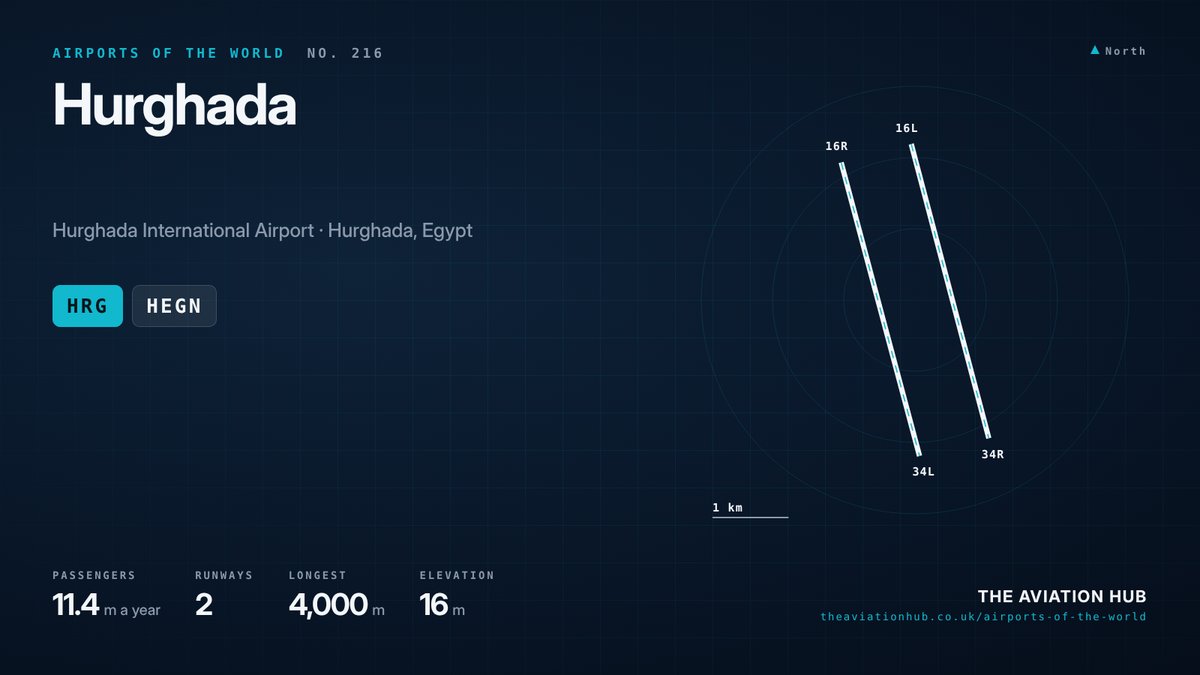
The IATA code is HRG and the ICAO code is HEGN. The airport sits inland, about 3 miles (5 km) south west of El Dahar, the old centre of Hurghada. Elevation is 52 ft (16 m). There are two parallel runways and two passenger terminals, Terminal 1 and Terminal 2.
Traffic reached about 9.6 million passengers in 2024 and passed 11 million in the latest count. Air Cairo uses Hurghada as a focus city, and EgyptAir links it with Cairo. The Egyptian state runs the airport through its national airports company. Flight information is on the airport’s official website.
How Hurghada’s Airport Came to Be
Hurghada began the twentieth century as a small fishing village on a barren coast. Package tourism transformed it from the 1980s, as divers discovered the reefs and European tour operators discovered year round sunshine a few hours from home. The airport grew with the resorts, and charter flights became its lifeblood.
Growth has not been smooth. Political unrest after 2011 hit bookings hard. The 2015 bombing of a Russian airliner after take off from Sharm el Sheikh led Russia to suspend flights to the Egyptian resorts for several years. Russian carriers did not return to Hurghada until 2021, and the pandemic interrupted traffic in between.
The modern era began on 17 December 2014, when President Abdel Fattah el Sisi inaugurated a new terminal complex. It covers about 92,000 square metres over three levels, with 72 check in counters and 20 departure gates. It cost around 335 million dollars, mainly financed by the Arab Fund for Economic and Social Development.
Runways at Hurghada Airport
Two parallel runways serve the field, and both are long. Runway 16L/34R measures 4,000 m (13,123 ft) by 45 m, and Runway 16R/34L is also 4,000 m (13,123 ft) but 60 m wide. Both are asphalt. Those lengths comfortably handle a fully loaded Boeing 777 or Airbus A330 on long charter flights.
The Red Sea coast is famously windy, and the prevailing wind blows from the north and north west. That means Runways 34L and 34R are in use most of the time, with arrivals approaching from the south over the desert. Departures climb north, and the strong headwind helps shorten the take off run.
With two long runways and modest peak hour demand, runway capacity is not a constraint at Hurghada Airport. The pressure points are stands, terminal space and immigration at the morning and evening charter peaks.
Terminals and Airlines
The 2014 complex and the older building now work side by side as Terminal 1 and Terminal 2. Both are functional and built around fast turnarounds. Visa purchase and immigration can be slow when several wide bodies arrive together, so allow time on arrival.
Leisure airlines dominate the schedule at Hurghada Airport. Condor, TUI, Eurowings, Corendon and Discover connect Germany and the Benelux countries. easyJet and TUI lead the British market, and Jet2 arrives in February 2027, while Wizz Air and Polish charter carriers serve Central Europe. Aeroflot and other Russian airlines have returned.
Egyptian carriers play a smaller role. Air Cairo is the most active, flying both domestic routes and charters to Europe. EgyptAir connects the resort with Cairo daily.
Routes and Destinations
Germany is the biggest market, with flights from almost every major German airport. Russia, the United Kingdom, Poland, the Czech Republic, Switzerland, Austria and Scandinavia follow. The British market has grown quickly, with Jet2 starting flights from seven UK airports in February 2027.
Domestic traffic is light, and Cairo is the main domestic route. Some airlines have looked further afield, and Air Cairo starts a route from Hurghada Airport to Mombasa in Kenya in December 2026.
The season runs all year, but its shape shifts. Winter brings northern Europeans escaping the cold, while summer is busier with families and Eastern European markets. London Gatwick is about 2,400 miles (3,900 km) away, roughly five hours in the air.
Getting to and from Hurghada Airport
There is no rail link, and most visitors travel on transfer coaches booked through their tour operator. Resort hotels in Sakkala and El Dahar are 10 to 20 minutes away by road. Makadi Bay and El Gouna take around 30 to 40 minutes, and Soma Bay and Safaga closer to an hour.
Taxis wait outside arrivals at Hurghada Airport, but agree the fare before getting in. A ride into central Hurghada usually costs a few hundred Egyptian pounds. Private transfers booked in advance are often the cheapest sensible option for independent travellers. Car hire is available, though few tourists drive on Egypt’s roads.
Luxor, with its temples and tombs, is about four hours away by road. Many tour operators run day trips from the resorts.
Spotting and Photography
Hurghada Airport offers a parade of European charter liveries against a backdrop of desert mountains to the west. Mornings and evenings are the busiest periods, with several wide bodies in the mix on some days. The bright desert light is harsh at midday, so early morning and late afternoon give the best results.
The terminal departure areas have views over the apron and are the only sensible place for photography. Window seats on arrival give the best view of the parallel runways and the coast.
Egypt treats airports as sensitive sites. Photography near the perimeter, police posts or military areas can lead to arrest, so keep cameras out of sight outside the terminal and follow every instruction from security staff.
What Comes Next
The aviation ministry says the airport can handle up to 13 million visitors a year using the 2014 terminal as its core. Traffic is closing in on that figure, so further terminal work is likely within a few years.
Demand depends heavily on politics and security perceptions in Europe and Russia. When confidence is high, airlines add capacity fast. Egypt’s tourism strategy targets far higher visitor numbers, and the Red Sea coast is central to it.
Hurghada Airport is heading for more growth as Egypt’s resorts recover and expand. See it alongside Sharm el Sheikh and Marsa Alam on the Airports of the World map.
Continue to follow The Aviation Hub for more analysis and insight.
Advertise with us Your brand, in front of an aviation audience Home page and in-article placements, sold directly, one advertiser per slot. From £250 a year. See the rates

