
Hyderabad Airport Guide: India’s Greenfield Pioneer
Hyderabad Airport at Shamshabad is India's first greenfield private airport, a hub for IndiGo with a 4,260 m runway. Read about its routes, access and spotting.
 By The Aviation Hub
7 min read
Updated October 20, 2026
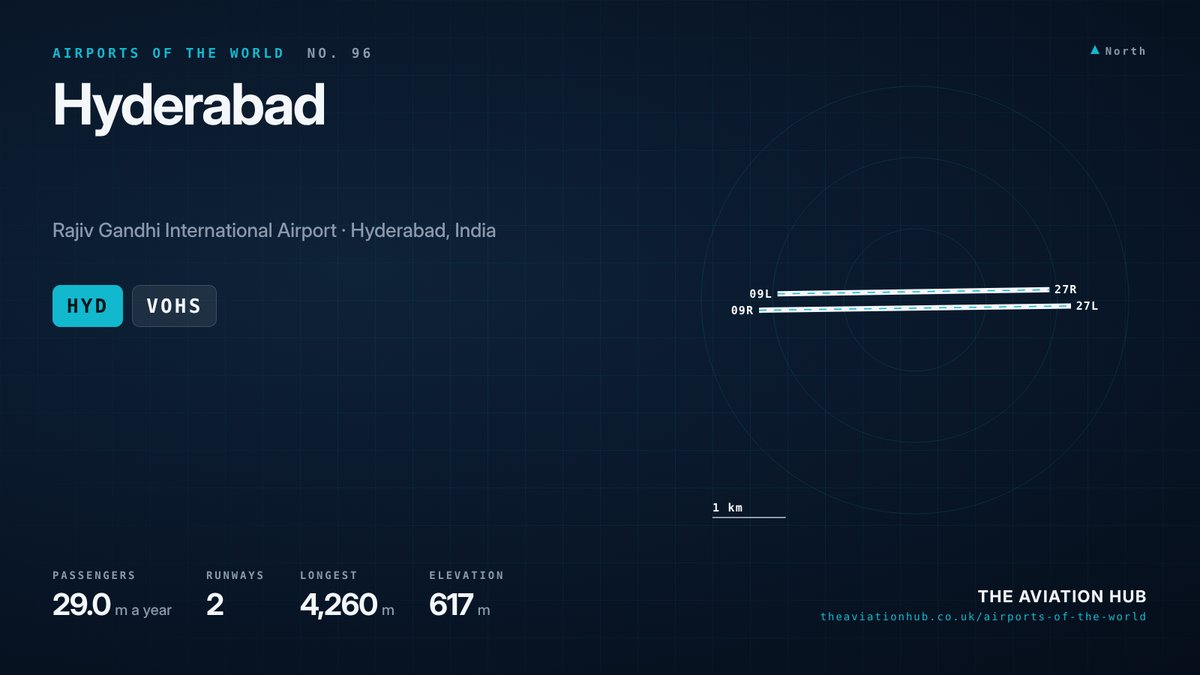
Rajiv Gandhi International Airport is the gateway to Hyderabad and the state of Telangana, and one of the fastest growing big airports in India. It stands at Shamshabad, around 15 miles (24 km) south of the city centre, on a site that covers about 2,200 hectares. Hyderabad Airport handled roughly 30 million passengers in the year to March 2026 and is a major hub for IndiGo. It was the first greenfield airport in India built under a public private partnership, and its single integrated terminal and long main runway set a template for later Indian airports.
Hyderabad Airport at a Glance
The codes are HYD and VOHS. The field sits at 2,024 ft (617 m) above sea level on the Deccan plateau, about 15 miles (24 km) from the old city and roughly 20 miles (32 km) from the technology district of HITEC City. By area it is the largest airport in India.
Hyderabad Airport has two parallel runways and a single passenger terminal with international gates on the western side and domestic gates on the east. The Airports Authority of India counted around 30.5 million passengers between April 2025 and March 2026, up 3.4 per cent, with cargo at about 182,000 tonnes. IndiGo, SpiceJet, Alliance Air and Star Air use it as a hub, Air India treats it as a focus city and Air India Express has an operating base. GMR Hyderabad International Airport Limited, in which GMR Group holds 74 per cent and the Airports Authority and the Telangana government 13 per cent each, runs the field. Flight information is on the airport’s official website.
How Hyderabad’s Airport Came to Be
Hyderabad relied on Begumpet, a cramped airfield in the middle of the city, for most of the twentieth century. By the 1990s it had no room to grow, and in December 1998 the state chose Shamshabad over two rival sites because it sat beside two highways and a railway line. GMR won the concession and construction began in 2005.
Commercial flights started on 23 March 2008, a week later than planned after airlines objected to ground handling charges. Lufthansa’s Frankfurt service was meant to make the first landing, but two SpiceJet flights beat it. Begumpet closed to scheduled traffic the same day and the HYD code moved to the new field. Airports Authority staff had gone on strike earlier that month over fears for their jobs.
The central government named the airport after Rajiv Gandhi, who had trained as a pilot in the city. The decision caused a long political row, and in 2014 the Ministry of Civil Aviation named the domestic terminal after the Telugu film star and chief minister N. T. Rama Rao. The second runway opened in 2012, the first domestic electronic boarding in India began here in 2015, and the terminal was expanded east in 2023 and west in 2024.
Runways at Hyderabad Airport
Runway 09R/27L is the original and main runway, 4,260 m (13,976 ft) long and 60 m (197 ft) wide on asphalt. It is one of the longest in India and approved for the Airbus A380, with an instrument landing system at both ends. Runway 09L/27R began life as a parallel taxiway and opened as a runway in 2012. It measures 3,707 m (12,162 ft) by 45 m (148 ft), also asphalt, and is used mainly while the main runway is closed for maintenance.
The two runways sit too close together for independent parallel approaches, so the airport operates as a single runway field in practice with the second strip as insurance. That still gives comfortable capacity for the present. Westerly winds dominate in the monsoon months from June to September, so the 27 ends are busiest then, while the drier winter months bring more use of the 09s.
The elevation and summer heat, which regularly passes 40C in May, make the long main runway useful for the heavy wide body departures to the Gulf and Europe.
Terminals and Airlines
The single terminal at Hyderabad Airport is a wide, bright building with a common check in hall and separate security channels for domestic and international travel. The eastern wing, now carrying the N. T. Rama Rao name, handles the domestic operation dominated by IndiGo, with Air India, Air India Express, SpiceJet, Akasa Air, Alliance Air and Star Air alongside. The 2023 eastern extension added gates and a larger security area.
The western wing is international. Emirates, Qatar Airways, Etihad, flydubai, Saudia, Oman Air and Air Arabia cover the Gulf, Singapore Airlines, Malaysia Airlines, Thai Airways and Cathay Pacific reach South East and East Asia, and Lufthansa, KLM and British Airways serve Europe. Ethiopian Airlines links Addis Ababa. The 2024 western extension lifted the terminal’s capacity to 40 million passengers a year.
A separate cargo terminal, run by a joint venture between GHIAL and Menzies Aviation, handles pharmaceuticals, which are a Hyderabad speciality. Amazon Air and Blue Dart base freighters here.
Routes and Destinations
Delhi, Bengaluru, Mumbai, Chennai and Kolkata are the busiest domestic routes, with IndiGo running shuttle frequencies on each. The airline serves more destinations from Hyderabad than any other carrier and links the city with dozens of smaller towns across the south and centre of India. Visakhapatnam and Tirupati are the heaviest flows within the Telugu states.
Dubai, Doha, Abu Dhabi, Jeddah and Singapore lead the international list, reflecting the enormous Gulf workforce from Telangana and Andhra Pradesh. British Airways’ London Heathrow service, at around 4,800 miles (7,750 km), is the longest route from Hyderabad Airport. Traffic peaks around the Sankranti and Diwali festivals, and the summer school holidays push Gulf and South East Asian loads to their highest.
Getting to and from Hyderabad Airport
The 13 km (8 mile) PV Narasimha Rao Expressway, an elevated road completed in 2009, carries traffic from the airport into the Mehdipatnam area in 30 to 40 minutes. The Outer Ring Road, NH 44 and NH 765 connect the rest of the city and the region. Prepaid taxis, Uber and Ola all operate from the arrivals forecourt, with fares to HITEC City or the old city of roughly 700 to 1,000 rupees (£6 to £9).
The Pushpak Airport Liner, run by the state transport corporation since 2012, is the cheapest sensible option. Air conditioned coaches leave every 30 minutes or so for the main hubs and hotel districts for a few hundred rupees. The nearest railway station is Umdanagar, about 4 miles (6 km) away, but it is of little use to most travellers.
A 31 km airport metro link was approved in 2019 and later dropped after a change of state government, so there is no rail connection for now. A revised line is part of the second phase of the Hyderabad Metro.
Spotting and Photography
Hyderabad Airport is one of the more comfortable Indian airports for enthusiasts because the terminal glass is clean and the apron is close. The departure gates on both wings face the stands and the runways, so patient observers can catch most of the day’s international movements from inside.
Outside, the airport approach road offers glimpses of the airfield. The light is best in the early morning and late afternoon, when the summer haze is thinnest, and the winter months from November to February bring the clearest skies.
Indian law treats airport photography with suspicion and the Central Industrial Security Force patrols the perimeter. Never photograph security staff or checkpoints, stay well back from the fence, and expect questions if you linger with a long lens. A polite explanation and a willingness to move on usually settles matters.
What Comes Next
The terminal expansions of 2023 and 2024 have given the airport breathing space at 40 million passengers, and the master plan allows for a second terminal and additional runways on the north side of the approach road, with an eventual capacity of 80 million. GMR is also developing Hyderabad Airport City, a 1,500 acre aerotropolis of offices, hotels, logistics parks and an aerospace cluster.
Growth is tied to Hyderabad’s pharmaceutical and technology industries and to the Gulf labour market. The missing metro link is the obvious weakness, and the cargo operation is the quiet success story.
Hyderabad Airport is the model that Indian airport privatisation was built on and it still sets the standard. Compare it with the other Indian hubs on the Airports of the World map.
Continue to follow The Aviation Hub for more analysis and insight.
Advertise with us Your brand, in front of an aviation audience Home page and in-article placements, sold directly, one advertiser per slot. From £250 a year. See the rates

