
Ibiza Airport Guide: Party Island Peaks and Private Jets
Ibiza Airport handles over 9 million passengers, most of them in summer. Our guide covers its runway, airlines, routes, buses and the best spotting.
 By The Aviation Hub
6 min read
Updated October 20, 2026
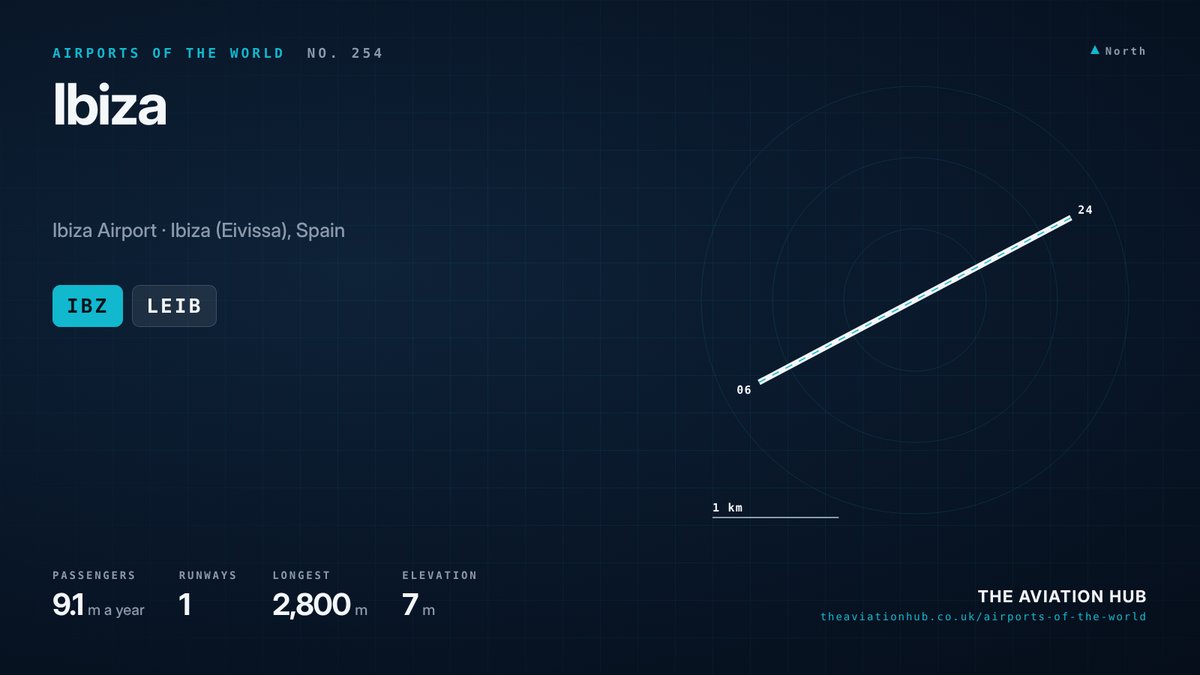
Ibiza’s airport sits on flat land by the Ses Salines salt flats, a short drive southwest of Ibiza Town. Ibiza Airport handled more than 9 million passengers in 2024, an astonishing total for an island of around 150,000 residents. Almost all of that traffic arrives between May and October, when clubbers, families and the super rich pour in from across Europe.
Ibiza Airport at a Glance
The IATA code is IBZ and the ICAO code is LEIB. Ibiza Airport lies about 4 miles (7 km) southwest of Ibiza Town, in the municipality of Sant Josep, at an elevation of 7 metres (24 feet). It has a single runway and one passenger terminal.
Traffic reached about 9.1 million passengers in 2024, comfortably above the 8.2 million handled in 2019. Vueling treats the island as a focus city with a seasonal base, and Ryanair, easyJet, Jet2, TUI, Iberia and Air Europa all fly in large numbers. The state controlled operator Aena runs the airport, and flight information and parking are on the airport’s official website.
A Short History of Ibiza’s Airfield
The airfield began life as a temporary military strip during the Spanish Civil War. Tourist flights used it briefly in 1949 before it closed again in 1951. As visitors began to discover the Balearic Islands, the airport reopened on 1 April 1958, with early services to Palma, Barcelona, Valencia and Madrid.
International flights followed in July 1966, when round the clock customs opened the island to direct charters from northern Europe. The package holiday boom of the 1970s and 1980s, and then the rise of the island’s club scene, drove steady growth. By the late 1990s more than 3.6 million passengers a year passed through.
The airport’s darkest day came on 7 January 1972, when Iberia Flight 602, a Sud Aviation Caravelle, struck high ground near Sa Talaia while approaching the airport, killing all 104 people on board. Over the following decades the runway, taxiways, aprons and terminal were expanded in stages to cope with ever bigger summer peaks.
Runways at Ibiza Airport
Ibiza Airport has one runway, 06/24, which is 2,800 metres (9,186 feet) long and 45 metres wide with an asphalt surface. It handles everything from turboprops to the Airbus A321neo and Boeing 737 MAX that dominate the summer schedule, as well as occasional wide bodies.
Arrivals on runway 24 come in from the northeast over the sea and pass low over Playa d’en Bossa, one of the island’s busiest beaches. Arrivals on runway 06 approach from the southwest over the sea and the Es Codolar coast. Wind direction decides which end is used, and the high ground of Sa Talaia to the northwest shapes the procedures.
A single runway with limited apron space makes summer weekends tight. Saturdays and Sundays bring waves of changeover flights, and aircraft parking fills quickly when private jets arrive for big events and the club season.
Terminals and Airlines
All passenger flights use one terminal, enlarged in stages to handle the summer crush. The building is compact for the traffic it handles, and summer Saturdays test it hard. Private jets, which arrive in large numbers every summer, use a separate general aviation facility.
Vueling is the most important year round airline, linking Ibiza Airport with Barcelona, Seville, Valencia and Bilbao using Airbus A320 family aircraft. Iberia Express and Air Europa serve Madrid, and regional carriers add links to Palma, Valencia and other Spanish cities. In summer, Ryanair and easyJet fly in from bases across Europe.
British holiday airlines are a strong presence, with Jet2 and TUI flying from regional airports around the UK. Transavia, KLM, Eurowings, Condor and Edelweiss bring in Dutch, German and Swiss visitors, while Italian and French carriers add further capacity in July and August.
Routes and Destinations
Barcelona was the busiest route in 2025 with about 1.3 million passengers, followed by Madrid with roughly 936,000 and Palma with around 564,000. These domestic links run all year and keep the airport ticking over in winter.
Amsterdam leads the international table, followed by Manchester, London Gatwick, Paris Orly and London Stansted, each carrying between about 220,000 and 320,000 passengers. The UK is the single biggest foreign market, with flights from more than a dozen British airports in high summer.
Seasonality is extreme. Several dozen international routes run only in summer, and some winter days see little more than the domestic shuttles. United Airlines plans to add a seasonal Newark route from June 2027, which would give Ibiza Airport its first scheduled link to the United States.
Getting to and from Ibiza Airport
There is no rail on the island. Bus line 10 runs between the terminal and Ibiza Town roughly every 20 to 30 minutes, taking about 20 minutes. It is the cheapest sensible option, costing a few euros. Seasonal buses link the airport with San Antonio, Santa Eulalia and Playa d’en Bossa during the summer.
Taxis wait outside arrivals and charge around €20 to €25 (roughly £17 to £22) to Ibiza Town and more to the resorts on the west coast. Summer queues can be long, so many visitors pre book a transfer. A dual carriageway links the airport with Ibiza Town in about 15 minutes.
Car hire desks sit in the terminal, and short and long stay car parks face the building. Travellers heading to Formentera take a taxi or bus to the port in Ibiza Town and continue by ferry, since that island has no airport.
Spotting and Photography
Ibiza Airport is a summer favourite for spotters. Playa d’en Bossa is the classic spot for runway 24 arrivals, with aircraft passing low over the sand and the sea. The salt flats and roads around Ses Salines give views of the southwestern end of the runway.
Business aviation is the real highlight. On busy summer days the apron fills with Gulfstreams, Bombardier Global jets and Falcons, and the occasional private Boeing or Airbus wide body. Afternoon and evening light suits the beach approach, while the salt flats side south of the runway works best around the middle of the day.
The Ses Salines area is a protected natural park. Stay on paths and public roads, respect the fences and keep drones well away from the approach paths.
What Comes Next
Capacity is less about the runway than about the island itself. Local politicians and residents worry about overtourism, water supply and housing, and there is little appetite for major airport growth. Aena’s investment focuses on improving the terminal and aprons rather than adding new capacity.
The planned Newark service shows that airlines see value beyond Europe, and winter traffic is slowly broadening. Ibiza Airport looks set to stay intensely seasonal, busy, profitable and at the centre of the island’s debate over how many visitors it can take. Explore other Balearic airports on the Airports of the World map.
Continue to follow The Aviation Hub for more analysis and insight.
Advertise with us Your brand, in front of an aviation audience Home page and in-article placements, sold directly, one advertiser per slot. From £250 a year. See the rates

