
Indianapolis Airport Guide: Midfield Terminal and FedEx Giant
Indianapolis Airport pairs a 2008 midfield terminal with a vast FedEx hub. Read about its runways, airlines, busiest routes, transport links and spotting.
 By The Aviation Hub
6 min read
Updated October 20, 2026
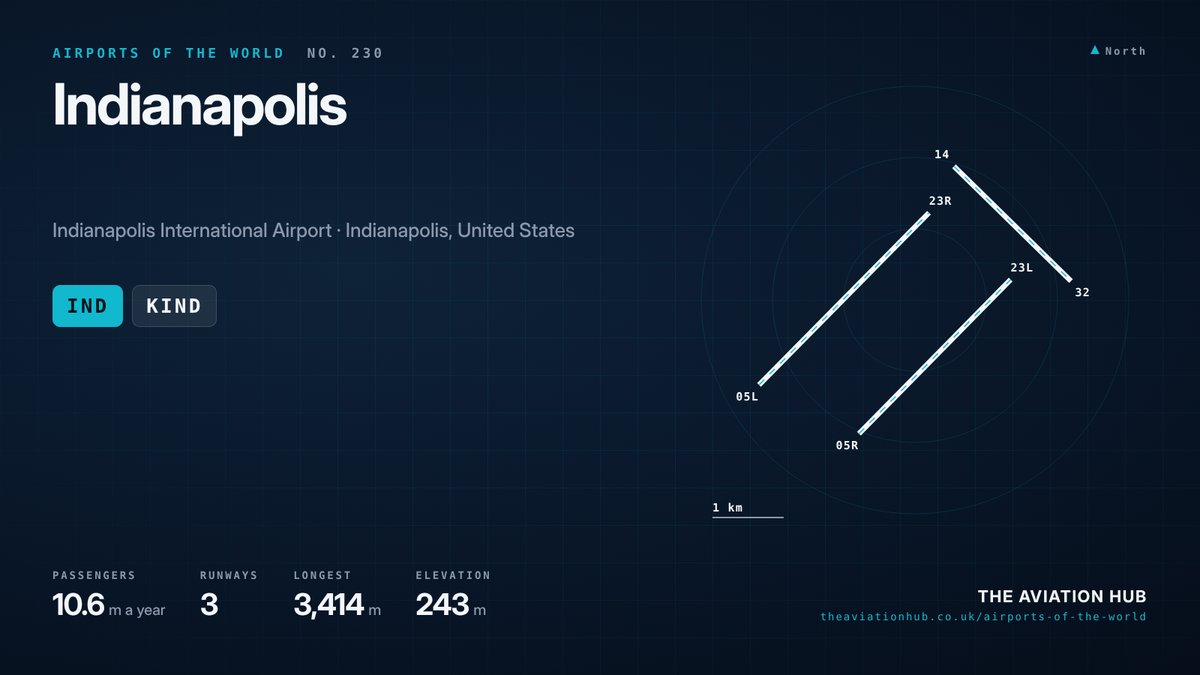
Indianapolis International Airport sits about 7 miles (11 km) south west of downtown Indianapolis, the state capital of Indiana. Passengers know it for a calm, compact midfield terminal that regularly wins customer service awards. Freight people know it for the FedEx Express hub, the second largest in the company’s network after Memphis. Indianapolis Airport handled about 10.6 million passengers in 2025, and the parcels moving through overnight make it far busier than that number suggests.
Indianapolis Airport at a Glance
The IATA code is IND and the ICAO code is KIND. The field lies at 797 feet (243 m) on flat farmland and industrial estates beside Interstate 70. It has three runways and a single terminal with two concourses and 39 gates. In 2025 it recorded 10,616,093 passengers, a modest rise on 2024.
No passenger airline runs a hub here. Southwest carries the largest share of travellers, with American, Republic, Delta and United behind, and Allegiant keeps an operating base. Republic Airways, which flies regional jets for the big three carriers, has its headquarters at Indianapolis Airport. The Indianapolis Airport Authority owns and runs the field. Parking, security wait times and flight status appear on the airport’s official website.
How Indianapolis’s Airport Came to Be
The airport opened on 24 September 1931 as Indianapolis Municipal Airport, replacing Stout Field as the city’s main airfield. In 1944 it was renamed Weir Cook Municipal Airport after Colonel Harvey Weir Cook, a First World War fighter ace from Indiana who died flying a P-39 over New Caledonia in the Second World War. It became Indianapolis International Airport in 1976.
A new terminal opened in 1957 on the east side of the field and was expanded several times. American Trans Air, better known as ATA, grew up here and was the city’s own airline until it collapsed in 2008. FedEx built its hub in the late 1980s and expanded it steadily, turning the field into a major cargo gateway.
The turning point came in November 2008. The Colonel H. Weir Cook Terminal opened between the parallel runways, replacing the cramped 1957 building, which was later demolished. Indianapolis Airport gained a modern terminal with room to grow, built on land that had been set aside for the purpose years earlier.
Runways at Indianapolis Airport
There are three runways. Runway 05L/23R is concrete, 3,414 metres (11,200 feet) long and 46 metres wide. Its parallel twin, 05R/23L, is also concrete and 46 metres wide, with a length of 3,048 metres (10,000 feet). Runway 14/32 is the crosswind runway, asphalt, 2,218 metres (7,278 feet) long and 46 metres wide.
The two parallels sit far enough apart to run independent operations, with the terminal and aprons in the space between them. South westerly winds are the norm, so 23L and 23R see the most use. The parallels comfortably handle the McDonnell Douglas MD-11 and Boeing 777F freighters that fill the FedEx ramp each night. Runway 05R/23L was rebuilt in a project finished in late 2024, helped by a federal grant of 26.6 million dollars.
Terminals and Airlines
The single terminal splits into two concourses beyond one central security checkpoint. Concourse A has 20 gates and handles Aer Lingus, Air Canada, Avelo, Delta, Frontier, Sun Country and United. It also contains the customs and immigration hall, so every international arrival uses it.
Concourse B at Indianapolis Airport has 19 gates and serves Alaska, Allegiant, American and Southwest. Southwest runs the busiest operation with its Boeing 737 fleet. American and Delta fly mostly Airbus A320 family and Boeing 737 aircraft, plus regional jets from Republic and other partners. The central civic plaza, with local art and views of the airfield, is a pleasant place to wait.
Passengers move between concourses airside without clearing security again. The design scores well in surveys because walking distances are short and the building rarely feels crowded.
Routes and Destinations
Indianapolis Airport serves more than 50 nonstop destinations. Atlanta was the busiest route in the year to March 2026, with about 447,000 passengers, ahead of Denver, Chicago O’Hare, Orlando and Dallas Fort Worth. Florida is a constant draw, and Allegiant fills gaps with leisure routes to smaller sun destinations.
Aer Lingus launched a Dublin route in May 2025. The flight covers roughly 3,700 miles (6,000 km) and gives the city a direct route to Europe, with onward connections across the Aer Lingus network. Delta flew to Paris from 2018 until the pandemic, a reminder that transatlantic flying here depends on one airline’s appetite. Air Canada connects Toronto, and seasonal flights reach Cancun and other Caribbean beaches.
Cargo is the airport’s real heavyweight. The FedEx hub sorts parcels for much of the eastern United States and handles wide body freighters through the night.
Getting to and from Indianapolis Airport
There is no rail link. IndyGo Route 8 runs from the terminal to downtown for a standard city fare and takes around 45 minutes, which makes it the cheapest option. The planned Blue Line rapid bus route will end at the airport. Construction began in February 2025, with completion expected by 2028.
Most people drive. Interstate 70 runs past the airport entrance and reaches downtown in about 20 minutes outside the rush hour, while Interstate 465 links the suburbs. Taxis and ride hailing cars use the Ground Transportation Center inside the parking garage, where ten rental car companies also sit. The garage was expanded in early 2024, and cheaper economy lots run shuttle buses to Indianapolis Airport.
Spotting and Photography
The midfield layout at Indianapolis Airport means the terminal is surrounded by aircraft, and the large windows in the central plaza and concourses give good views. Outside, public roads near the ends of the parallel runways let spotters catch arrivals on 23L and 23R, with the sun behind them in the afternoon.
The FedEx hub is the main attraction. The heaviest freighter waves come late at night and before dawn, but MD-11, Boeing 767F and 777F movements often stretch into daylight, especially early in the morning. A retired FedEx Boeing 727 survives on site as a fire training airframe. The passenger mix is mostly narrow body, so the Aer Lingus Airbus A321 adds welcome interest.
Stay on public land, keep clear of the cargo ramps and do not park on interstate shoulders. Airport police patrol the perimeter and will question anyone loitering near fences.
What Comes Next
The terminal has spare capacity, so the current projects focus on comfort and access. A 253 room Westin hotel is under construction beside the terminal, due in December 2027. The 183 acre solar farm, once billed as the largest at any airport, continues to supply clean power. The Blue Line will give the field its first rapid transit link.
There are setbacks. AAR plans to close its maintenance base by February 2027, with around 330 jobs affected. Indianapolis Airport is heading for steady growth, anchored by FedEx and a loyal domestic market, with the next long haul route the prize everyone wants. Compare it with other Midwest airports on the Airports of the World map.
Continue to follow The Aviation Hub for more analysis and insight.
Advertise with us Your brand, in front of an aviation audience Home page and in-article placements, sold directly, one advertiser per slot. From £250 a year. See the rates

